USAID/OFDA
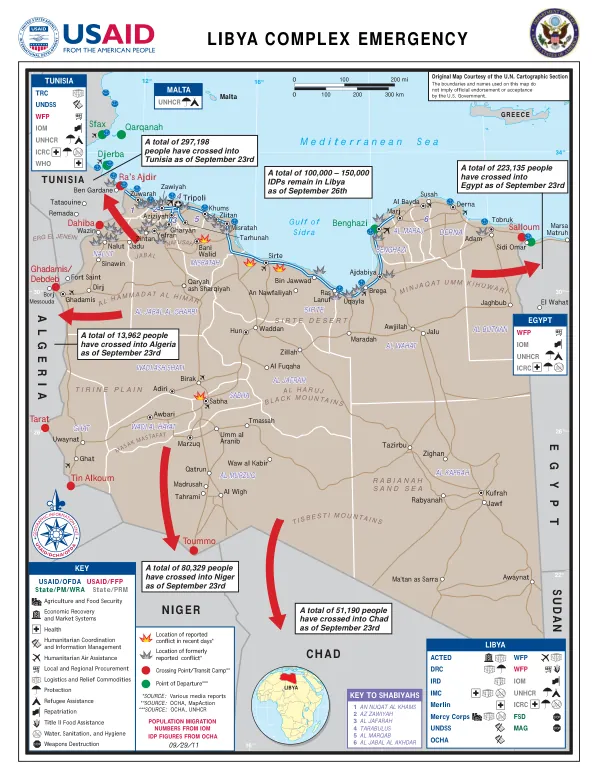
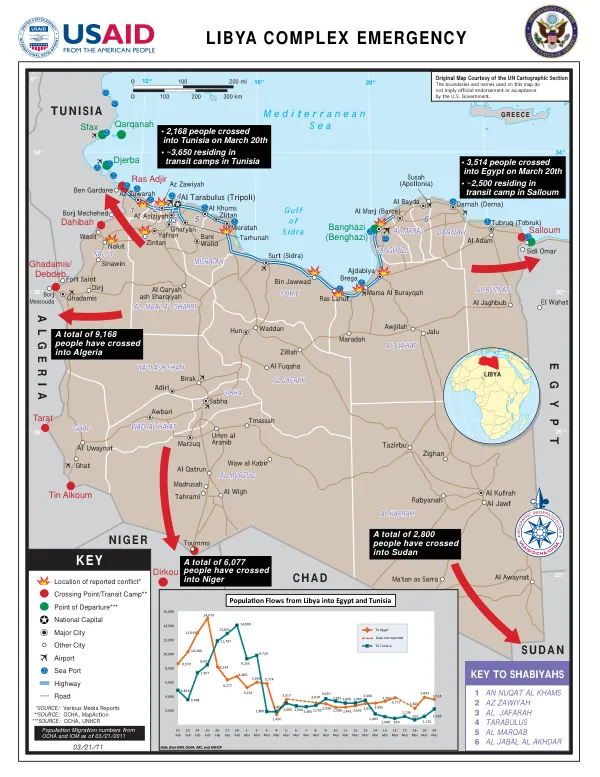
USAID/OFDA Libya Program Map 3/21/2011
The Gulf of Sidra, located in the Mediterranean Sea, is a significant body of water that borders several countries in North Africa.
2011 · 1 pages
Sign in to readA free account is required to download.
Abstract
The region is characterized by a complex geography, with numerous cities, towns, and villages situated along its coastline. The cities of Misratah, Sibha, and Banghazi are among the major urban centers in the area. Population migration patterns in the region have been influenced by the Libyan complex emergency, which began in 2011. According to data from the International Organization for Migration (IOM), the Office for the Coordination of Humanitarian Affairs (OCHA), the International Medical Corps (IMC), and the United Nations High Commissioner for Refugees (UNHCR), a total of 6,077 people have crossed into Niger, while 9,168 people have entered Algeria. In addition, 2,168 people crossed into Tunisia on March 20th, with approximately 3,650 individuals residing in transit camps in Tunisia. The data also indicates that 3,514 people crossed into Egypt on March 20th, with around 2,500 individuals residing in a transit camp in Salloum. Furthermore, a total of 2,800 people have crossed into Sudan. The population migration numbers have fluctuated over time, with varying numbers of people crossing into different countries. For instance, on February 23rd, 7,307 people crossed into Egypt, while on March 20th, 14,979 people entered Algeria. The region's population migration patterns are influenced by various factors, including conflict, economic conditions, and access to basic necessities such as food, water, and shelter. The data from IOM, OCHA, IMC, and UNHCR provides valuable insights into the complex dynamics of population migration in the region. The information is essential for humanitarian organizations and governments to develop effective strategies for addressing the needs of displaced individuals and communities. The Libyan complex emergency has resulted in significant displacement of people, with many individuals seeking refuge in neighboring countries. The data highlights the need for continued support and assistance to those affected by the conflict, as well as the importance of addressing the root causes of displacement. The region's complex geography and population migration patterns underscore the need for a comprehensive and coordinated approach to addressing the humanitarian needs of displaced individuals and communities.
Related documents