USAID/OFDA
USAID/OFDA New Zealand Earthquake Fact Sheet #1 2/25/2011
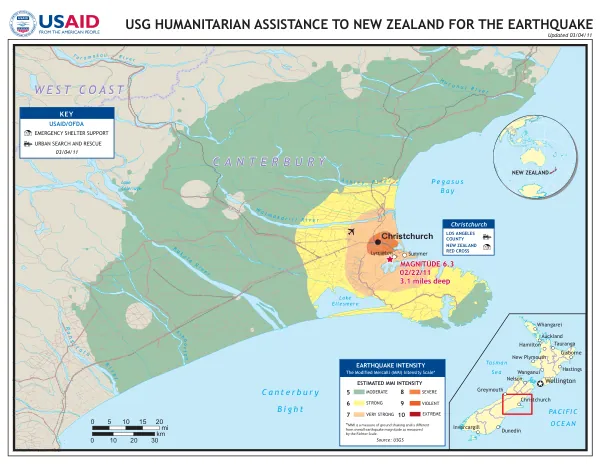
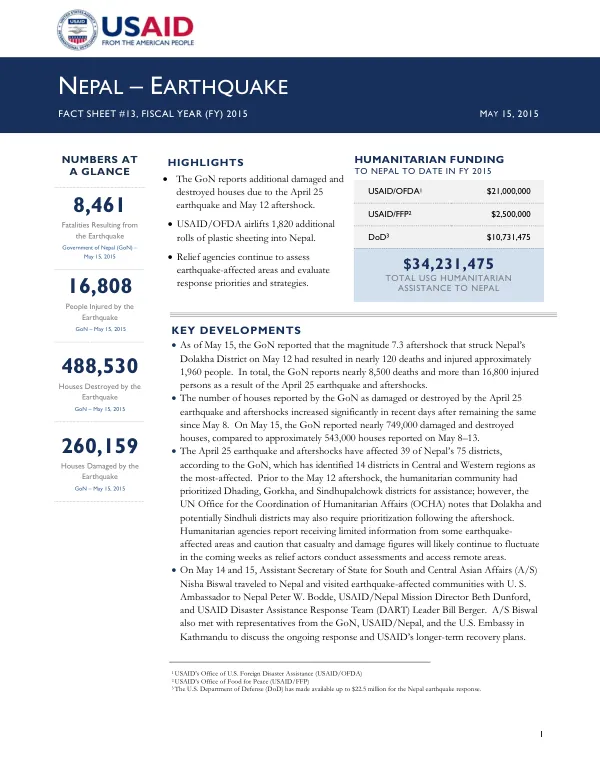
The earthquake that struck Christchurch, New Zealand's second largest urban area, occurred on February 22, 2011, at 1251 hours local time.
2011 · 2 pages
Sign in to readA free account is required to download.
Abstract
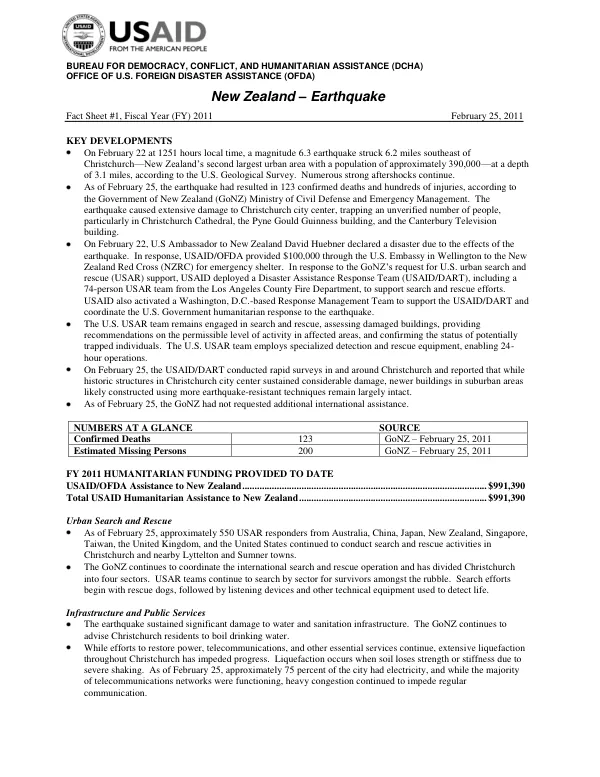
The magnitude 6.3 earthquake was centered 6.2 miles southeast of Christchurch at a depth of 3.1 miles, according to the U.S. Geological Survey. The earthquake resulted in numerous strong aftershocks and extensive damage to Christchurch city center, trapping an unverified number of people, particularly in Christchurch Cathedral, the Pyne Gould Guinness building, and the Canterbury Television building. As of February 25, the earthquake had resulted in 123 confirmed deaths and hundreds of injuries, according to the Government of New Zealand (GoNZ) Ministry of Civil Defense and Emergency Management. The U.S. Ambassador to New Zealand, David Huebner, declared a disaster due to the effects of the earthquake, and in response, USAID/OFDA provided $100,000 through the U.S. Embassy in Wellington to the New Zealand Red Cross (NZRC) for emergency shelter. USAID also deployed a Disaster Assistance Response Team (USAID/DART), including a 74-person USAR team from the Los Angeles County Fire Department, to support search and rescue efforts. The U.S. USAR team remained engaged in search and rescue, assessing damaged buildings, providing recommendations on the permissible level of activity in affected areas, and confirming the status of potentially trapped individuals. The team employed specialized detection and rescue equipment, enabling 24-hour operations. As of February 25, the USAID/DART conducted rapid surveys in and around Christchurch and reported that while historic structures in Christchurch city center sustained considerable damage, newer buildings in suburban areas likely constructed using more earthquake-resistant techniques remained largely intact. As of February 25, approximately 550 USAR responders from Australia, China, Japan, New Zealand, Singapore, Taiwan, the United Kingdom, and the United States continued to conduct search and rescue activities in Christchurch and nearby Lyttelton and Sumner towns. The GoNZ continued to coordinate the international search and rescue operation and had divided Christchurch into four sectors. USAR teams continued to search by sector for survivors amongst the rubble, beginning with rescue dogs, followed by listening devices and other technical equipment used to detect life. The earthquake sustained significant damage to water and sanitation infrastructure, and the GoNZ advised Christchurch residents to boil drinking water. While efforts to restore power, telecommunications, and other essential services continued, extensive liquefaction throughout Christchurch had impeded progress. As of February 25, approximately 75 percent of the city had electricity, and while the majority of telecommunications networks were functioning, heavy congestion continued to impede regular communication. The Christchurch hospital had admitted 594 patients since the earthquake, and New Zealand USAR personnel reported that the hospital was admitting all varieties of cases, including injuries requiring surgery.
Related documents