GOVERNMENT OF SENEGAL
Nepal – Earthquake Fact Sheet #4, Fiscal Year (FY) 2015
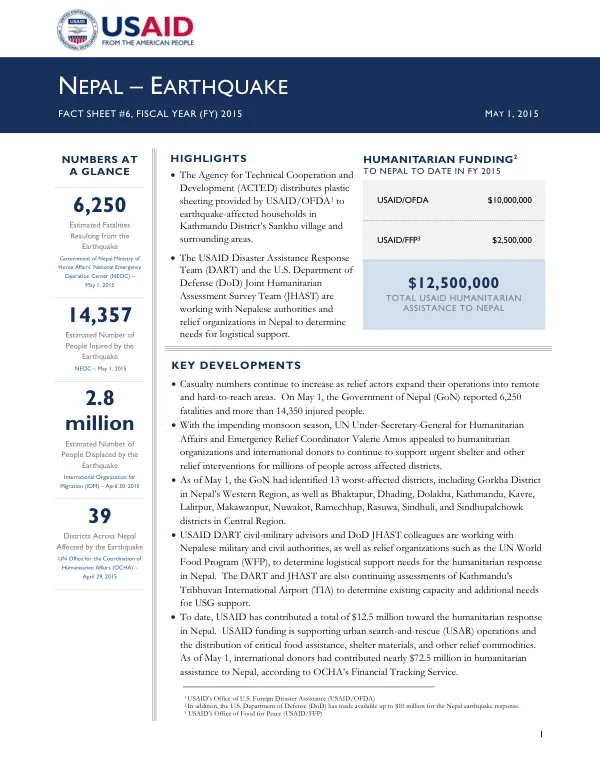
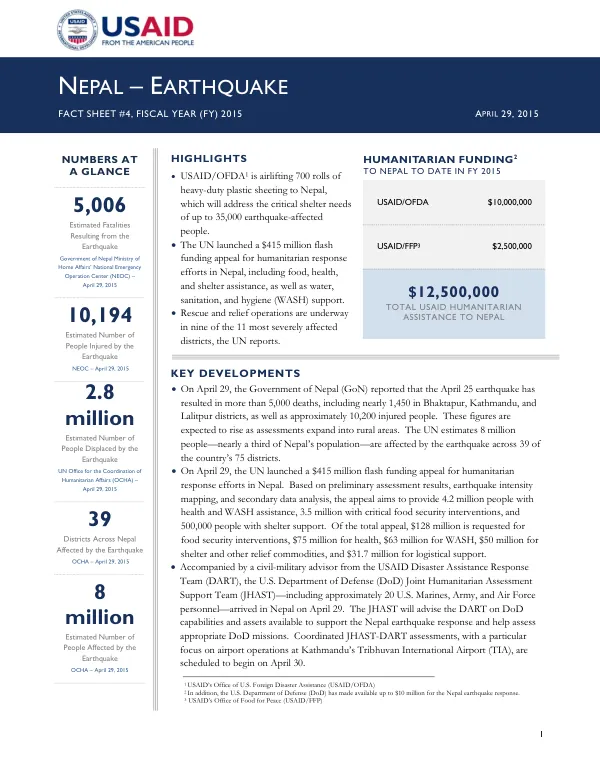
The Government of Nepal reported on April 29 that the April 25 earthquake resulted in more than 5,000 deaths, including nearly 1,450 in Bhaktapur, Kathmandu, and Lalitpur districts, as well as approximately 10,200 injured people.
2015 · 6 pages
Sign in to readA free account is required to download.
Abstract
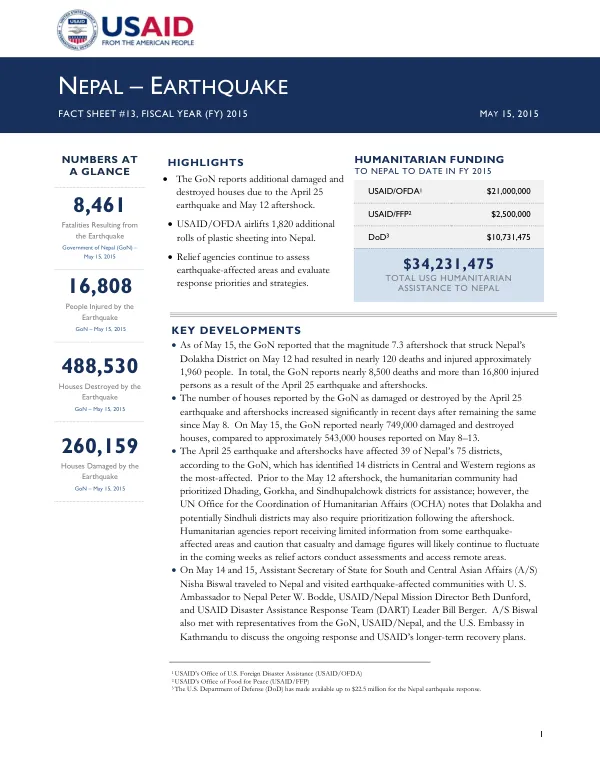
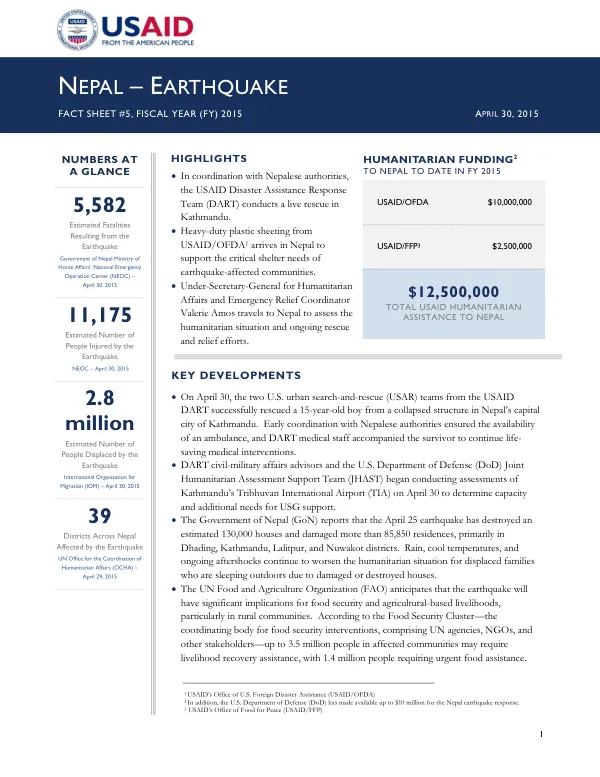
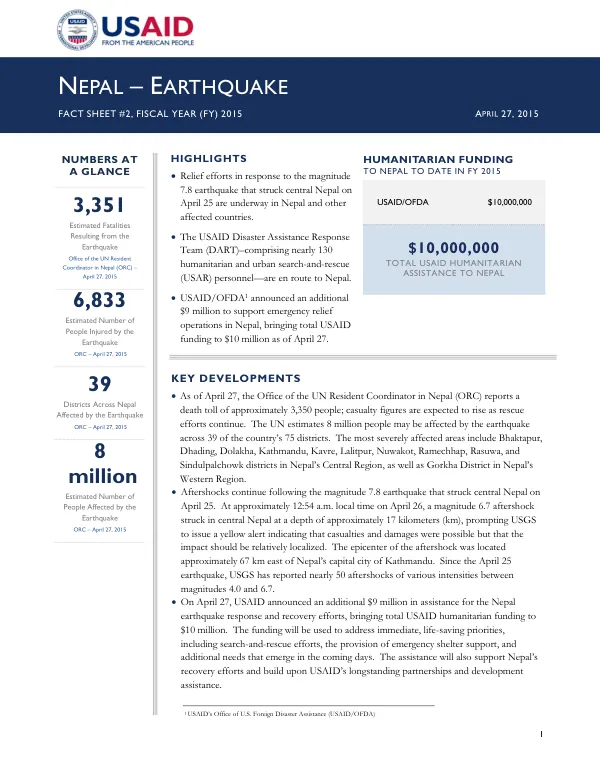
The UN estimates 8 million people, nearly a third of Nepal's population, are affected by the earthquake across 39 of the country's 75 districts. The UN launched a $415 million flash funding appeal for humanitarian response efforts in Nepal, aiming to provide 4.2 million people with health and WASH assistance, 3.5 million with critical food security interventions, and 500,000 people with shelter support. The appeal includes $128 million for food security interventions, $75 million for health, $63 million for WASH, $50 million for shelter and other relief commodities, and $31.7 million for logistical support. The U.S. Department of Defense (DoD) Joint Humanitarian Assessment Support Team (JHAST) arrived in Nepal on April 29, accompanied by a civil-military advisor from the USAID Disaster Assistance Response Team (DART). The JHAST will advise the DART on DoD capabilities and assets available to support the Nepal earthquake response and help assess appropriate DoD missions. Coordinated JHAST-DART assessments, with a particular focus on airport operations at Kathmandu's Tribhuvan International Airport (TIA), are scheduled to begin on April 30. The UN reports that approximately 2.8 million people countrywide are displaced following the April 25 earthquake. Displaced populations in Kathmandu Valley are gathering in public spaces, including Kathmandu's Halchowk Stadium, Memorial Park, and several recreational fields, as well as along roadsides. The Government of Nepal has identified 16 open spaces in Bakhtapur, Kathmandu, and Lalitpur districts for use as displacement sites for earthquake-affected populations that have lost their homes. To address critical shelter needs among earthquake-affected households, USAID/OFDA is airlifting 700 rolls of heavy-duty plastic sheeting to benefit an estimated 7,000 households, or up to 35,000 people. USAID/OFDA partner Save the Children (SC) has distributed 204 household shelter kits purchased with USAID/OFDA funding from a previous fiscal year and pre-positioned in their Central Region warehouse. SC also plans to distribute 1,800 tarpaulins for shelter repair. The Government of Nepal Ministry of Health and Population (MoHP) officials reported that 11 earthquake-affected districts are in need of critical health support. The most urgent health-related needs include tents for use as shelter at overwhelmed or damaged hospitals and health centers, as well as logistics support. The MoHP has deployed directors to each of the 11 districts to coordinate international medical teams. In addition, assessment teams led by senior MoHP officials, in coordination with UN World Health Organization (WHO) Surveillance Medical Officers, report that approximately 90 percent of health facilities outside primary cities are non-operational. The Food Security Cluster estimates that approximately 1.4 million people will require immediate food assistance across 12 districts during the next three months; rapid needs assessments are underway in each of these prioritized districts. The earthquake has disrupted preparations for the next planting season, which begins in June, and may affect food security and livelihoods in the coming months. An estimated 70 percent of Nepal's population relies on agricultural production as their primary livelihoods.
Related documents