MIYAMOTO INTERNATIONAL, INC.
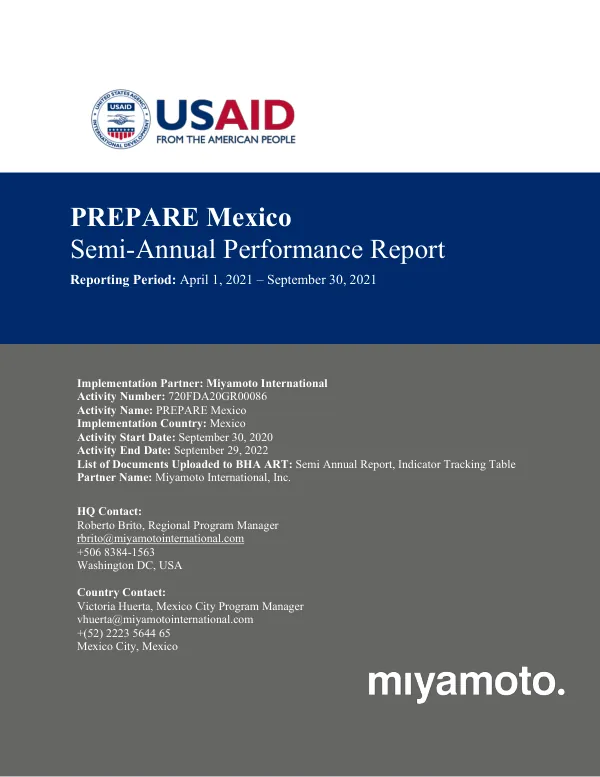
Semi-Annual Performance Report: PREPARE Mexico
The PREPARE Mexico project, implemented by Miyamoto International, aims to strengthen and institutionalize the risk management and response capacity of public disaster authorities and private-sector partners in highly vulnerable urban settings.
2021 · 16 pages
Sign in to readA free account is required to download.
Abstract
The project, funded by USAID/BHA, has a total budget of $1,500,000 and a 24-month implementation period from September 30, 2020, to September 29, 2022. The project's goal is to facilitate the incorporation of risk management and response best practices, strategies, and tools into public policy and planning processes. To achieve this objective, Miyamoto International has established Technical and Expert Working Groups in Mexico City and Zapopan, which will work on incorporating risk management and response best practices and strengthening public-private collaboration. The project has also formed a Social Monitoring Committee in Zapopan, comprising municipal institutions, to advance the objective of increasing knowledge of basic seismic-resistant construction techniques among vulnerable populations in high-risk neighborhoods. The program has prioritized women, the elderly, disabled people, and other marginalized groups for participation in community-level training. The project has made significant progress in gathering experts to sanction Miyamoto's work on a collaborative and democratic forum. Both locations have made advances in gathering experts that will be able to sanction Miyamoto's work on a collaborative and democratic forum through Technical and Expert Working Groups. The project has also joined the ARISE Mexico Network, which was started by the United Nations' office for Disaster Risk Reduction (UNDRR) in 2015 to support the private sector in becoming a key partner for reducing disaster risk. Through this network, the private sector will be involved in the Expert Working Groups regarding the incorporation of risk management and response best practices as well as in the strengthening of public-private collaboration. The project has also made progress in measuring results, with indicators such as the number of hazard risk reduction plans, policies, strategies, disaster preparedness, and contingency plans developed and in place. The project has achieved a significant increase in the number of people participating in discussions about national risk reduction strategies, with 40 people participating in Zapopan and 31 people participating in Mexico City. The project has also made progress in making national and local risk assessment, hazards data, and vulnerability information available within target areas. The project has achieved a significant increase in the percentage of disaster risk management and response actors citing improvements in municipal-level preparedness, with 90% of actors in Zapopan and 27 actors in Mexico City citing improvements. The project has also made progress in strengthening public-private partnerships, with 10 private sector businesses directly engaged in response or DRR-related activities in Mexico City and 3 private sector businesses directly engaged in response or DRR-related activities in Zapopan. Overall, the PREPARE Mexico project has made significant progress in achieving its objectives and has established a strong foundation for public-private collaboration in the application of risk management and response tools.
Related documents