MIYAMOTO INTERNATIONAL, INC.
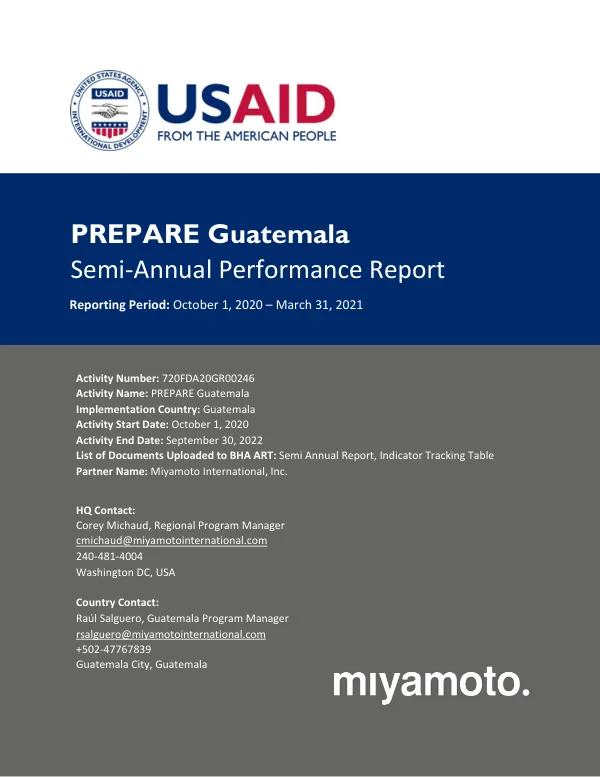
Semi-Annual Performance Report: PREPARE Guatemala
The PREPARE Guatemala program began on October 1, 2020, with a $1,000,000 budget and a two-year period of performance.
2021 · 12 pages
Sign in to readA free account is required to download.
Abstract
The program aims to reduce vulnerability to seismic risk in the Guatemala City Metropolitan Area through targeted technical and capacity building assistance closely aligned with existing disaster risk reduction (DRR) strategy and investments. Miyamoto, in partnership with Project Concern International (PCI), the Government of Guatemala (GoG), and other partners, will achieve this goal through a coordinated effort to collect existing data on seismic hazard, generate new data on seismic exposure and vulnerability, and systematically analyze aggregated data for improved understanding of seismic risk in Guatemala City. Improved risk knowledge will then be used to inform disaster risk management (DRM) measures in the city's most vulnerable neighborhoods. During the reporting period, Miyamoto and PCI laid the foundation for PREPARE Guatemala implementation. A Miyamoto-PCI partnership agreement was signed in October, followed by the hiring of a Guatemalan national with extensive engineering and community development experience to lead program implementation as Miyamoto's National Program Manager (NPM). Miyamoto and PCI personnel then held joint planning and coordination sessions to further develop the program strategy and work plan. A series of key informant interviews and stakeholder consultations led by the NPM were conducted in November and December to obtain baseline data on existing knowledge, resources, and capacities as they relate to disaster risk. These consultations, combined with a review of secondary data, focused broadly on seismic risk in Guatemala City. This included a review of the historical impact of earthquakes in Guatemala and research on the seismic hazard (soil conditions, ground acceleration patterns, fault lines), seismic exposure (building typologies, construction codes and norms) as well as human vulnerability (economic, social) to earthquakes. A detailed baseline report characterizing the risk landscape in Guatemala City and local capacities to manage it was submitted to BHA in December. A program launch event was held on February 4, 2021, a symbolic day in the country for its commemoration of the 1976 earthquake that devastated Guatemala City. Due to the coronavirus pandemic, the event was held virtually and attended by 49 people (14 women) from 26 organizations, including GoG national and municipal level officials, leaders from academia and civil society as well as senior representatives of USAID's Bureau for Humanitarian Assistance-LAC, Miyamoto, and PCI. After the launch, Miyamoto and PCI led additional partner outreach to consult on geographical boundaries for the seismic risk assessment. A target area measuring approximately 20km2 and encompassing adjacent territories within the Municipalities of Guatemala City and Mixco was selected. With the boundaries defined, Miyamoto and partners spearheaded additional, targeted risk data collection and began discussions with structural experts from the Guatemalan Engineers Association (CIG), the Guatemalan Association of Structural and Earthquake Engineers (AGIES), and San Carlos University for support collecting exposure data on approximately 3,000 buildings beginning in May. The program has made progress in several areas. A baseline report characterizing the risk landscape in Guatemala City and local capacities to manage it was submitted to BHA in December. The program launch event was held on February 4, 2021, and was attended by 49 people from 26 organizations. The target area for the seismic risk assessment was selected, and Miyamoto and partners began collecting exposure data on approximately 3,000 buildings. However, the program has not yet achieved several of its objectives. The number of hazard risk reduction plans, policies, strategies, disaster preparedness, and contingency plans developed and in place is still zero. The number of people participating in discussions about national risk reduction strategies as a result of the program is also zero. The national and local risk assessment, hazards data, and vulnerability information is not yet available within the target areas. The program has also not yet made progress in several areas. The number of people trained in disaster preparedness, risk reduction, and management is still zero. The number of people passing final exams or receiving certificates is also zero. The percentage of people trained who retain skills and knowledge after two months is not yet available. Overall, the PREPARE Guatemala program has made progress in laying the foundation for its implementation and has begun collecting data on seismic risk in Guatemala City. However, the program has not yet achieved several of its objectives and has not yet made progress in several areas.
Related documents