CATHOLIC RELIEF SERVICES ORGANIZATION
USAID/OFDA Situation Report
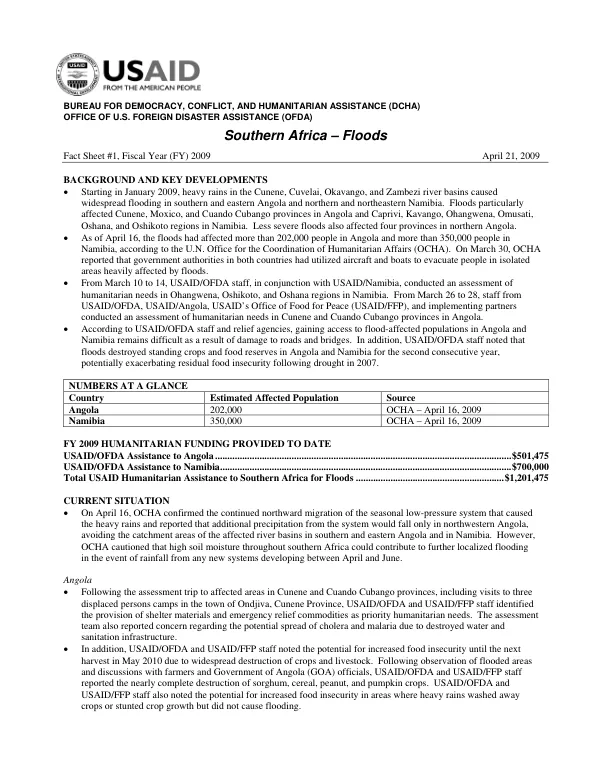
Heavy rains in the Cunene, Cuvelai, Okavango, and Zambezi river basins caused widespread flooding in southern and eastern Angola and northern and northeastern Namibia starting in January 2009.
2009 · 3 pages
Sign in to readA free account is required to download.
Abstract
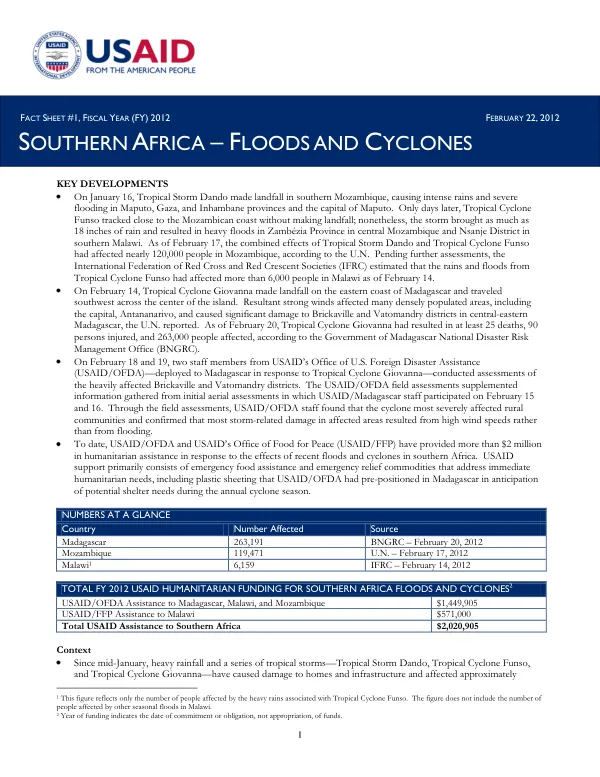
The floods particularly affected Cunene, Moxico, and Cuando Cubango provinces in Angola and Caprivi, Kavango, Ohangwena, Omusati, Oshana, and Oshikoto regions in Namibia. Less severe floods also affected four provinces in northern Angola. As of April 16, the floods had affected more than 202,000 people in Angola and more than 350,000 people in Namibia, according to the U.N. Office for the Coordination of Humanitarian Affairs (OCHA). Government authorities in both countries had utilized aircraft and boats to evacuate people in isolated areas heavily affected by floods. USAID/OFDA staff, in conjunction with USAID/Namibia, conducted an assessment of humanitarian needs in Ohangwena, Oshikoto, and Oshana regions in Namibia from March 10 to 14. Staff from USAID/OFDA, USAID/Angola, USAID's Office of Food for Peace (USAID/FFP), and implementing partners conducted an assessment of humanitarian needs in Cunene and Cuando Cubango provinces in Angola from March 26 to 28. Gaining access to flood-affected populations in Angola and Namibia remains difficult due to damage to roads and bridges. Floods destroyed standing crops and food reserves in Angola and Namibia for the second consecutive year, potentially exacerbating residual food insecurity following drought in 2007. The Government of Angola (GOA) Civil Protection Unit reported 60 flood-related deaths as of April 16. OCHA reported that floods had displaced more than 81,000 people and destroyed nearly 4,000 houses. Flood damage to more than 230,000 hectares of arable land resulted in extensive livestock and crop losses, according to OCHA. USAID/OFDA provided $501,475 in assistance to Angola and $700,000 in assistance to Namibia for flood response efforts. In Angola, USAID/OFDA provided funding to Catholic Relief Services (CRS) for the purchase and distribution of flood emergency kits and to the International Organization for Migration (IOM) for the purchase and distribution of shelter materials and relief commodities. In Namibia, USAID/OFDA provided funding to the Namibian Red Cross Society (NRCS) for emergency relief commodities, to the U.N. Children's Fund (UNICEF) for emergency WASH assistance, and to the International Federation of Red Cross and Red Crescent Societies (IFRC) for shelter materials and other relief commodities. The floods destroyed more than 50 percent of roads in the affected regions, exacerbating damage to roads and bridges still under repair following damage caused by the 2008 flooding. The International Federation of Red Cross and Red Crescent Societies (IFRC) reported that landmines displaced by flood waters in affected areas pose an additional risk to both flood-affected and displaced populations. OCHA estimated that more than 544,000 individuals could be at risk of increased food insecurity in 2009 and 2010 as a result of the floods.
Related documents