USAID DEC
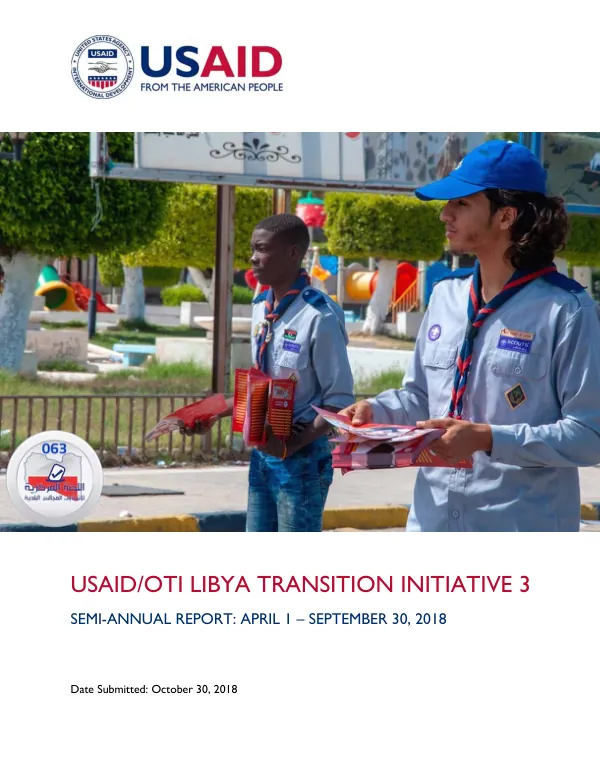
USAID/OTI LIBYA TRANSITION INITIATIVE 3 SEMI-ANNUAL REPORT: APRIL 1 – SEPTEMBER 30, 2018
Sign inUNITED NATIONS
USAID/OTI LIBYA TRANSITION INITIATIVE 3 SEMI-ANNUAL REPORT: APRIL 1 – SEPTEMBER 30, 2018
The Libya Transition Initiative 3 (LTI 3) is a follow-on program launched by USAID's Office of Transition Initiatives in May 2017 to support Libya's resilience to fragmentation and spoilers.
2018 · 16 pages
Sign in to readA free account is required to download.
Abstract
The program utilizes a quick-response mechanism to implement activities nationwide aimed at preventing further deterioration in political and security conditions, and keeping the space open for civilian leadership, reconciliation, and a positive political transition. During the reporting period, LTI 3 worked toward the following objectives: improving stability in strategic, conflict-affected areas; increasing citizens' confidence in their public institutions; and reducing the influence of extremist groups in strategic areas. The program implemented 47 activities totaling $14,341,070 in 15 municipalities across Libya from April 1 – September 30, 2018. Key results during the reporting period include the rehabilitation, repair, or provision of essential equipment for 30 community spaces and public facilities, including two water pumping stations, 17 educational facilities, three health facilities, three youth facilities, and five public spaces where cleaning efforts were supported. Additionally, the program replaced and repaired traffic lights, installed road signs, and rehabilitated one road, improving road safety and traffic flow for an estimated 80,000 people living in Sirte and 2,500 residents of Tripoli's Fashloum district. The program also supported sporting and recreational events by youth-led civil society organizations (CSOs) offering civic engagement opportunities to 4,600 youth. Furthermore, the distribution of equipment and small infrastructure repairs led by local government institutions and CSOs improved learning conditions for around 8,000 students in Ubari and Abu Salim. The program also distributed garbage bins and cleaning equipment improving waste management for a population of 50,000 in Ubari. Across Libya, citizens are engaged in daily struggles to secure basic services, access to cash and fuel, and security. The United Nations (UN)-backed Libyan Political Agreement (LPA) of December 2015 remains the primary avenue for national reconciliation efforts. However, efforts led by the head of the UN Support Mission in Libya (UNSMIL), Special Representative of the Secretary General (SRSG) Ghassan Salamé to bring rival political factions back to the negotiating table to amend the stalled agreement have yielded few results. Confidence in the Government of National Accord (GNA) created by the LPA is at an all-time low due to its failure to provide security, deliver basic services, and manage the country's crippling cash liquidity crisis. In Tripoli, the GNA has started to make some progress on security in the capital, but still fails to hold a monopoly on force even there. Exerting influence over political and economic entities, a handful of powerful militias have grown in strength and wealth, fueling resentment among armed actors excluded from this arrangement. In the East, the Libyan National Army (LNA) continues to exercise control or influence over more than half of Libya's populated territory, including in the East, large swaths of the South and some key areas in the western region. The Islamic State (IS) and other extremist groups continue to exploit Libya's lack of unity. Since their defeat in Sirte in December 2016, IS militants have regrouped in the wider Sirte region and expanded their influence in marginalized and far-flung communities. Conditions continue to vary significantly between and within Libya's four main regions. In western Libya, fragile alliances established by the GNA are holding, but powerful armed groups continue to dominate lucrative fuel-smuggling and human-trafficking industries. In the East, the LNA claimed defeat against the Derna Mujahedeen Shura Council (DMSC) in June 2018, bringing the last militant stronghold in eastern Libya under Haftar's control.