DAI GLOBAL, LLC
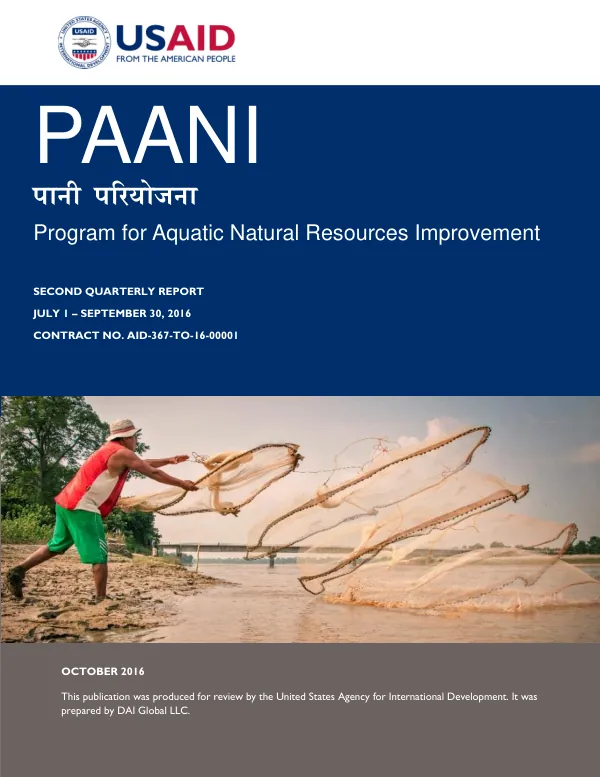
USAID PAANI SECOND QUARTERLY REPORT JULY 1-SEPTEMBER 30, 2016
The PANI Project, also known as Paani, is a USAID-funded initiative aimed at enhancing Nepal's ability to manage water resources for multiple uses and users through climate change adaptation and the conservation of freshwater biodiversity.
2016 · 37 pages
Sign in to readA free account is required to download.
Abstract
The project employs an integrated, whole-of-basin approach with activities at the watershed, river basin, and national levels to reduce threats to freshwater biodiversity and increase the ability of targeted human and ecological systems in the Karnali, Mahakali, and Rapti river basins to adapt to the adverse impacts of climate change through improved water management. At the watershed and river basin levels, PANI focuses on increasing the knowledge, engagement, and benefits of local water users in target river basins to build local freshwater management capacity. This includes sustainable hydropower, flood prevention, and participatory basin governance. At the national level, PANI aims to improve coordination among stakeholders at all levels and strengthen the policy and enabling environment. The project has four intermediate results, including: 1. Increased knowledge, engagement, and benefits for local water users in target river basins. 2. Improved basin-level resource management and sustainable hydropower. 3. Increased coordination and strengthened enabling environment among stakeholders at all levels. 4. Expanded knowledge base and built Nepal's capacity for on-going learning in freshwater biodiversity, climate change, and water management. PANI's overall funding comes from two US congressional earmarks: Biodiversity Conservation and Global Climate Change adaptation. The project's development hypothesis is based on the assumption that improved information, effective governance, local solutions, and a stronger policy environment will lead to the conservation of freshwater biodiversity, adaptation to climate change, and sustainable economic growth. The project's implementation is guided by five key principles, including an integrated river basin management approach that connects upstream and downstream stakeholders. PANI's results framework is presented in Annex B, and the project's development hypothesis is detailed in Exhibit 1. The PANI project has made significant progress in its first quarter of implementation, with DAI Global setting the technical and administrative foundation for project activities. The GON Ministry of Finance and USAID signed an Implementation Letter in mid-July 2016, enabling DAI to begin coordination and planning with GON and other partners to carry out the PANI project. PANI's overall funding of US$ will come from two US congressional earmarks, with each earmark having requirements that apply to all USAID programs worldwide. The project's development hypothesis is based on the assumption that improved information, effective governance, local solutions, and a stronger policy environment will lead to the conservation of freshwater biodiversity, adaptation to climate change, and sustainable economic growth. The PANI project has made significant progress in its first quarter of implementation, with DAI Global setting the technical and administrative foundation for project activities. The GON Ministry of Finance and USAID signed an Implementation Letter in mid-July 2016