TETRA TECH
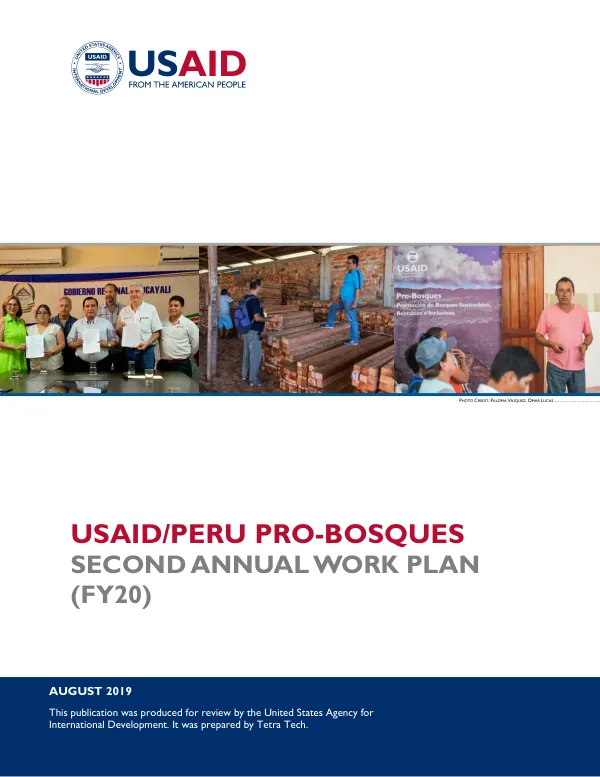
USAID/PERU PRO-BOSQUES: YEAR 2 (FY20) ANNUAL WORK PLAN
The USAID/Peru Pro-Bosques project aims to provide the pillars for sustainability, legality, inclusivity, and profitability necessary to support and modernize Peru's forest sector.
2020 · 47 pages
Sign in to readA free account is required to download.
Abstract
The project supports the strengthening of Peru's forest sector, focusing on strengthening forest governance through forest control and monitoring tools; promoting private sector engagement through sustainable forest management and improved business practices; and fostering market inclusiveness by increasing the participation of indigenous and other forest-dependent communities in forest value chains. The project's overall goal is to strengthen the forest sector in Peru, with three main objectives: (1) to strengthen monitoring and enforcement in the forest sector to increase legal timber for international and domestic use; (2) to improve private sector engagement in forest sector activities through the increase of efficiency in the use and transformation of forest resources; and (3) to foster market inclusiveness by increasing the participation of indigenous and other forest-dependent communities in forest value chains. The project is part of the Environmental Cooperation Agreement (ECA) between Peru and the United States, which aims to guarantee mutually supportive trade and environment policies, promote optimal use of natural resources for sustainable development, and strengthen bilateral environmental cooperation and collaboration. The project is also aligned with the National Forest Conservation Program to Mitigate Climate Change (NFCP) and the National Determined Contribution of Peru to the United Nations Framework Convention on Climate Change (UNFCC). The project will be implemented over a period of five years, from September 25, 2018, to September 24, 2023, with a total award amount of $23,046,696. The project will be implemented by Tetra Tech, with Dr. Hector Cisneros as the Chief of Party and Jason Girard as the Project Manager. The project's implementation strategy will focus on strengthening forest governance, promoting private sector engagement, and fostering market inclusiveness. The project will work with various stakeholders, including the Government of Peru, indigenous communities, and the private sector, to achieve its objectives. The project will also establish a monitoring and evaluation system to track progress and ensure accountability. The project's expected outcomes for FY20 include the strengthening of forest governance, the promotion of private sector engagement, and the increase of market inclusiveness. The project will also establish a system for monitoring and evaluating the project's progress and impact. The project's geographic focus will be on the Peruvian Amazon, with a focus on the regions of Loreto, Ucayali, and Madre de Dios. The project will work with various stakeholders in these regions to achieve its objectives and promote sustainable forest management practices. The project's implementation will be guided by a theory of change, which outlines the expected outcomes and impact of the project. The project's results chains will be used to track progress and ensure accountability. The project's monitoring and evaluation system will be established to track progress and ensure accountability. The project's budget for FY20 is $4,609,392, which will be used to support the project's implementation and achieve its objectives. The project's budget will be managed by Tetra Tech, with the support of the Government of Peru and other stakeholders. The project's coordination and partnership strategy will focus on building partnerships with various stakeholders, including the Government of Peru, indigenous communities, and the private sector. The project will also establish a system for coordinating with other projects and initiatives in the region to ensure alignment and avoid duplication of efforts. The project's performance indicator table and results framework will be used to track progress and ensure accountability. The project's Gantt chart will be used to track the project's timeline and ensure that activities are completed on schedule. The project's proposed list of short-term technical assistance (STTA) will be used to support the project's implementation and achieve its objectives. The project's implementation principles and critical assumptions will be used to guide the project's implementation and ensure that it is aligned with the project's objectives and goals. The project's work plan summary budget will be used to track the project's budget and ensure that it is aligned with the project's objectives and goals.