USAID
USAID Pollution Prevention Assistance: Success Story at ACPC in Jordan
The Arab Center for Pharmaceutical and Chemical Industries (ACPC) facility in Jordan's King Abdullah II Industrial Park in Sahab has undergone significant improvements following USAID pollution prevention assistance.
2015 · 1 pages
Sign in to readA free account is required to download.
Abstract
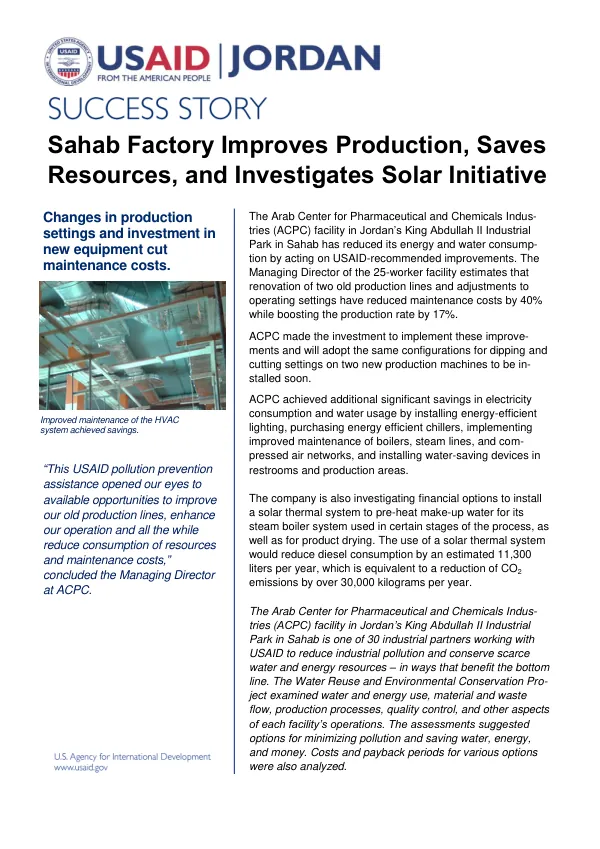
The facility, which employs 25 workers, has reduced its energy and water consumption by implementing USAID-recommended improvements. The Managing Director estimates that renovation of two old production lines and adjustments to operating settings have reduced maintenance costs by 40% while boosting the production rate by 17%. The improvements made by ACPC include the renovation of two old production lines and adjustments to operating settings, which have resulted in significant savings. The company has also invested in new equipment, including energy-efficient lighting, energy-efficient chillers, and water-saving devices in restrooms and production areas. These investments have achieved additional significant savings in electricity consumption and water usage. Furthermore, ACPC has implemented improved maintenance of boilers, steam lines, and compressed air networks, which has also contributed to the reduction in energy and water consumption. The company is also investigating financial options to install a solar thermal system to pre-heat make-up water for its steam boiler system used in certain stages of the process, as well as for product drying. The use of a solar thermal system would reduce diesel consumption by an estimated 11,300 liters per year, which is equivalent to a reduction of CO2 emissions by over 30,000 kilograms per year. This initiative is part of ACPC's efforts to reduce its environmental impact and conserve scarce water and energy resources. The improvements made by ACPC are part of a larger effort by USAID to reduce industrial pollution and conserve water and energy resources. The Water Reuse and Environmental Conservation Project examined water and energy use, material and waste flow, production processes, quality control, and other aspects of each facility's operations. The assessments suggested options for minimizing pollution and saving water, energy, and money. Costs and payback periods for various options were also analyzed, providing a framework for facilities like ACPC to make informed decisions about their operations. The success of ACPC's efforts is a testament to the effectiveness of USAID's pollution prevention assistance. By implementing these improvements, ACPC has not only reduced its environmental impact but also achieved significant cost savings. The company's experience serves as a model for other industrial facilities in Jordan and beyond, highlighting the importance of investing in sustainable practices and reducing pollution.