USAID
Jordan Potato & Corn Chips Co. Improves Production, Reduces Environmental Impact
Jordan Potato & Corn Chips Co.
2015 · 1 pages
Sign in to readA free account is required to download.
Abstract
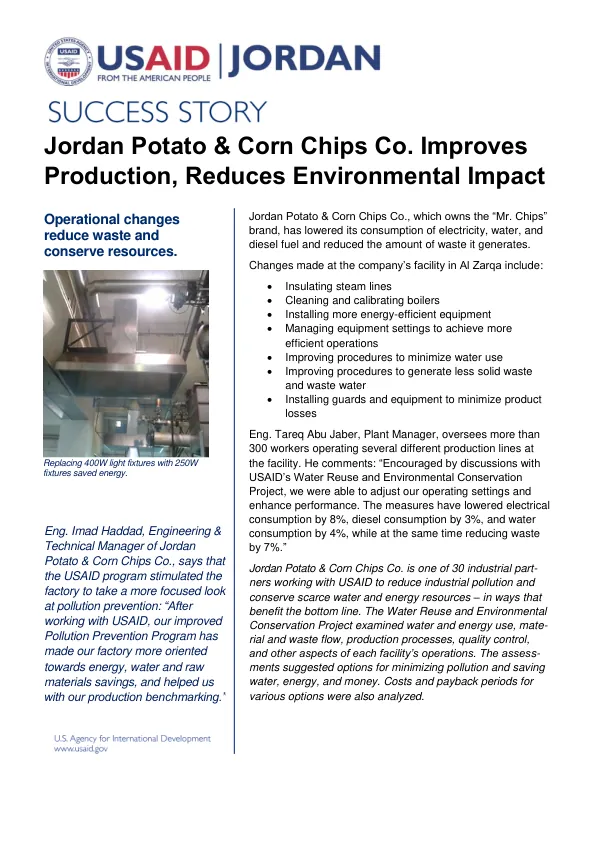
has implemented operational changes to reduce waste and conserve resources. The company, which owns the "Mr. Chips" brand, has lowered its consumption of electricity, water, and diesel fuel, and reduced the amount of waste it generates. Changes made at the company's facility in Al Zarqa include insulating steam lines, cleaning and calibrating boilers, installing more energy-efficient equipment, and managing equipment settings to achieve more efficient operations. The company has also improved procedures to minimize water use and generate less solid waste and wastewater. Additionally, guards and equipment have been installed to minimize product losses. These measures have resulted in a reduction of electrical consumption by 8%, diesel consumption by 3%, and water consumption by 4%, while also reducing waste by 7%. The company's Plant Manager, Eng. Tareq Abu Jaber, oversees more than 300 workers operating several different production lines at the facility. Jordan Potato & Corn Chips Co. is one of 30 industrial partners working with USAID to reduce industrial pollution and conserve scarce water and energy resources. The Water Reuse and Environmental Conservation Project examined water and energy use, material and waste flow, production processes, quality control, and other aspects of each facility's operations. The assessments suggested options for minimizing pollution and saving water, energy, and money. Costs and payback periods for various options were also analyzed. The company's Engineering and Technical Manager, Eng. Imad Haddad, notes that the USAID program stimulated the factory to take a more focused look at pollution prevention. The improved Pollution Prevention Program has made the factory more oriented towards energy, water, and raw materials savings, and helped with production benchmarking. The company's efforts to reduce waste and conserve resources have not only benefited the environment but also improved the company's bottom line. The Water Reuse and Environmental Conservation Project has provided a framework for industrial partners to identify areas for improvement and implement cost-effective solutions. By working together, these companies can reduce their environmental impact while also improving their operational efficiency and profitability.
Related documents