USAID DEC
USAID Pollution Prevention Assistance Yields Significant Savings for Jordanian Industries
Sign inUSAID
USAID Pollution Prevention Assistance Yields Significant Savings for Jordanian Industries
The USAID pollution prevention assistance program has been instrumental in helping industrial facilities in Jordan reduce their environmental impact and improve their economic performance.
2015 · 19 pages
Sign in to readA free account is required to download.
Abstract
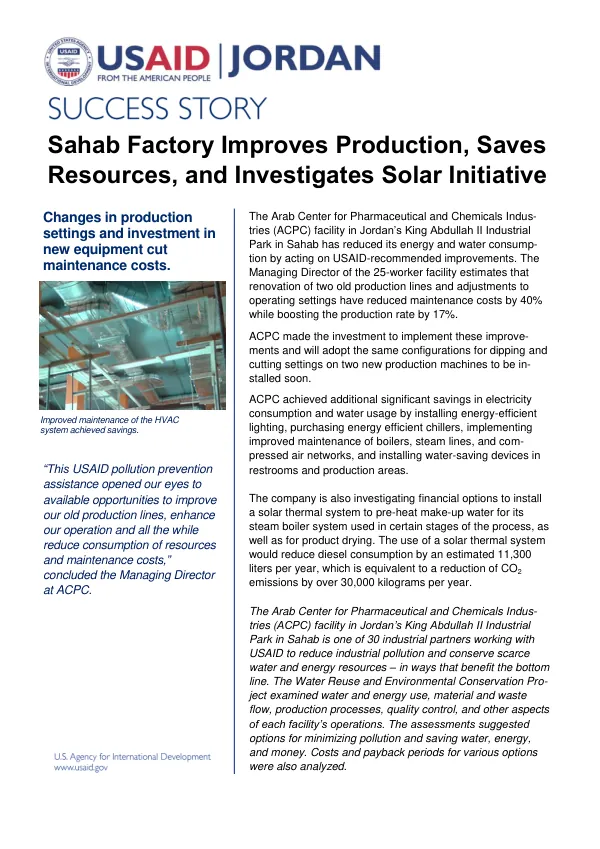
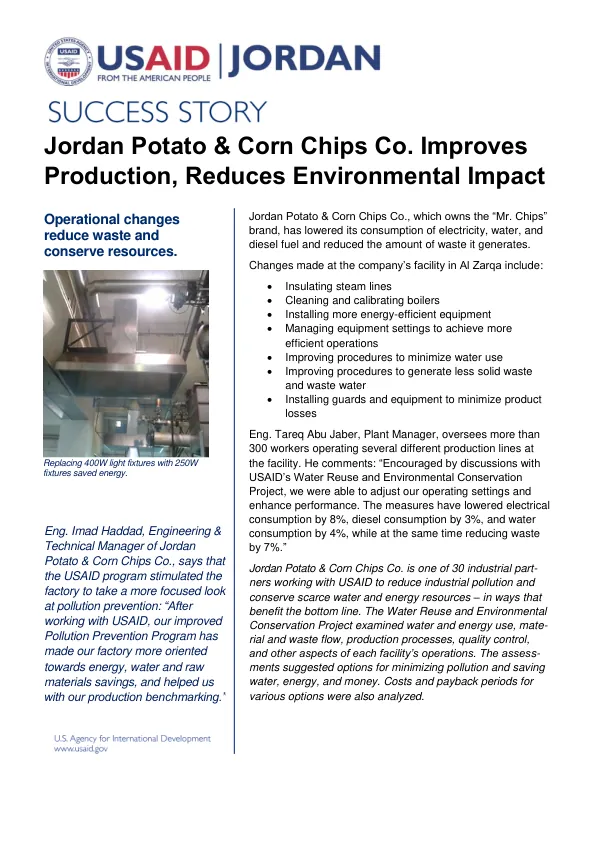
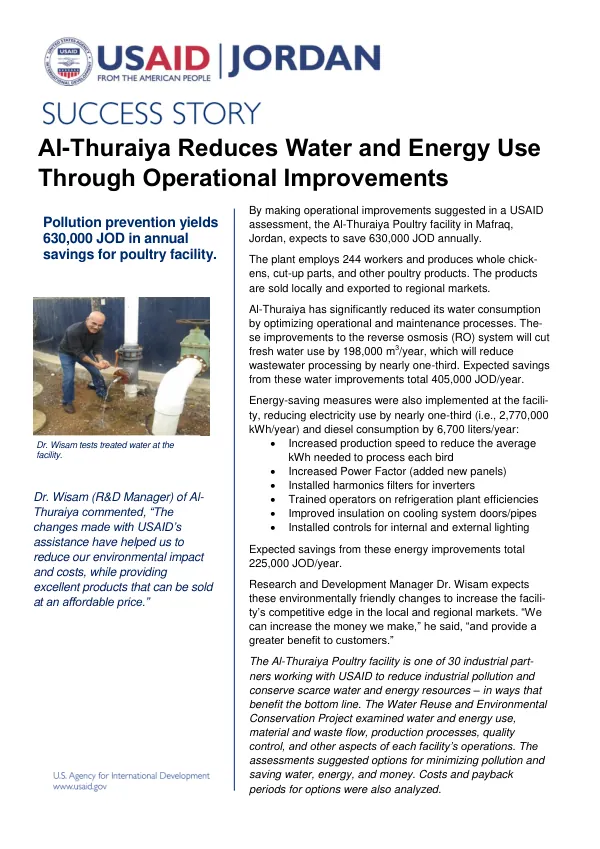
The program, which is part of the Water Reuse and Environmental Conservation Project, has worked with 30 industrial partners to identify opportunities for minimizing pollution and conserving scarce water and energy resources. One of the facilities that has benefited from the program is the Al-Baha Company for Caustic Chlorine, located in Jordan's Al Hallabat Industrial Park. The company has made significant investments in new equipment and technologies, including a new line for converting liquid sodium hydroxide into solid flakes, which has saved the company 46,800 JOD annually. The company has also installed a new hydrogen combustion boiler, which reduces heavy fuel oil use by 400 metric tons per year and reduces annual CO2 emissions by over 1.2 million kg. Another facility that has benefited from the program is the Arabian Development for Food Industries Co. (ADFICO), located in the Amman-Zarqa Free Zone in Jordan. The company has implemented a number of changes, including the installation of sub-meters for water and wastewater lines, which has allowed the company to pinpoint inefficiencies and make adjustments that have saved materials and workers' time. The company estimates that the savings in resources could translate into 36,000 JOD/year during full operation. The Arab Center for Pharmaceutical and Chemicals Industries (ACPC) facility in Jordan's King Abdullah II Industrial Park in Sahab has also benefited from the program. The company has implemented a number of changes, including the renovation of two old production lines and adjustments to operating settings, which have reduced maintenance costs by 40% while boosting the production rate by 17%. The company has also installed energy-efficient lighting, purchased energy-efficient chillers, and implemented improved maintenance of boilers, steam lines, and compressed air networks, which have saved the company significant amounts of energy and water. The program has also helped facilities to identify opportunities for reducing their environmental impact and improving their economic performance. For example, the Al-Baha Company for Caustic Chlorine has implemented a number of changes, including the installation of variable frequency drives (VFDs) on large cooling fans, which has cut the company's annual electricity consumption by approximately 75,600 kWh. The company has also implemented best practices in materials handling, which has generated 40,000 JOD in revenue through the sale of unwanted spare parts and reduced the risk of chemical spills. Overall, the USAID pollution prevention assistance program has been instrumental in helping industrial facilities in Jordan reduce their environmental impact and improve their economic performance. The program has worked with 30 industrial partners to identify opportunities for minimizing pollution and conserving scarce water and energy resources, and has helped facilities to implement a number of changes that have saved them significant amounts of money and reduced their environmental impact.