CHEMONICS
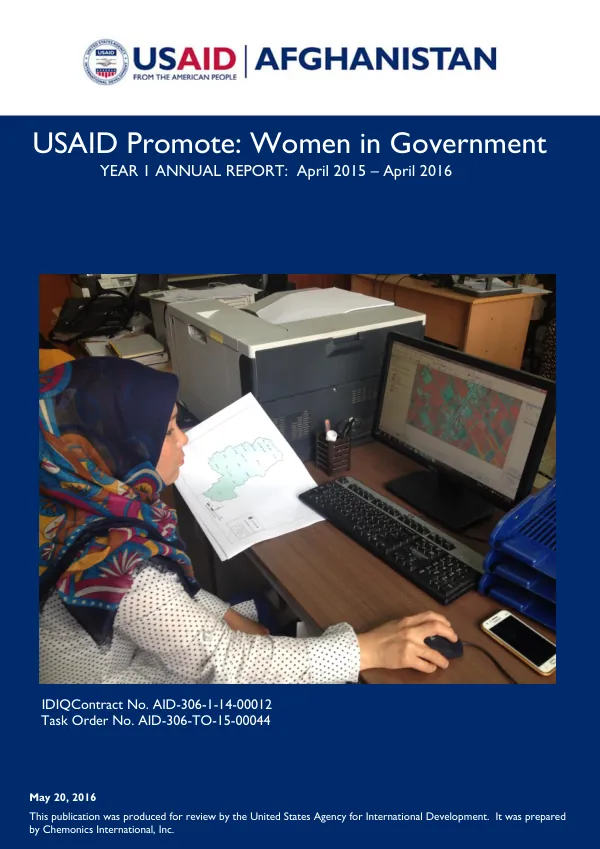
USAID Promote: Women in Government Year 1 Annual Report
The USAID Promote: Women in Government program was implemented in Afghanistan from April 2015 to April 2016.
2016 · 58 pages
Sign in to readA free account is required to download.
Abstract
The program aimed to increase the number of women in government positions and promote a more inclusive and equitable work environment. The program was implemented by Chemonics International, Inc. under the IDIQ Contract No. AID-1-14-00012 and Task Order No. AID-306-TO-15-00044. The program consisted of three main components: Women's Internship Program, Policy Reform, and Outreach and Communications. The Women's Internship Program provided training and mentorship to 16 female interns, who were placed in government ministries and agencies. The program aimed to equip the interns with the skills and knowledge necessary to succeed in their careers and to promote a more inclusive work environment. The Policy Reform component focused on addressing the barriers that prevent women from working in government. The program worked with government officials and civil society organizations to develop policies and procedures that promote gender equality and prevent harassment and discrimination. The program also provided training to government officials on gender-sensitive policies and procedures. The Outreach and Communications component aimed to increase local stakeholder support for women in government. The program worked with local media outlets to promote the program's goals and achievements, and to raise awareness about the importance of gender equality in government. The program also conducted focus group discussions and surveys to gather feedback from local stakeholders and to identify areas for improvement. The program made significant progress in its first year, with 16 female interns completing the program and being placed in government positions. The program also developed and implemented policies and procedures to promote gender equality and prevent harassment and discrimination. The program's outreach and communications efforts helped to raise awareness about the importance of gender equality in government and to promote the program's goals and achievements. The program's results and key achievements were monitored and evaluated through a variety of indicators, including the number of female interns placed in government positions, the number of policies and procedures developed and implemented, and the level of local stakeholder support for the program. The program's lessons learned and constraints and critical issues were also identified and addressed. The program's management and administration were overseen by the Chief of Party, who was responsible for ensuring that the program was implemented in accordance with the terms of the contract and the program's goals and objectives. The program's personnel, procurement, and administration were also managed by the Chief of Party, who worked closely with the Deputy Chief of Party and other program staff to ensure that the program was implemented effectively. The program's collaboration with the Government of the Islamic Republic of Afghanistan (GIRoA) and donor agencies was also an important aspect of the program. The program worked closely with GIRoA officials and donor agencies to ensure that the program was aligned with the government's priorities and goals, and to secure funding and support for the program. The program also conducted regular meetings with USAID's Monitoring and Evaluation (M&E) team to ensure that the program was meeting its goals and objectives. The program's highlighted activities for the next fiscal year included continuing to implement the Women's Internship Program, developing and implementing policies and procedures to promote gender equality and prevent harassment and discrimination, and continuing to raise awareness about the importance of gender equality in government through outreach and communications efforts.