USAID
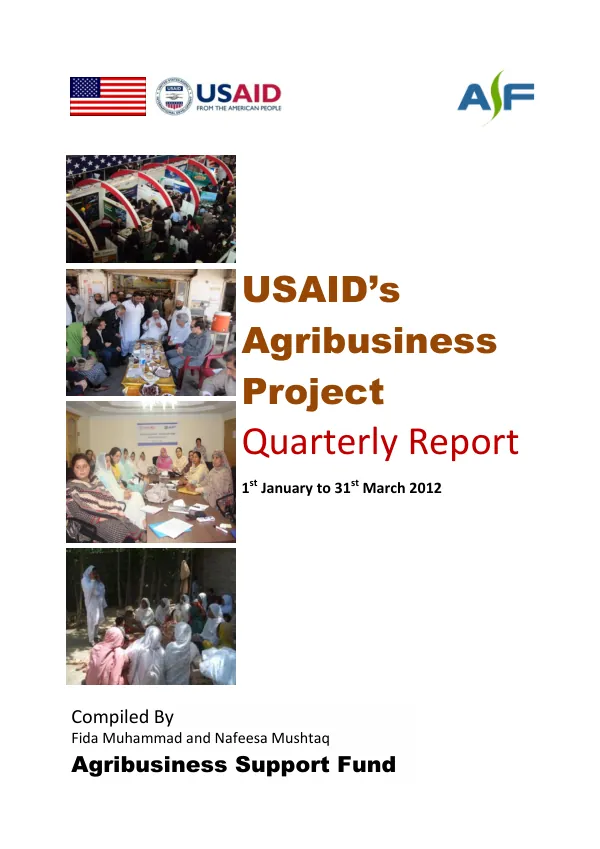
USAID’s Agribusiness Project Quarterly Report 1st January to 31st March 2012
The USAID's Agribusiness Project was commissioned by USAID on November 10, 2011, for a period of 5 years and is being implemented by the Agribusiness Support Fund (ASF).
2012 · 13 pages
Sign in to readA free account is required to download.
Abstract
The target sub-sectors for the project are horticulture and livestock, including dairy and fisheries. The project aims to address the priority problems and constraints impeding the development of the agriculture sector in Pakistan. Interventions under the project will focus on improving and strengthening off-farm and on-farm activities by enhancing the competitiveness of enterprises to explore and exploit their potential in both domestic and international markets. The project will serve as a catalyst to mobilize the private sector's investment in agribusinesses and related enterprises as a means for NGOs/RSPs, BDSPs, and other community organizations to provide agribusiness support services in their communities. The ultimate objective is to strengthen private sector value chains to become commercially viable and sustainable. Implementation of activities will be carried out in collaboration with international and local partner organizations with relevant experience in marketing/enterprise development, value chains, and rural development-related activities. The overall goal of the USAID's Agribusiness Project is to support improved conditions for broad-based economic growth, create employment opportunities, and contribute to poverty alleviation through the increase in competitiveness of horticulture and livestock value chains in partnership with all stakeholders. The specific objectives of the project are to strengthen the capacity in horticulture and livestock value chains to increase sales to domestic and foreign markets, strengthen the capacity of smallholders and farmer enterprises to operate autonomously and effectively, and increase agriculture efficiency and productivity through the adoption of new farming techniques and technological innovation among targeted beneficiaries. The project activities are organized under two components: technical assistance (TA) for capacity building and program support, and partnership window cost-sharing grants. Under component-1, the project will offer ongoing technical and capacity building assistance to upgrade and strengthen the priority value chains in horticulture and livestock sub-sectors. Component-2 involves the launch of a national cost-sharing grants program, offering a wide range of customized grant products to all players within the selected priority value chains. During the quarter, focus was on preparatory activities to launch activities in the field, staff orientation, and stakeholder consultations. The project continued staff recruitment based on the requirement of the project, and a total of 131 staff positions were filled out by the end of the quarter. The project has a target of establishing a project office and regional office in 9 areas of the country, and as on March 31, 2012, premises for the project office in Lahore and regional offices in Faisalabad, Gilgit-Baltistan, Karachi, Sukkur, and DI Khan were acquired on rent. The project has made significant progress in staffing, with 47 persons recruited during the quarter, including 10 female candidates. The project has also established offices in various locations, including Islamabad, Lahore, Peshawar, DI Khan, Gilgit, Sukkur, Karachi, Multan, Faisalabad, and Quetta. The project has a target of establishing a project office and regional office in 9 areas of the country, and as on March 31, 2012, premises for the project office in Lahore and regional offices in Faisalabad, Gilgit-Baltistan, Karachi, Sukkur, and DI Khan were acquired on rent. The project has a total estimated agreement amount of $89,412,942, with obligations to date of $10,300,000. The accrued expenditures for the quarter were $782,664, and the estimated expenditures for the next quarter are $2,000,000. The project has a target of achieving the overall targets of the project, and in the subsequent years, focus will be shifted from activities and output reporting to outcome reporting.
Related documents