USAID DEC
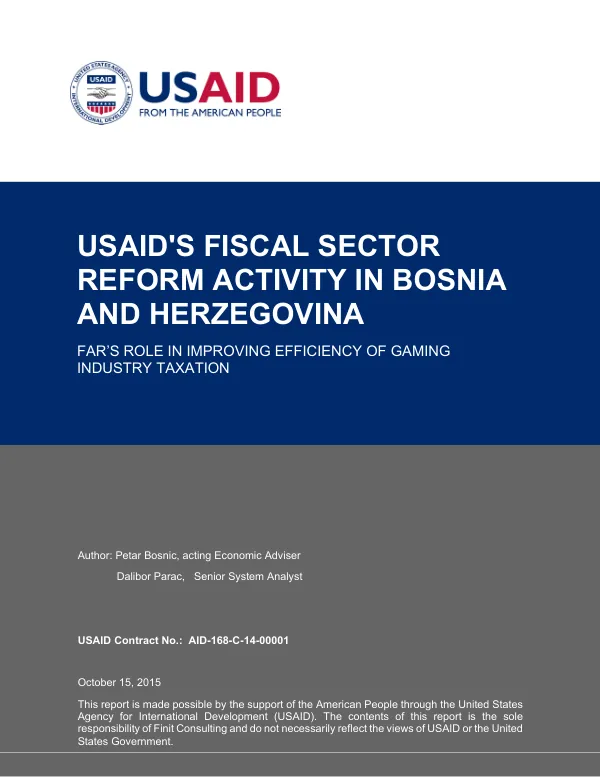
USAID's Fiscal Sector Reform Activity in Bosnia and Herzegovina: FAR's Role in Improving Efficiency of Gaming Industry Taxation
Sign inDELOITTE CONSULTING, LLP
USAID's Fiscal Sector Reform Activity in Bosnia and Herzegovina: FAR's Role in Improving Efficiency of Gaming Industry Taxation
The Fiscal Sector Reform Activity in Bosnia and Herzegovina (FAR) Project aimed to improve the efficiency of gaming industry taxation.
2015 · 10 pages
Sign in to readA free account is required to download.
Abstract
The project was implemented by Finit Consulting under a contract with the United States Agency for International Development (USAID). The FAR Project focused on the Federation of Bosnia and Herzegovina (FBiH), where the gaming industry was characterized by a lack of effective taxation and a high risk of tax evasion. Prior to the adoption of the new Law on Games of Chance, the previous law had been in effect since December 2001. The number of organizers and types of games had increased significantly, and incomes and profits from the business had grown. However, the previous law had inadequately specified terms, manner, and organizers of games, types of games, and the system of supervision over the organizers, leading to difficulties and dilemmas in decision-making processes. The new Law on Games of Chance was published in the FBiH Official Gazette on February 7, 2015, and aimed to consolidate the gaming industry market by creating necessary preconditions for the improvement of financial discipline of entities operating in the industry. The law specified several provisions to achieve this goal, including the obligation to hold back and make monthly payments of 5% of the total amount paid by players in betting games and 10% of the total turnover of casinos and automat clubs. The FAR Project's role in improving gaming industry taxation was to expand the use of software by integrating it into the existing systems within the FBiH Tax Administration. The project aimed to link the new gaming industry monitoring software to the current systems within the Tax Administration, enabling more efficient taxation and reducing the risk of tax evasion. The FAR Project's work plan was adapted to reflect the new Law on Games of Chance, which had already been adopted. The project's initial activities, including the analysis of the present status of the gaming industry and the legislative framework, became redundant as they had already been developed in a study conducted by the FBiH Ministry of Finance. The FAR Project's new role focused on IT activities, including the design and implementation of the IT solution for improved taxation of the gaming industry. The FAR Project's implementation was delayed due to the adoption of the new Law on Games of Chance, which had not yet been fully implemented. The organizers of games of chance had been given a 6-month deadline to synchronize their systems, and the FBiH Tax Administration had a 9-month deadline to pass necessary implementing acts. Once the Law and by-laws had been fully implemented, it would be possible to identify potential weaknesses and start working on amendments. The FAR Project's recommendations focused on expanding the use of software to improve taxation efficiency and reduce the risk of tax evasion. The project's work plan was adapted to reflect the new Law on Games of Chance, and the project's role was to link the new gaming industry monitoring software to the current systems within the FBiH Tax Administration.
Related documents