USAID DEC
USAID'S Food and Enterprise Development Program for Liberia (FED) Bi-Weekly Report August 1-15, 2013
Sign inDAI
USAID'S Food and Enterprise Development Program for Liberia (FED) Bi-Weekly Report August 1-15, 2013
The Food and Enterprise Development Program for Liberia (FED) is a USAID-funded initiative aimed at improving agricultural productivity and enterprise development in Liberia.
2013 · 10 pages
Sign in to readA free account is required to download.
Abstract
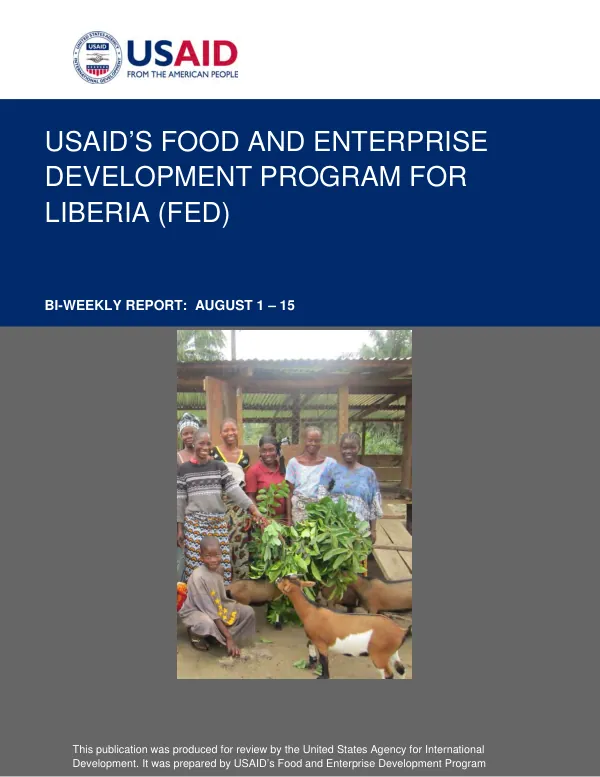
The program operates in six counties: Margibi, Montserrado, Bong, Lofa, Nimba, and Grand Bassa. During the first two weeks of August 2013, FED reported promising harvests in both the PUA and cassava value chains. In the upland and lowland rice sites, work has intensified with canal, plot, and bund construction ongoing, and widespread seed transplanting taking place. FED has distributed 6 goat feeders to lead farmer sites throughout its counties of operation and treated and dewormed 178 goats. Additionally, 18 participants were trained in the advantages of mineral salt lick usage at their sites. At 30 PUA sites, layouts have been taking place, and planting of corn, peanuts, and beans is underway. Preparations for the input supply pilot voucher program are ongoing and are scheduled to roll out next month across Nimba and Lofa. FED has also been informed by the United States African Development Agency (USADF) that they are awarding grants to four beneficiaries in cassava processing due to FED's assistance. In Component One: Increased Agriculture Productivity, input supply activities have been ongoing. Meetings were held among six farmer groups in Bong and Nimba counties for the preparation of the list of voucher recipients to be provided to four agro-dealers. The voucher designs have been finalized, and extension materials are being developed with a graphic designer. A local printer is being identified to print vouchers. Rice activities have also been taking place. Three communities in Nimba signed the partnership agreement/MOU in the rice processing center activity, outlining the specific roles and responsibilities of each party (FED and farming groups) in the setting up of rice mills and community warehouses/stores. FED is working with 26 lowland rice groups, and all of these groups have cleared and laid out their fields with inner canal, plots, and bund construction ongoing. Cassava activities have focused on the 17 cassava groups, with all of the groups having cleared their fields and currently planting cassava cuttings on ridges and mounds as appropriate. In Grand Bassa, the following communities received cassava cuttings and were trained on the improved technology practices of handling and planting methods. Four farmer groups are ready for harvest, and FED is providing assistance in market linkages. Peri-urban vegetables activities have also been ongoing. Four ICA's were subcontracted to carry out seedling production training to 24 seedling producers in FED's six counties. Identification of seedling producers will commence on August 26, 2013, with coordination from county managers. Selection criteria include female participation, evidence of producing vegetables for sale to vegetable farmers, located close to a community market, and willingness to keep records. In Montserrado, extension officer William Dent visited the Johnsonville Women's Group project, which was established in 2011 with a membership of 38 women cultivating vegetables and cassava on 4 hectares of land. They have expressed interest in being part of the FED's program, and an initial assessment is ongoing with the group for selection. Weeding was carried out in 2 plots of corn and cowpeas, layout was completed at an additional 2 plots, and 55Kgs of hot pepper were harvested and sold for 4,400LD at the Kpomai vegetable site in Montserrado. In Margibi, two nurseries (1x10m) were constructed at the Kakata demonstration site and vegetable seeds sown into nurseries for production. Green field located in compound #2 carried out field maintenance of 4 plots (10m2) of corn while Kuwaki vegetables farmers' laid out four plots of peanuts and harvested 7Kgs of fresh pepper. In Bong, the six vegetable farmers' groups have completed clearing and layout of sites, and Corn, Peanuts, and Beans are being planted by these groups. In Grand Bassa, the PUA value chain has made significant progress, with all eight group production sites active in the planting of peanuts and maize. Own Your Own vegetable producer group has reported sales of 280 kg of maize for revenues of $4,365LD ($55.00 USD). In Lofa, there has been 2.53 hectares of rainy season crops planted among seven PUA sites, and additional field work is being carried out for the planting of peanuts and peppers. In Nimba, all eight PUA groups are actively planting peanuts, cowpeas, and maize.