USAID DEC
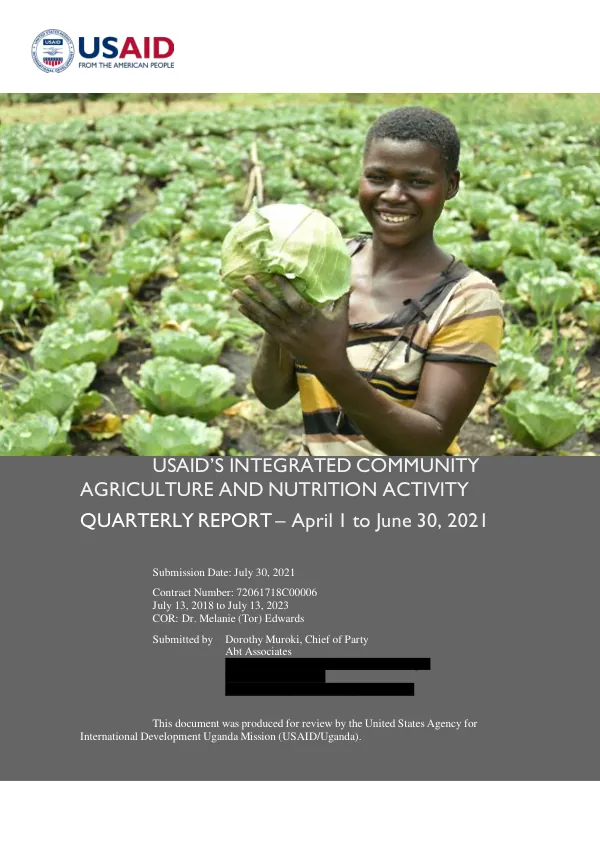
USAID’s Integrated Community Agriculture and Nutrition Activity Quarterly Performance Report
Sign inABT ASSOCIATES
USAID’s Integrated Community Agriculture and Nutrition Activity Quarterly Performance Report
The Integrated Community Agriculture and Nutrition Activity (ICAN) is a flagship USAID resilience program working to build the next generation of resilient Ugandans.
2021 · 42 pages
Sign in to readA free account is required to download.
Abstract
The program's goal is to improve economic activities for poor households while improving nutrition for women and children, strengthening community and local governance. ICAN operates in three sub-regions: Karamoja, Acholi, and Kigezi, with a focus on improving agricultural productivity, nutrition, and resilience. ICAN's approach involves leveraging community structures to intensify group mobilization and reach more people, particularly after the national government relaxed COVID-19 restrictions on gatherings. The program has made significant progress in reaching its targets, including reaching more than 165,371 beneficiaries, at least 79 percent of whom are women. This quarter, 4,244 groups improved their governance and formalized operations, taking the program to 87 percent of its annual target. The program has also intensified its work on nutrition-sensitive agriculture activities, with 47,947 individuals involved in such activities during Q2, up from 37,555 last quarter. A key activity is the promotion of kitchen gardens, where families use improved agriculture technology to grow vegetables for sale and home consumption. The program has also worked on the goat-for-milk project in Karamoja, working with lead mothers and other women within communities to reach elders and households to raise goats for milk production. To ensure sustainability, ICAN has continued engaging several community structures in the Journey to Self-Reliance and worked with more communities to develop and update resilience plans. The program has collaborated with cultural leaders to preserve hills in Kigezi, plant more trees in Acholi, and encourage live fencing in Karamoja. Community leaders have facilitated dialogues with the Uganda Wildlife Authority to encourage ways to peacefully coexist with wildlife. ICAN has also partnered with Makerere University to enable skills-building and placement of 30 new graduates for ICAN internships in monitoring, evaluation, and learning, as well as program activity implementation across all intervention areas. Fifteen of these will graduate from the internship program next quarter, when ICAN will also commence leadership trainings for out-of-school youth. In response to challenges, ICAN has made appropriate adaptations, such as moving from SMS to voice messages to send social behavior change messages to those who cannot read and write. The program has also intensified its back-to-school campaign to address the needs of pregnant girls and ensure they return to school. Regular learning events have been held to review implementation and tease out learnings from experiences. ICAN's progress toward targets is significant, with more than 165,371 beneficiaries reached, at least 79 percent of whom are women. The program has also made progress in improving agricultural productivity, nutrition, and resilience, with 47,947 individuals involved in nutrition-sensitive agriculture activities during Q2. The program's approach to leveraging community structures and engaging in the Journey to Self-Reliance has been effective in reaching its targets and ensuring sustainability. The program's collaboration with cultural leaders, community leaders, and Makerere University has been instrumental in promoting resilience and improving agricultural productivity. ICAN's ability to adapt to challenges and make appropriate changes has been critical in ensuring the program's success. As the program moves forward, it is expected to continue making significant progress in improving economic activities for poor households, improving nutrition for women and children, and strengthening community and local governance.