USAID
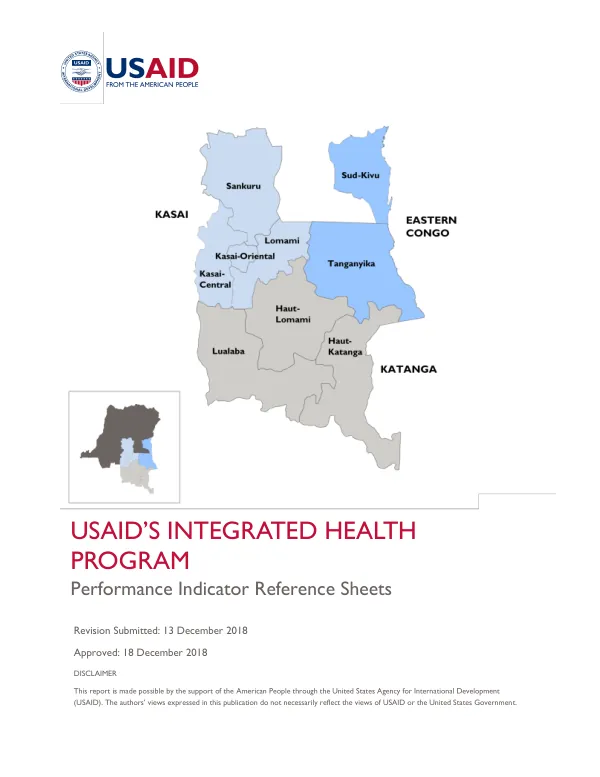
USAID’s Integrated Health Program Performance Indicator Reference Sheets
The Integrated Health Program (IHP) in the Democratic Republic of the Congo (DRC) aims to strengthen the country's health system and improve access to quality health services.
2018 · 140 pages
Sign in to readA free account is required to download.
Abstract
The program is implemented by the United States Agency for International Development (USAID) and focuses on three main results: strengthened health systems, increased access to quality health services, and increased adoption of healthy behaviors. Strengthened health systems are a key component of the IHP. The program aims to enhance the capacity of provincial, health zone, and facility levels to plan, implement, and monitor services. This includes improving transparency and oversight in health service financing and administration, strengthening the capacity of Community Service Organizations (CSOs) and community structures to provide health system oversight, and improving the effectiveness of stakeholder coordination at the provincial and health zone levels. The IHP also focuses on increasing access to quality health services. This includes increasing the availability of quality, integrated facility-based health services, improving referral systems from community-based platforms to health centers and reference hospitals, and strengthening collaboration between central and decentralized levels through sharing of best practices and contributions to policy dialogue. In addition to strengthening health systems and increasing access to quality health services, the IHP aims to increase adoption of healthy behaviors. This includes increasing the practice of priority healthy behaviors at the individual, household, and community levels, increasing the use of facility- and community-based health services, and reducing socio-cultural barriers to the use of health services and the practice of key healthy behaviors. The IHP uses a range of indicators to measure its progress, including the percentage of health facilities with functional emergency obstetric and newborn care services, the percentage of pregnant women receiving antenatal care, and the percentage of children under five years old receiving vaccinations. The program also uses a range of tools and approaches, including the District Health Information System 2 (DHIS2), the Demographic and Health Survey (DHS), and the Integrated Governance Activity (IGA). The IHP is implemented in partnership with a range of stakeholders, including the Government of the DRC, civil society organizations, and the private sector. The program is funded by USAID and other donors, and is expected to continue until 2025. The IHP has made significant progress in strengthening health systems and increasing access to quality health services in the DRC. The program has helped to improve the capacity of health facilities to provide emergency obstetric and newborn care services, increase the availability of antenatal care and vaccinations, and reduce the number of maternal and child deaths. However, the IHP still faces significant challenges, including limited resources, inadequate infrastructure, and a shortage of skilled health workers. The program will need to continue to work with stakeholders to address these challenges and ensure that the health system in the DRC is strengthened and able to provide quality health services to all citizens. The IHP has also made significant progress in increasing adoption of healthy behaviors in the DRC. The program has helped to increase the practice of priority healthy behaviors, such as exclusive breastfeeding and use of insecticide-treated bed nets, and has reduced socio-cultural barriers to the use of health services and the practice of key healthy behaviors. Overall, the IHP is a critical component of the DRC's health system, and has made significant progress in strengthening health systems, increasing access to quality health services, and increasing adoption of healthy behaviors. The program will continue to be an important partner in the DRC's efforts to improve the health and well-being of its citizens. The IHP has also established a range of partnerships with stakeholders, including the Government of the DRC, civil society organizations, and the private sector. The program is funded by USAID and other donors, and is expected to continue until 2025.