USAID DEC
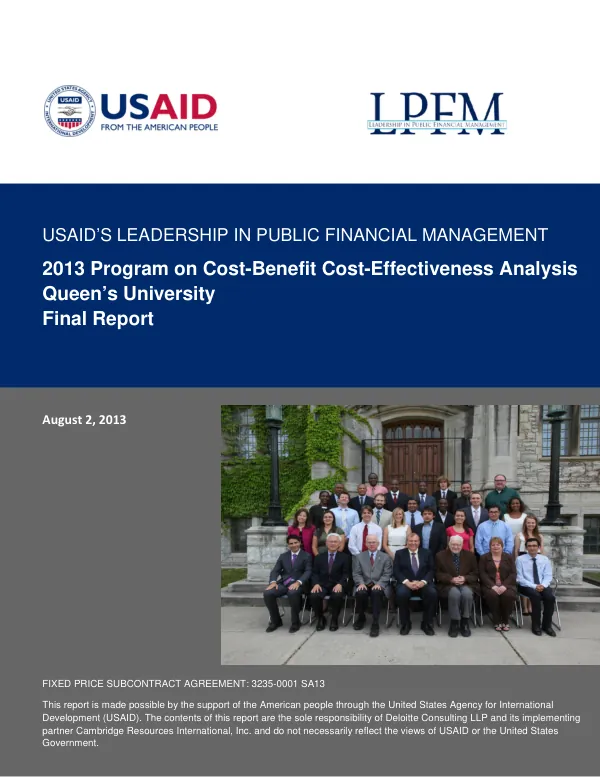
USAID’s Leadership in Public Financial Management 2013 Program on Cost-Benefit Cost-Effectiveness Analysis Final Report
Sign inCAMBRIDGE RESOURCES INTERNATIONAL
USAID’s Leadership in Public Financial Management 2013 Program on Cost-Benefit Cost-Effectiveness Analysis Final Report
The 2013 Program on Cost-Benefit and Cost-Effectiveness Analysis was designed and implemented by Cambridge Resources International, Inc.
2013 · 86 pages
Sign in to readA free account is required to download.
Abstract
(CRI) through Deloitte Consulting as the prime contractor. The program was awarded by the United States Agency for International Development (USAID) and was conducted from July 1 to 26 at the Campus of Queen's University in Kingston, Ontario, Canada. The program covered various aspects involved in financial, economic, stakeholder, and risk analysis of development projects. The theoretical and practical parts of the program were selected based on the USAID areas of focus and the current challenges in project evaluation. A total of 15 participants attended the program, including officers from the USAID Headquarters office in Washington DC, foreign service officers and nationals from the USAID field offices, and government officials from the Ministry of Finance of Nicaragua and the Geothermal Company of Kenya. The program's academic content included a range of subjects in finance, economics, risk analysis, computer techniques, and management that apply to development projects. Participants were evaluated based on their performance on quizzes, solutions to four preparatory case studies, and the completion of a feasibility study. Each participant applied the knowledge and skills acquired to prepare an integrated appraisal of a major investment/development project. The program's topics included objectives of investment appraisal, organizing the different stages of investment appraisal, financial analysis, risk analysis, economic analysis, sector-specific techniques, cost-effectiveness, and stakeholder impact assessment. Participants also achieved a high degree of proficiency in the use of microcomputers, specifically in the use of computers in project modeling and the software "Crystal Ball" in assessing the riskiness of investment projects. The program's schedule consisted of 75 lecturing hours, plus 100 hours of laboratory and case analysis. The program's content, course requirements, level of instruction, and classroom contact hours were comparable to two semester-length graduate courses in many North American universities. The participants found the program valuable, as it is relevant to their work. The program evaluation results were well above the benchmarks, and the course was uniformly found to be very useful. All participants suggested that their colleagues must also be given the opportunity to participate in this program. A number of useful suggestions were included in the evaluations, which are listed in the recommendations for future programs. The program's venue, Queen's University campus, was found to be an ideal place to focus on such an intensive training program. The campus provides a range of high-quality facilities, and the city of Kingston is one of the main tourist attractions around Lake Ontario and the Thousand Islands. A total of 6 participants from Haiti attended the program, who joined late due to visa obtainment delay. Special catch-up sessions were organized for these participants, and a set of lecture notes was translated to French and distributed to them. A bi-language tutor (English and French) was available throughout the course to assist in overcoming any language-related issues. The participants were evaluated based on performance on both written tests and case study submissions. There were two quizzes, one in the second week and the other in the fourth. The table below summarizes the components of the total grade and their weights: Component Preparatory Cases (Average) Major Case Quizzes (Average) Weight 25% 35% 40% The question sheets from the two quizzes are included in the binder sent along with this report.
Related documents