GOVERNMENT OF INDONESIA
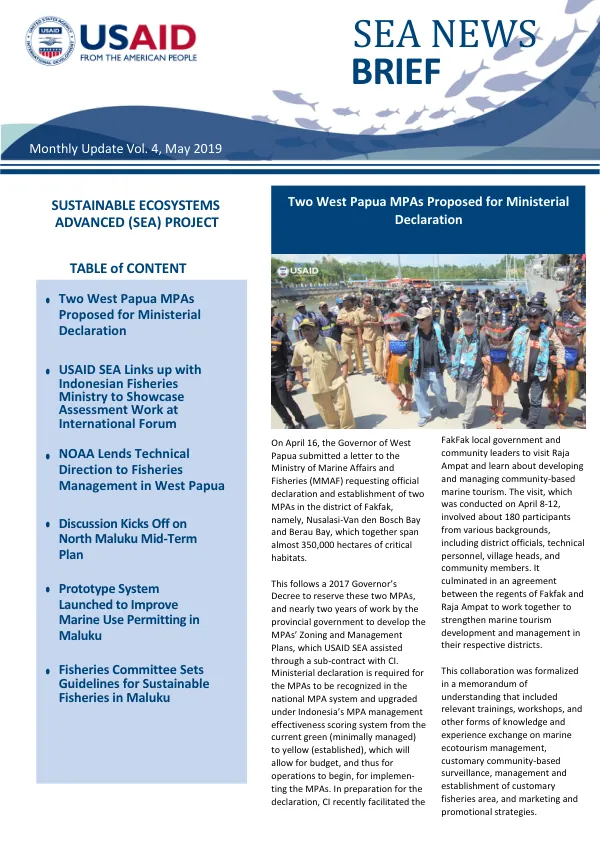
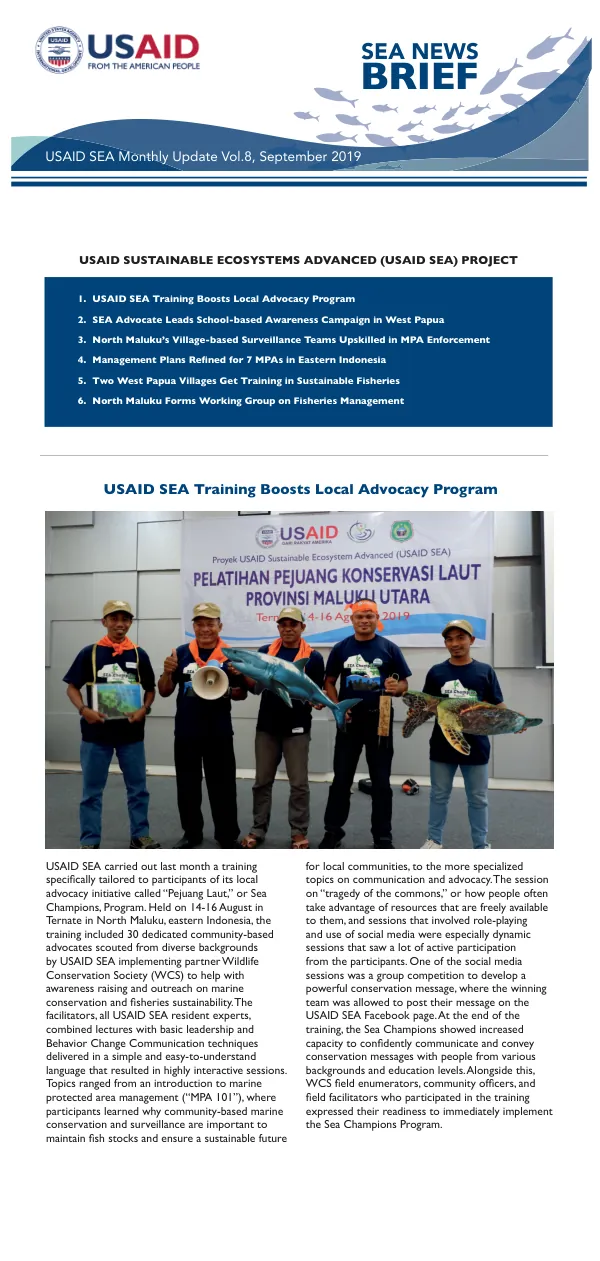
USAID SEA NEWS BRIEF JULY 2019
The Indonesian Government has been working to improve the management of marine protected areas (MPAs) in the country.
2019 · 3 pages
Sign in to readA free account is required to download.
Abstract
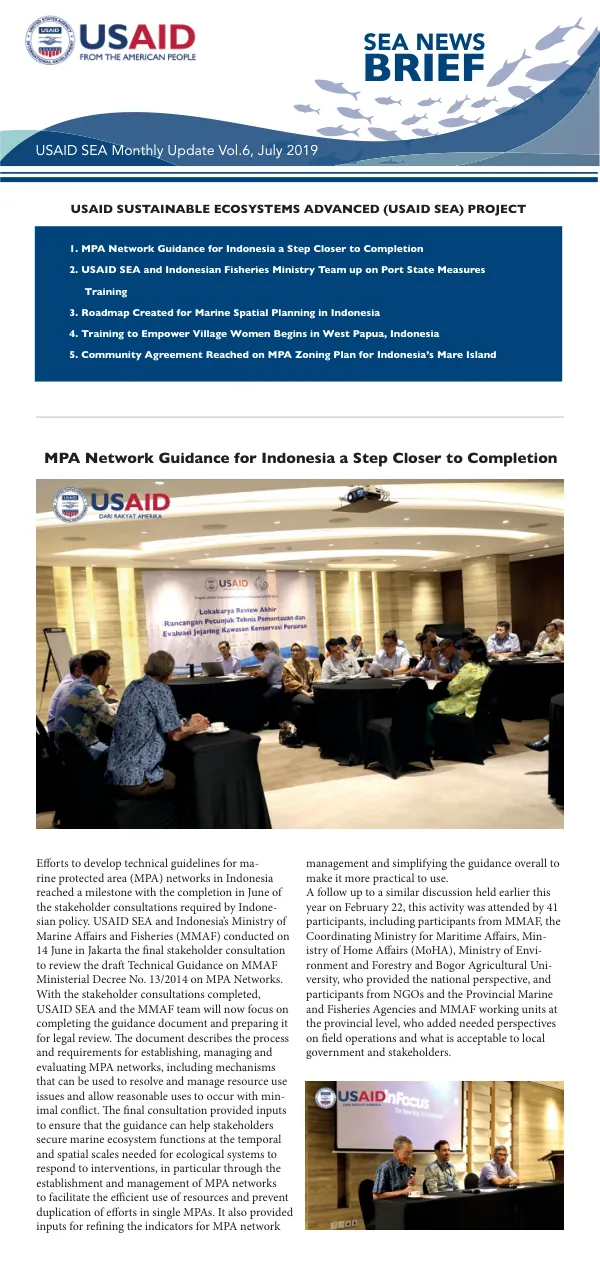
A key step in this effort is the development of technical guidance for MPA networks, which will provide a framework for establishing, managing, and evaluating these areas. USAID SEA and the Ministry of Marine Affairs and Fisheries (MMAF) conducted a stakeholder consultation on June 14 in Jakarta to review the draft Technical Guidance on MMAF Ministerial Decree No. 13/2014 on MPA networks. The consultation was attended by 41 participants, including representatives from MMAF, the Coordinating Ministry for Maritime Affairs, Ministry of Home Affairs, Ministry of Environment and Forestry, and Bogor Agricultural University. The participants provided inputs to ensure that the guidance can help stakeholders secure marine ecosystem functions at the temporal and spatial scales needed for ecological systems to respond to interventions. The guidance will provide mechanisms for resolving and managing resource use issues and allowing reasonable uses to occur with minimal conflict. It will also refine indicators for MPA network management and simplify the guidance to make it more practical to use. The completion of the stakeholder consultations marks a significant milestone in the development of the technical guidance, and USAID SEA and the MMAF team will now focus on completing the guidance and preparing it for review. In addition to the development of the technical guidance, USAID SEA and the MMAF have also been working on training port state measures (PSM) inspectors in Indonesia. A two-day review workshop was held on June 19-20 to evaluate and upgrade the PSM Inspectors Training Manual. The workshop was designed to cover knowledge and skills stipulated in a draft MMAF decree on the implementation of the PSM Agreement and working documents from the Office of Law Enforcement of the U.S. National Oceanic and Atmospheric Administration (NOAA). USAID SEA is working with NOAA to support MMAF in implementing the PSM, an international instrument to prevent, deter, and eliminate illegal, unreported, and unregulated (IUU) fishing. The workshop was attended by 60 participants, including participants from MMAF, the Coordinating Ministry for Maritime Affairs, Ministry of Home Affairs, Ministry of Environment and Forestry, and the U.S. National Oceanic and Atmospheric Administration (NOAA). The workshop helped to upgrade the PSM Inspectors Training Manual, which will be institutionalized in the MMAF Training Center as the main tool for improving the capacity of fisheries surveillance officers to conduct vessel boarding inspections. USAID SEA and the Indonesian Fisheries Ministry have also been working on marine spatial planning (MSP) in Indonesia. A symposium was held on June 24-28 to share knowledge and discuss the challenges of MSP in Indonesia, particularly in the eastern Indonesian provinces of Maluku, North Maluku, and West Papua. The symposium was attended by 60 participants, including participants from MMAF, the Coordinating Ministry for Maritime Affairs, Ministry of Home Affairs, Ministry of Environment and Forestry, and the U.S. National Oceanic and Atmospheric Administration (NOAA). The symposium resulted in a roadmap for the provinces to move forward with their MSP initiatives, while anticipating potential obstacles to conserving and managing their marine and fish resources. The roadmap emphasizes the need for good coordination and integration among different agencies and levels of government to implement MSP at different scales of management. This will require more detailed plans at local scales to complement the broad spatial scale plans for entire provinces. USAID SEA and the Indonesian Fisheries Ministry will continue to support the provinces in implementing MSP and improving the management of their marine and fish resources. In West Papua, USAID SEA has been working to empower village women through training in food processing. A training program was conducted on June 20-22 for women from three villages in Teminabuan, South Sorong, West Papua. The training was part of USAID SEA's strategy to incentivize marine stewardship and provide women with skills and knowledge in food processing as a means of economic empowerment. The training was attended by 31 participants from USAID SEA-supported marine protected areas in the villages of Saylor, Inanwatan, and Konda. The training covered the processing of shrimp into various value-added products, such as shrimp crackers, shrimp crackers, shrimp broth powder, and shrimp burger meat. The training also provided basic knowledge in basic product hygiene and sanitation, in anticipation of the women turning their newly acquired skills into a source of income. Various organizations supported the activity, including the South Sorong district government, District Women Empowerment Organization, South Sorong Fisheries Office, UNIPA, and the South Sorong Marine Protected Areas initiation team. The women's group plans to establish a small enterprise, which will be formally registered by end-July as a home industry producer. A follow-up training is scheduled for September 2019 to include more products to add to the group's product line. In North Maluku, communities in and around Mare Island have agreed to support a plan to expand the coral reef area in the Mare Island Marine Protected
Related documents
Documents in this collection
 2018
2018USAID DEC
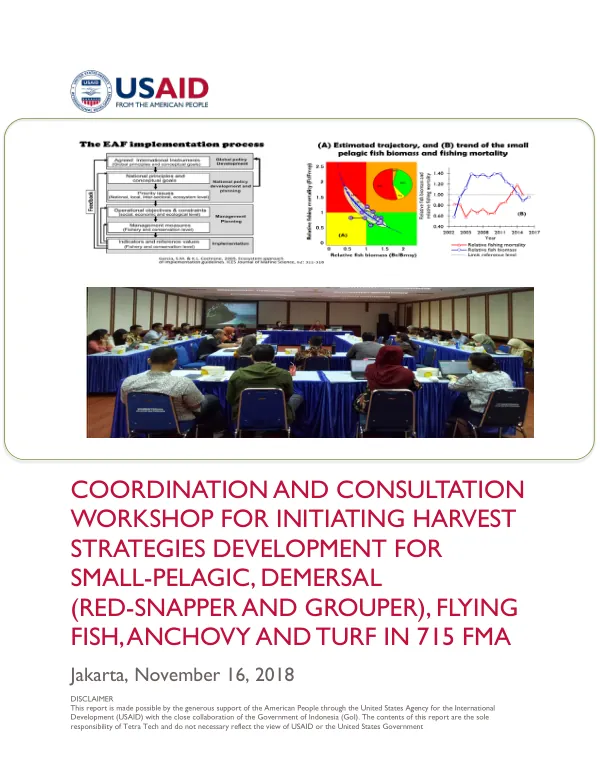
Coordination and Consultation Workshop for Initiating Harvest Strategies Development for Small-Pelagic, Demersal, Flying Fish, Anchovy, and Turf in 715 FMA
Open record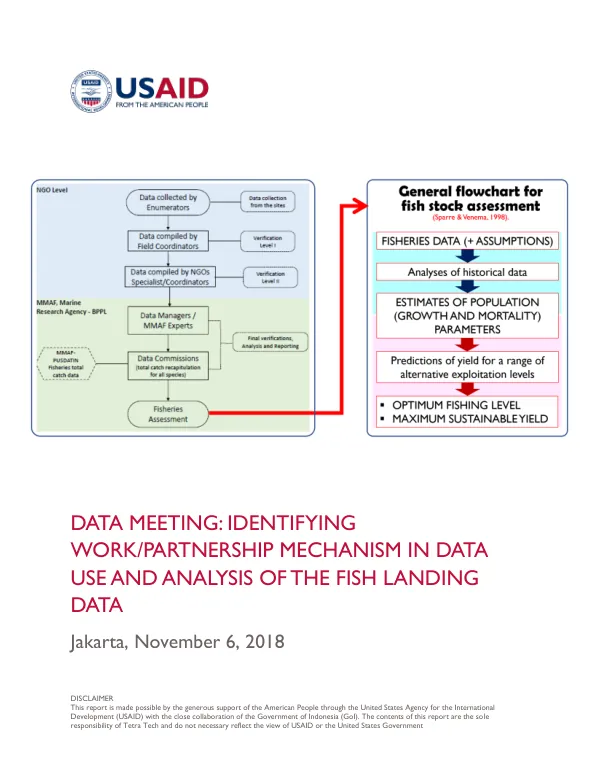 2018
2018USAID DEC
Data Meeting: Identifying Work/Partnership Mechanism in Data Use and Analysis of Fish Landing Data
Open record