DEVTECH SYSTEMS, INC.
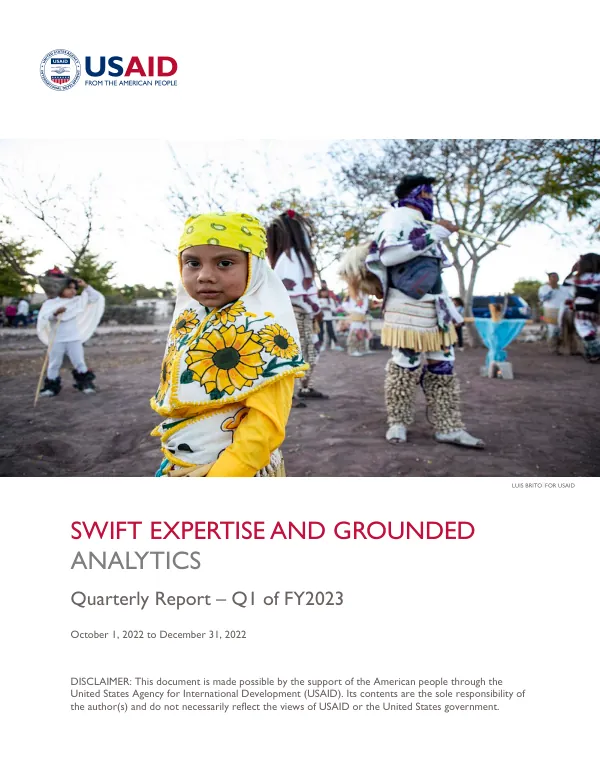
USAID SEGA Year 2, Quarter 1, Quarterly Progress Report
The Democratic Openings Methodology was developed and applied to identify countries experiencing or likely to experience democratic openings.
2023 · 10 pages
Sign in to readA free account is required to download.
Abstract
A core team of four members, including subject matter experts in democratic openings, was established to develop, design, and implement the methodology. The proposed methodology employs a two-step, mixed methods approach, drawing on quantitative and qualitative approaches. The first step involves an in-depth analysis of rigorously accrued and available quantitative data on democratic openings. The University of Gothenburg's Variety of Democracy (V-Dem) Indices were identified as the best fit for the quantitative approach to recognizing potential democratic openings. Several of V-Dem's indicators represent the most rigorous, detailed, and data-driven efforts to quantify democratic dynamics globally. The application of V-Dem's indices constitutes Step One, the Quantitative Component, of the proposed methodology. Quantitative data and indices based on these datasets are not, by themselves, as reliable a source of information as they would be if augmented by deep personal experience with the countries and the interpretations that experience and insight brings to the analysis. A parsimonious six qualitative elements are likely to have the most effect on a democratic opening and its path: per capita income, government performance and effectiveness, the salience of ethnic religious and other identity divisions, dependency on primary commodities and exports and presence of a rentier state, geopolitical and regional influences, and historical legacies. In addition, four less-critical but still important factors to consider are the caliber of leadership, the size and autonomy of the middle class, the level of party-system internalization, and governance functions performed by non-government entities. Together, the two steps in the proposed methodology provide a coherent, data-based process for recognizing actual and potential democratic openings, ordering them by probability, and then applying a qualitative filter to decide the best candidates for assistance. The SEGA team conducted pilot testing of the methodology in the first quarter of FY2023, conducting both qualitative and quantitative analysis. Through the implementation of the methodology, the team identified six countries as "somewhat likely" to experience a democratic opening. The findings of the pilot testing and methodology implementation were presented to USAID/DRG in November 2022, and DevTech received formal approval of all deliverables under the work order, successfully bringing activities to a close. The Digital Democracy Analysis was conducted to inform the DRG Center's emerging digital democracy strategy. The study aimed to document and analyze trends and patterns in the digital democracy and digital repression landscape in up to 40 USAID countries. The analysis included an examination of countries' legal and regulatory environments, institutional resiliencies to digital repression, the capacity of the technology sector to embed human rights and democratic values, and existing multi-stakeholder networks and partnerships. The study's findings will inform future program design and provide a comprehensive understanding of the digital democracy and digital repression landscape in USAID countries. The analysis will help identify opportunities for USAID to support the development of digital democracy and mitigate the risks of digital repression. The study's results will be used to inform the development of a digital democracy strategy that aligns with USAID's Digital Strategy and promotes the use of technology to support democratic values and human rights. The Localization Support project aimed to produce learning products providing guidance, best practices, and recommendations for future DEG Center localization efforts. The project also aimed to capture stores, experiences, and perceptions of USAID's Local Partners to reflect the wider discourse around localization. The project's deliverables will be used to inform the development of a localization strategy that supports the growth of local capacity and promotes the use of local resources to achieve development outcomes. The Lebanon Media Assessment was designed in two phases, with Phase 2 dependent on further discussion with USAID/Lebanon following completion of Phase 1. The assessment aimed to produce a scoping assessment of the main priorities, gaps, and opportunities within the media sector in Lebanon and provide specific types of intervention and support to media as a main stakeholder towards democracy. The assessment's findings will be used to inform the development of a media strategy that supports the growth of a free and independent media sector in Lebanon.
Related documents