USAID DEC
USAID/Sindh Community Mobilization Program, Year VI Work Plan Narrative
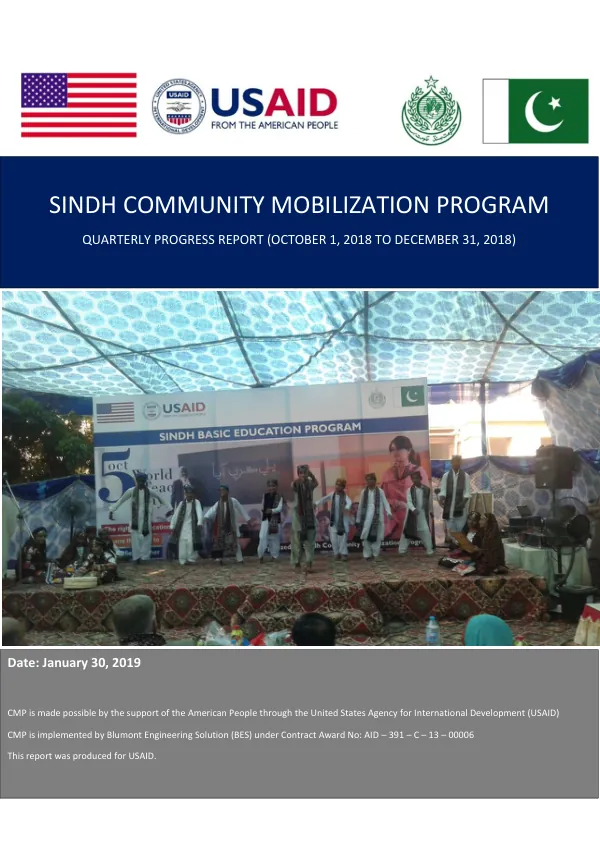
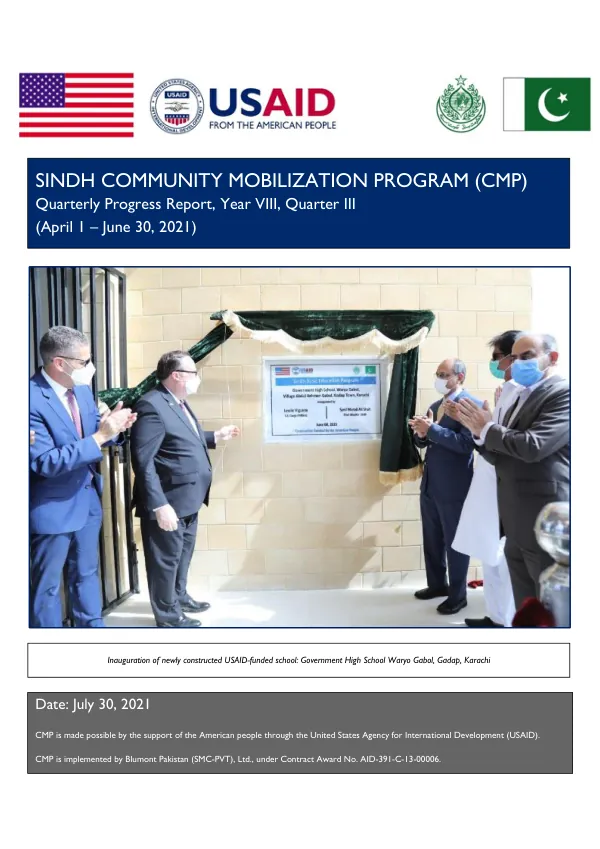
The Sindh Community Mobilization Program (CMP) is a five-year program funded by the United States Agency for International Development (USAID) as part of the Sindh Basic Education Program (SBEP).
2018 · 60 pages
Sign in to readA free account is required to download.
Abstract
The program is implemented by Blumont Engineering Solutions and its partners, Health and Nutrition Development Society (HANDS) and Indus Resource Centre (IRC). The program's geographic focus covers seven districts in northern Sindh, including Dadu, Jacobabad, Khairpur, Kashmore, Larkana, Qamber Shahdadkot, and Sukkur, as well as five towns of Karachi City. The program is a cornerstone of SBEP, an activity signed by USAID and the Government of Sindh (GOS) to support the GOS's broader Sindh Education Reform Program agenda. The program aims to increase and sustain student enrollment in primary, middle, and higher secondary schools. The program's four key components are: 1. Increase communities' involvement in the GOS reform of consolidating, merging, and upgrading schools. 2. Improve community and district government coordination for increased girls' enrollment. 3. Improve child nutrition in selected communities and government schools through research that informs innovation and good practice. 4. Pilot component: Launch the Education Management Organization (EMOs). The program's annual work plan for FY VI outlines the descriptions, implementation mechanisms, and results for all major activities and sub-activities under various program components. The program will focus on aligning successful and best practices with the School Education and Literacy Department (SELD) frameworks to sustain these beyond the project's life. Under component one, the program will conduct a feasibility study for the implementation of consolidation, merging, and upgrading reform. The program will provide assistance to district education offices for the preparation of feasibility for the consolidation and/or upgradation of target schools. The feasibility study will cover the distance of schools, number of children, socio-cultural norms of communities, and the willingness of both communities and overall communities to consolidate or merge schools. The program will also provide orientations to concerned stakeholders, including school management committees (SMCs) and school and district education administration officials, on consolidation, merging, and upgrading schools' policies. The program will facilitate coordination at the provincial level with the Reform Support Unit (RSU), Karachi. The program will continue to implement its strategy and activities based on the community mobilization baseline study, community-based models, and the implementation of the nutrition program developed on the basis of the health and nutrition practices survey's findings. The program will also emphasize strengthening and empowering SMCs through technical support, facilitating the development and implementation of Social Mobilization Plans (SMPs) and School Improvement Plans (SIPs), and promoting and facilitating community-led events, such as listeriosis prevention campaigns and annual school days. The program will also focus on improving child nutrition in selected communities and government schools through research that informs innovation and good practices. The program will provide assistance to the district education offices for the preparation of feasibility for the consolidation and/or upgradation of target schools. The program's geographic focus covers seven districts in northern Sindh, including Dadu, Jacobabad, Khairpur, Kashmore, Larkana, Qamber Shahdadkot, and Sukkur, as well as five towns of Karachi City. The program's implementation will be implemented in these areas, with a focus on increasing and sustaining student enrollment in primary, middle, and higher secondary schools. The program's implementation will be implemented through various activities, including: * Conducting a feasibility study for the implementation of consolidation, merging, and upgrading reform. * Providing assistance to district education offices for the preparation of feasibility for the consolidation and/or upgradation of target schools. * Providing orientations to concerned stakeholders, including school management committees (SMCs) and school and district education administration officials, on consolidation, merging, and upgrading schools' policies. * Facilitating coordination at the provincial level with the Reform Support Unit (RSU), Karachi. * Implementing the program's strategy and activities based on the community mobilization baseline study, community-based models, and the implementation of the nutrition program developed on the basis of the health and nutrition practices survey's findings. * Strengthening and empowering SMCs through technical support, facilitating the development and implementation of Social Mobilization Plans (SMPs) and School Improvement Plans (SIPs), and promoting and facilitating community-led events, such as listeriosis prevention campaigns and annual school days.
Related documents