USAID DEC
USAID Sorghum and Millet Innovation Lab (SMIL) Project: Combining High Digestible Protein Trait with Waxy/Heterowaxy Endosperm Traits to Develop Superior Functionality in Sorghum for Food Applications to Promote Sorghum Value Chain in Ethiopia
Sign inUNIVERSITY OF PRETORIA
USAID Sorghum and Millet Innovation Lab (SMIL) Project: Combining High Digestible Protein Trait with Waxy/Heterowaxy Endosperm Traits to Develop Superior Functionality in Sorghum for Food Applications to Promote Sorghum Value Chain in Ethiopia
The USAID Sorghum and Millet Innovation Lab (SMIL) Project aims to develop superior functionality in sorghum for food applications to promote the sorghum value chain in Ethiopia.
2019 · 46 pages
Sign in to readA free account is required to download.
Abstract
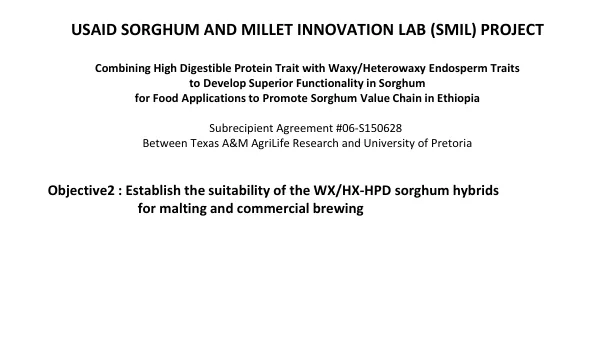
The project combines high digestible protein trait with waxy/heterowaxy endosperm traits to create sorghum hybrids suitable for malting and commercial brewing. The project is a subrecipient agreement between Texas A&M AgriLife Research and the University of Pretoria. Sorghum is a tropical cereal grain that is rich in starch, protein, and fat, making it an ideal crop for brewing. In Africa, sorghum and African millets have been used for brewing for centuries, with a sophisticated brewing tradition that dates back to ancient times. The grain sizes and weights of African tropical cereals, including sorghum, pearl millet, finger millet, fonio, and tef, vary significantly compared to barley and maize. The composition of African tropical cereal grains, including sorghum, pearl millet, finger millet, fonio, and tef, differs from barley and maize in terms of starch, protein, fat, and crude fibre content. Sorghum has a high starch content, with 70.8% of its dry weight consisting of starch. The grain also contains a significant amount of protein, with 11.0% of its dry weight consisting of protein. In contrast, barley and maize have lower starch and protein content. The parts of the sorghum kernel and their chemical composition are also of interest in brewing. The germ of the sorghum kernel produces roots and shoots when sprouted during malting, while the endosperm is the main component of cereal adjunct in brewing. The aleurone layer is not as important in sorghum as it is in barley. The glumes, which are the outer coverings of the sorghum kernel, are loose and should be removed during threshing. Glumes are the outer coverings of the sorghum kernel, which are equivalent to the husk around the barley kernel. However, unlike barley, the glumes of sorghum are loose and should be removed during threshing. The phylogenetic relationship between the cereal species, including sorghum, pearl millet, finger millet, fonio, and tef, has been studied in detail. The evolutionary distance between these species is measured in units of substitution per nucleotide site, with values ranging from 0.2 to 0.99. The USAID SMIL Project aims to establish the suitability of the WX/HX-HPD sorghum hybrids for malting and commercial brewing. The project will also explore the potential of sorghum and other African tropical cereals as raw materials for brewing in Africa and for gluten-free brewing. The project has the potential to promote the sorghum value chain in Ethiopia and to contribute to the development of a more diverse and sustainable brewing industry in Africa.