JOHNS HOPKINS UNIVERSITY
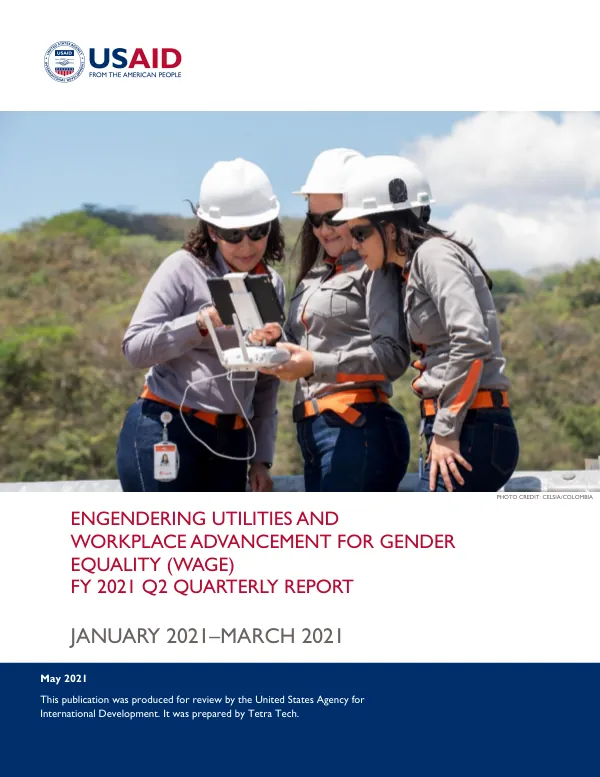
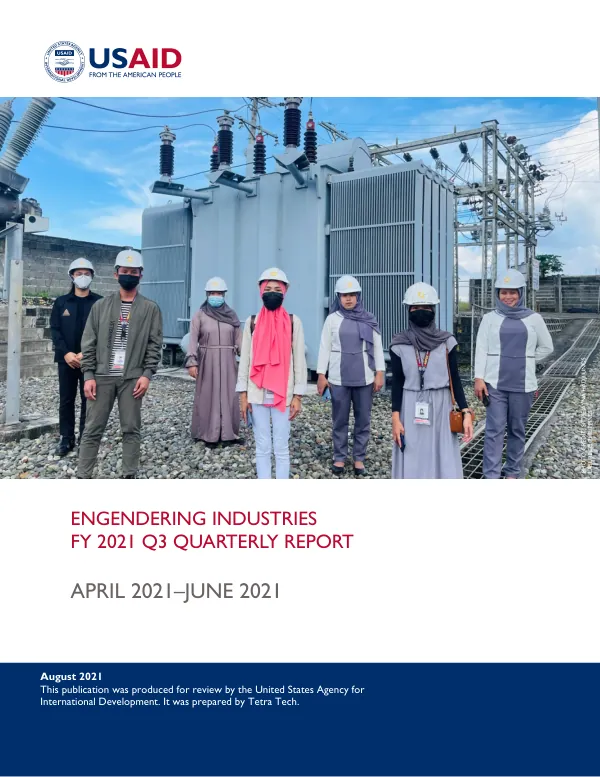
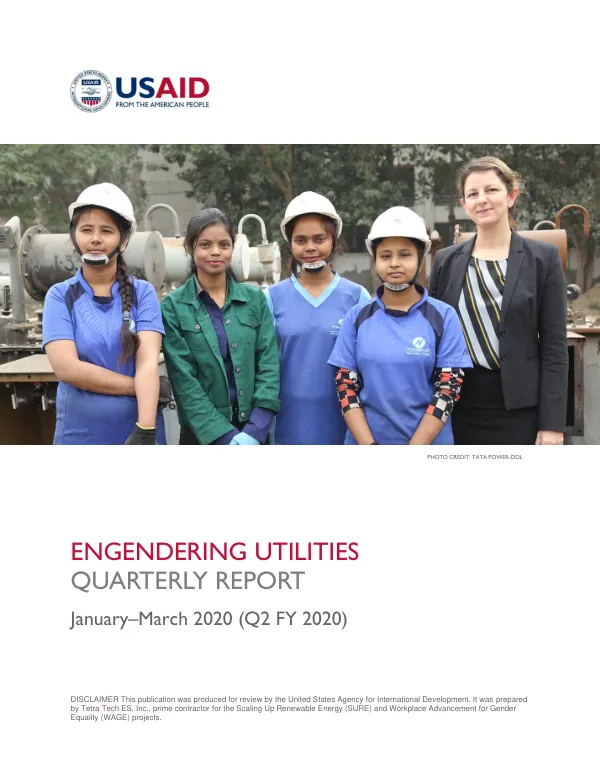
Engendering Industries FY20 Q2 Report
The Engendering Utilities program aims to improve gender equality in the energy and water sectors, contributing to the overall strength and resilience of these sectors, as well as the empowerment of women within them.
2020 · 91 pages
Sign in to readA free account is required to download.
Abstract
This program is part of both the Scaling Up Renewable Energy (SURE) project and the Workplace Advancement for Gender Equality (WAGE) projects. Engendering Utilities partners with 29 selected utilities to improve gender equality and business performance outcomes in utilities through the implementation of gender equity and organizational change management interventions throughout the employee life cycle. The program builds the capacity of utility leaders to implement gender equality interventions in their organizations through customized best practices, demand-driven coaching, and the Gender Equity Executive Leadership Program (GEELP). GEELP implementation for Cohorts 2 and 3 was successful, with successful completion of Modules 4 and 5 and initiation of Module 6 for Cohort 2. However, the final in-person Cohort 2 module and graduation ceremony, as well as the Cohort 3 GEELP kickoff with Module 1, were postponed due to the COVID-19 outbreak and travel restrictions. Throughout this quarter, Cohorts 1 and 2 continued working with their assigned Change Management Consultants (CMC) to use baseline assessment results in creating approaches to enhance gender equality within their organizations. Coaching support this quarter included 3-day in-person coaching trips to two Cohort 2 utilities and two Cohort 1 utilities. However, previously scheduled coaching trips were canceled due to COVID-19 travel bans, and regularly scheduled coaching for Cohorts 2 and 3 could not be continued in their usual frequency due to utilities' response mechanisms to the pandemic. The twelve new Cohort 3 utility partners selection was completed, out of which four are electric utilities and eight are water utilities. All twelve utility partners signed and submitted Letters of Commitment virtually. Three onboarding trips took place this quarter with KENGEN, Imo State Water Corporation, and Sonabel. In lieu of in-person onboarding trips, coaches are working with their assigned Cohort 3 utilities to initiate a virtual onboarding process. The Leadership and Empowerment Initiative with John Hopkins University involved designing the virtual hub, introductory conversations with two utilities who will pilot the adapted Empowered Entrepreneur training, and branding and naming of the virtual hub. The Monitoring, Evaluation, and Learning (MEL) program was updated, and the two remaining Cohort 1 drafts baseline assessment drafts were finalized. Cohorts 1 and 3 initiated data collection and baseline assessment drafting. The Best Practices Framework tools and resources are identified and tracked on an ongoing basis for future enhancements. The program analyst and CMCs are working to identify resources for the enhancement of version 3 of the Best Practices Framework. Partnerships with learning institutions for the Accelerated Executive Course piloting are progressing, with Pilot 1 in Kenya, Pilot 2 in Vietnam, and Pilot 3 in Nigeria scheduled for 2021 due to COVID-19. Work continues for Accelerated Executive Course curricula development and plans to hold a virtual human-centered design workshop. The Engendering Utilities program is a global program, funded by USAID's Office of Energy and Infrastructure and Office of Gender Equality and Women's Empowerment, and is managed by USAID/Washington. The program partners with 29 current partner utilities across three cohorts of utilities, representing 21 countries from various regions.