POWER AFRICA
USAID SOUTHERN AFRICA ENERGY PROGRAM ESWATINI COUNTRY PROFILE
The Kingdom of Eswatini is a landlocked country that relies heavily on South Africa to supply nearly 80 percent of its power needs.
2024 · 2 pages
Sign in to readA free account is required to download.
Abstract
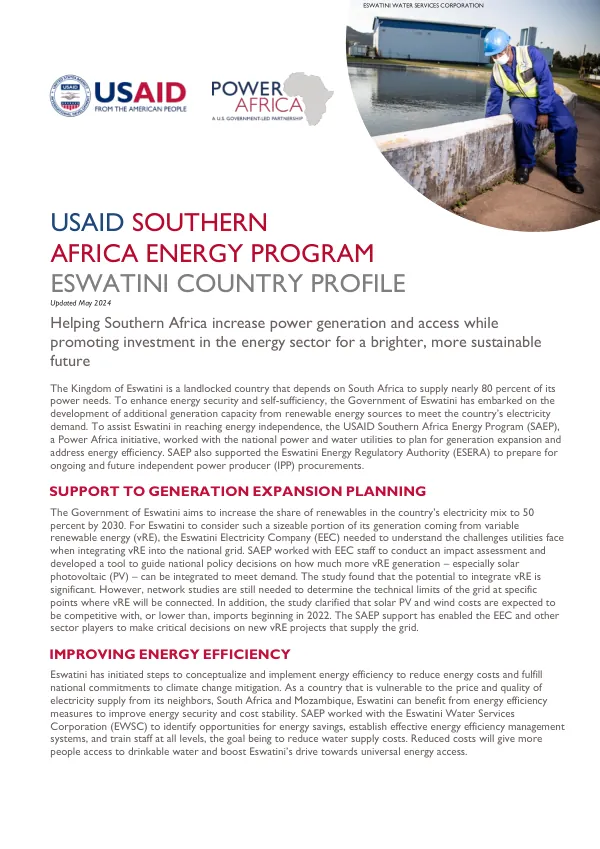
To enhance energy security and self-sufficiency, the Government of Eswatini has embarked on the development of additional generation capacity from renewable energy sources to meet the country's electricity demand. The USAID Southern Africa Energy Program (SAEP), a Power Africa initiative, worked with the national power and water utilities to plan for generation expansion and address energy efficiency. The Government of Eswatini aims to increase the share of renewables in the country's electricity mix to 50 percent by 2030. To achieve this goal, SAEP worked with the Eswatini Electricity Company (EEC) to conduct an impact assessment and develop a tool to guide national policy decisions on how much more variable renewable energy (vRE) generation, especially solar photovoltaic (PV), can be integrated to meet demand. The study found that the potential to integrate vRE is significant, but network studies are still needed to determine the technical limits of the grid at specific points where vRE will be connected. Eswatini has initiated steps to conceptualize and implement energy efficiency to reduce energy costs and fulfill national commitments to climate change mitigation. SAEP worked with the Eswatini Water Services Corporation (EWSC) to identify opportunities for energy savings, establish effective energy efficiency management systems, and train staff at all levels. The goal is to reduce water supply costs, giving more people access to drinkable water and boosting Eswatini's drive towards universal energy access. In 2020, the enhanced energy efficiency management focus and equipment investments saved EWSC over 5,100 megawatt-hours, a 20-percent reduction compared to the previous year. At a national level, SAEP helped the Ministry of Natural Resources and Energy (MNRE) to develop an energy efficiency strategy and action plan (NEESAP) and kick off its implementation, including the implementation of labeling standards, consideration of fiscal incentives, and the redesign of tariffs to minimize electricity consumption by households and the agriculture sector. Fair and balanced regulation is necessary to create an environment where utilities are able to provide reliable services to all those willing to pay at a reasonable price. SAEP assisted the Eswatini Energy Regulatory Authority (ESERA) to evaluate the EEC's tariff change applications on two occasions. SAEP advised the regulator on best practice processes for tariff reviews. Separately, SAEP delivered recommendations for ESERA to assess future rate cases, including substantive process and procedural improvements. SAEP support for ESERA's 2021 tariff review will result in lower electricity tariffs, saving consumers around $44 million over the next two years. SAEP assisted the MNRE to develop procurement regulations critical in guiding competitive procurement of electricity generation. The regulations provide ESERA with mechanisms and processes to properly conduct electricity infrastructure procurement in Eswatini in line with the 2007 Electricity Act. In June 2019, ESERA issued a public tender for the competitive procurement of 40 megawatts (MW) of solar PV capacity. The second tranche for ~40 MW of biomass was released in August 2020. This procurement is aligned with the MNRE's Energy Master Plan and Short-Term Generation Expansion Plan. SAEP supported the MNRE to plan for generation expansion. The EWS's Mahamba Water Treatment Plant is a key facility that requires reliable and efficient energy supply. In October 2022, SAEP arranged a meeting between Eswatini government officials and the South Africa Renewable Energy IPP Office to gather insights that can influence further changes to Eswatini's policies.