DELOITTE CONSULTING, LLP
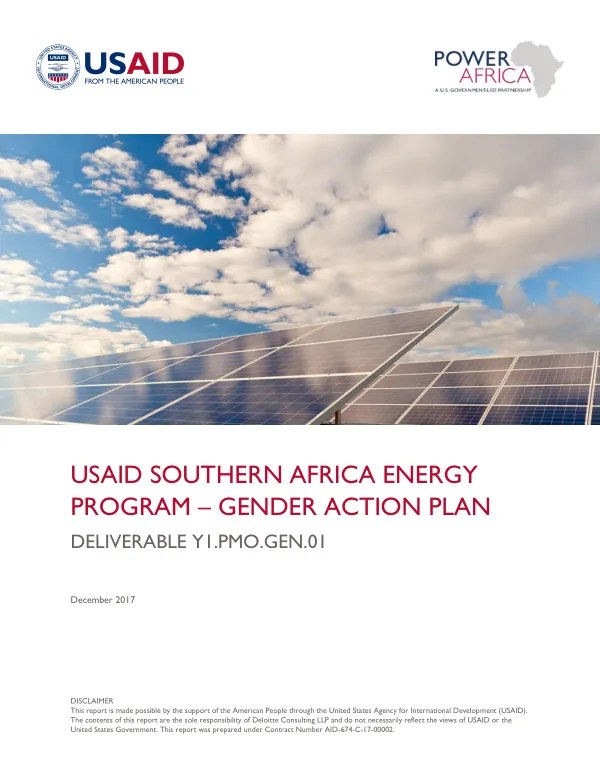
USAID Southern Africa Energy Program – Gender Action Plan
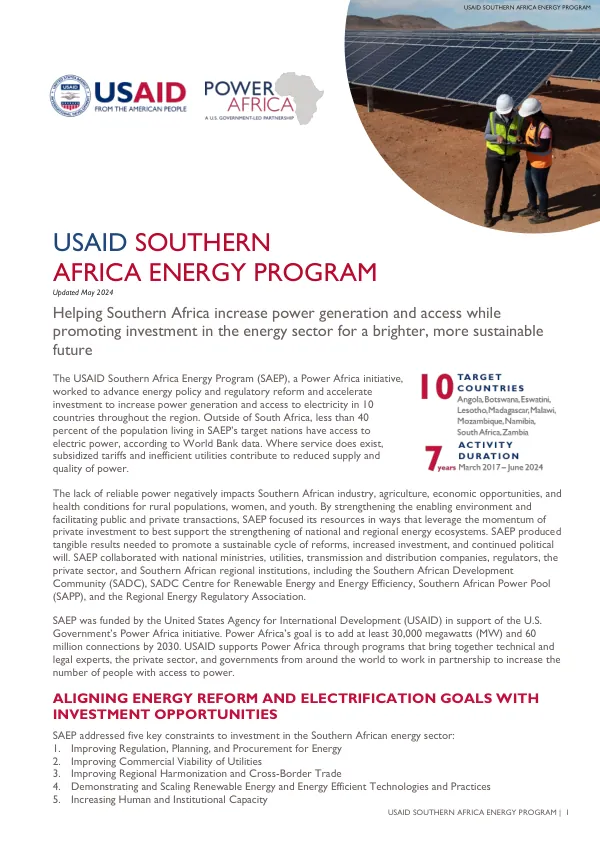
The Southern Africa Energy Program (SAEP) is a forward-looking program implemented by Deloitte Consulting LLP, aiming to overcome the challenges of energy access and power sector development in Southern Africa.
2018 · 69 pages
Sign in to readA free account is required to download.
Abstract
SAEP will employ an agile approach to design, deploy, monitor, and sustain interventions that are responsive to the needs of the region over the next five years. The program recognizes that sustainable advancement of the regional energy ecosystem requires promoting energy-enabling environment reforms, stimulating private sector participation, and promoting new investment in the power sector. As part of the Power Africa initiative, SAEP will contribute to the Power Africa goals, which include increasing access to modern energy services, enhancing social and economic opportunities, and increasing female participation in the energy sector. SAEP's specific gender equality goal is to integrate social and gender considerations into all aspects of planning, programming, and execution to increase access by women to modern energy services, increase female employment opportunities at utilities and government agencies, and increase the number of women trained in energy reform and associated fields. The SAEP program will focus on five outcomes: improved regulation, planning, and procurement; improved commercial viability of utilities; improved regional harmonization and cross-border trade; locally demonstrated renewable energy and energy efficiency technologies; and increased human and institutional capacity. The program will work in six countries: Malawi, Namibia, Madagascar, Swaziland, Lesotho, and Botswana, with additional focus on South Africa, Angola, Mozambique, and Zimbabwe. SAEP will work to increase the number of women in the energy sector, with a focus on increasing female employment opportunities at utilities and government agencies. The program will also work to increase the number of women trained in energy reform and associated fields, with a goal of increasing the number of women in leadership positions in the energy sector. SAEP will also work to promote energy-enabling environment reforms, stimulate private sector participation, and promote new investment in the power sector. The SAEP program will be implemented over the next five years, with a focus on increasing access to modern energy services, enhancing social and economic opportunities, and increasing female participation in the energy sector. The program will work to achieve the following goals: increasing access to 3,000 MWs of new generation, 1,000 MWs of new transmission capacity, and 3,000 new connections. The SAEP program will be implemented in six countries: Malawi, Namibia, Madagascar, Swaziland, Lesotho, and Botswana, with additional focus on South Africa, Angola, Mozambique, and Zimbabwe. The program will work to increase access to modern energy services, enhance social and economic opportunities, and increase female participation in the energy sector. SAEP will work to achieve the following goals: increasing access to 3,000 MWs of new generation, 1,000 MWs of new transmission capacity, and 3,000 new connections.