RTI INTERNATIONAL
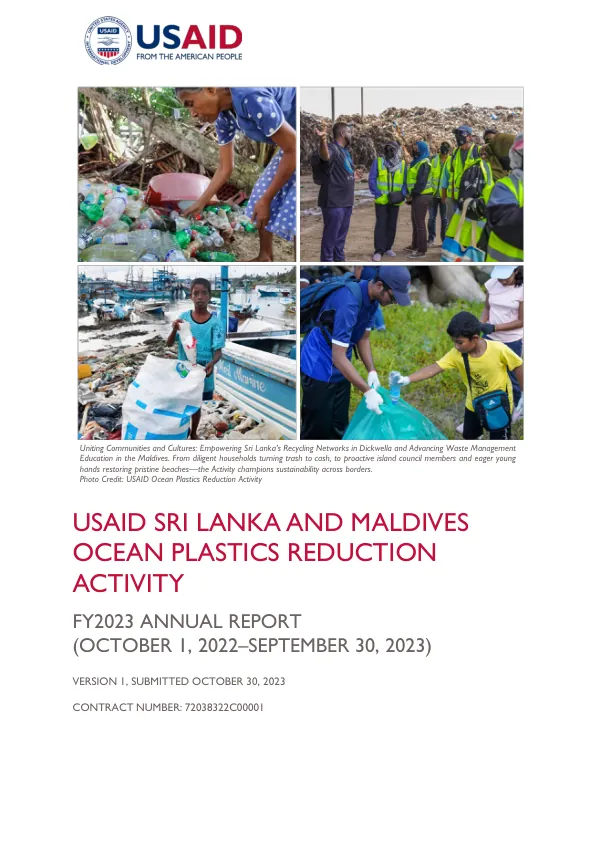
USAID Sri Lanka and Maldives Ocean Plastics Reduction Activity FY2023 Annual Report
The Ocean Plastics Reduction Activity in Sri Lanka and the Maldives made significant strides in its first year of implementation.
2023 · 81 pages
Sign in to readA free account is required to download.
Abstract
Establishing trust with key stakeholders at various government levels was a notable achievement. Political economy analyses (PEAs) were completed in both countries, providing a deeper understanding of specific requirements and optimal entry points for technical assistance. In response to unforeseen challenges in Sri Lanka, including financial and political upheavals, the Activity adapted its approach to prioritize key areas for quick wins and impact. Budgetary constraints and limited funding available in Year 1 led to a revision of priorities, with a focus on sustaining activities until March 2024. Stakeholder engagement was a key aspect of the Activity's work. A stakeholder workshop was organized with 36 senior government officials from various ministries and departments, and coordination with national government agencies and other USAID activities was maintained. The Activity also officially launched in Maldives with the participation of relevant stakeholders on March 8, 2023. Waste management initiatives were a major focus of the Activity. A waste fair and International Day of Zero Waste were coordinated in Sri Lanka, and a baseline study for single-use plastic (SUP) importation was initiated for both Sri Lanka and the Maldives. A technology scouting process was also introduced to identify innovative solutions for waste management. The Activity expanded on the work initiated by the USAID Clean Cities, Blue Ocean program (CCBO) on bottled water usage, seeking ways to increase adoption of water filtration systems as an environmentally friendly and more economical alternative. A survey on the informal waste collection sector in Sri Lanka was completed, and targeted interventions were identified to increase collection rates and enhance economic opportunities along the recycling value chain. Collaboration with key partners, including Ceylon Cold Stores and Viridis (Pvt) Ltd, a major plastic recycler, was a key aspect of the Activity's work. Partnerships with these organizations helped to increase the adoption of environmentally friendly practices and improve waste management in the region. The Activity's work in the first year of implementation laid the foundation for future success. By establishing trust with key stakeholders, adapting to challenges, and prioritizing key areas for impact, the Activity was able to make significant strides in reducing ocean plastics in Sri Lanka and the Maldives. Implementation of the Activity's work was guided by the Activity Monitoring, Evaluation, and Learning Plan (AMELP). The AMELP provided a framework for monitoring and evaluating the Activity's progress, and for identifying areas for improvement. The plan was regularly reviewed and updated to ensure that the Activity was on track to meet its objectives. The Activity's work was also guided by the principles of gender equality and social inclusion (GESI). The Activity recognized the importance of involving women and marginalized communities in its work, and took steps to ensure that their needs and perspectives were taken into account. The Activity's budget for the first year of implementation was limited, and the Activity had to adapt its approach to prioritize key areas for impact. Despite these challenges, the Activity was able to make significant strides in reducing ocean plastics in Sri Lanka and the Maldives. The Activity's work in the first year of implementation was also marked by several notable achievements. These included the completion of the PEA, the establishment of trust with key stakeholders, and the launch of the Activity in Maldives. The Activity's work in the first year of implementation laid the foundation for future success, and provided a strong foundation for the Activity's continued work in reducing ocean plastics in Sri Lanka and the Maldives.