FINTRAC
USAID-STAMP: Smallholder Technology and Access to Markets Program in Zimbabwe
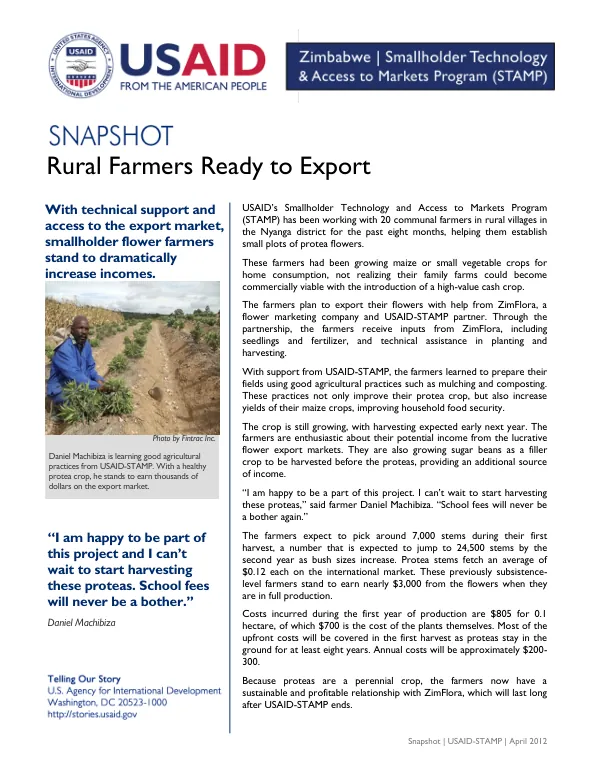
The USAID Smallholder Technology and Access to Markets Program (STAMP) has been working with 20 communal farmers in rural villages in the Nyanga district for the past eight months.
2012 · 1 pages
Sign in to readA free account is required to download.
Abstract
The program's primary objective is to help these farmers establish small plots of protea flowers, a high-value cash crop that can be exported to the international market. Prior to the program, the farmers were growing maize or small vegetable crops for home consumption, unaware of their family farms' potential for commercial viability. The farmers receive inputs from ZimFlora, a flower marketing company and USAID-STAMP partner, including seedlings and fertilizer. They also receive technical assistance in planting and harvesting. Through the partnership, the farmers learned to prepare their fields using good agricultural practices such as mulching and composting. These practices not only improve their protea crop but also increase yields of their maize crops, improving household food security. The crop is still growing, with harvesting expected early next year. The farmers are enthusiastic about their potential income from the lucrative flower export markets. They are also growing sugar beans as a filler crop to be harvested before the proteas, providing an additional source of income. The farmers expect to pick around 7,000 stems during their first harvest, a number that is expected to jump to 24,500 stems by the second year as bush sizes increase. Protea stems fetch an average of $0.12 each on the international market, with the farmers standing to earn nearly $3,000 from the flowers when they are in full production. The costs incurred during the first year of production are $805 for 0.1 hectare, of which $700 is the cost of the plants themselves. Most of the upfront costs will be covered in the first harvest as proteas stay in the ground for at least eight years. Annual costs will be approximately $200-$300. This sustainable and profitable relationship with ZimFlora will last long after USAID-STAMP ends, providing the farmers with a long-term source of income. The program's success is evident in the enthusiasm of the farmers, who are eager to start harvesting their proteas and reap the benefits of their new commercial venture. With the support of USAID-STAMP and ZimFlora, these previously subsistence-level farmers are poised to increase their incomes and improve their household food security.
Related documents