FINTRAC
USAID-STAMP: Supporting Smallholder Farmers in Paprika Production
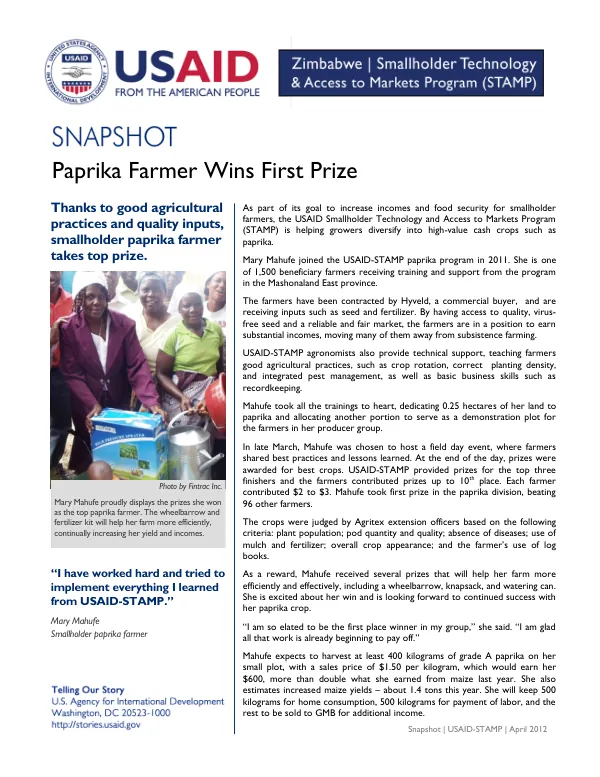
The USAID Smallholder Technology and Access to Markets Program (STAMP) is supporting smallholder farmers in diversifying into high-value crops such as paprika.
2012 · 1 pages
Sign in to readA free account is required to download.
Abstract
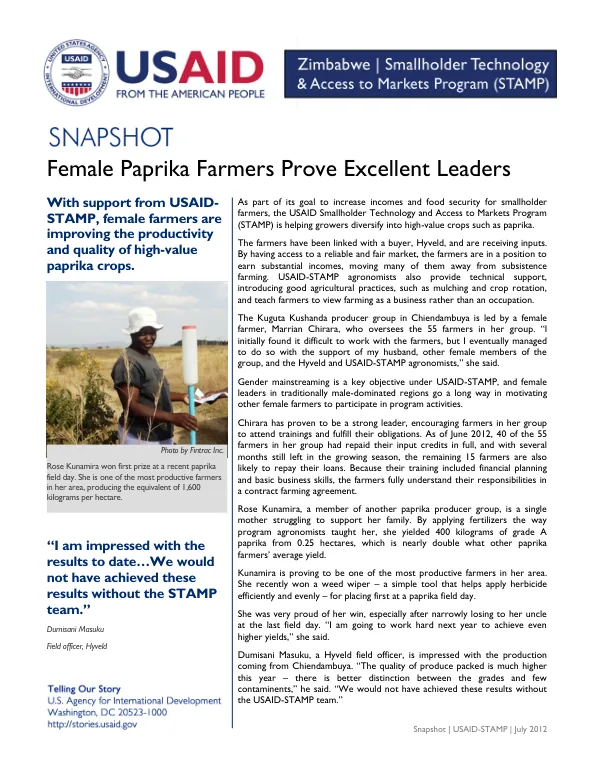
As part of this effort, female farmers are improving the productivity and quality of paprika crops with the assistance of STAMP agronomists. These experts provide technical support, introducing good agricultural practices such as mulching and crop rotation, and teach farmers to view farming as a business rather than an occupation. The program has linked farmers with a buyer, Hyveld, and provided them with inputs. This has enabled the farmers to earn substantial incomes, moving many of them away from subsistence farming. The Kuguta Kushanda producer group in Chiendambuya is led by a female farmer, Marrian Chirara, who oversees the 55 farmers in her group. Chirara has proven to be a strong leader, encouraging farmers in her group to attend trainings and fulfill their obligations. As of June 2012, 40 of the 55 farmers in her group had repaid their input credits in full. Rose Kunamira, a member of another paprika producer group, is a single mother struggling to support her family. With the support of STAMP agronomists, she has yielded 400 kilograms of grade A paprika from 0.25 hectares, nearly double what other paprika farmers' average yield. Kunamira is proving to be one of the most productive farmers in her area and recently won a weed wiper for placing first at a paprika field day. Dumisani Masuku, a Hyveld field officer, is impressed with the production coming from Chiendambuya, citing the higher quality of produce packed and better distinction between grades. The program's goal is to increase incomes and food security for smallholder farmers. By providing technical support and linking farmers with buyers, STAMP is helping growers to diversify into high-value crops and earn substantial incomes. Gender mainstreaming is a key objective under STAMP, and female leaders in traditionally male-dominated regions are motivating other female farmers to participate in program activities. The program's success is evident in the improved productivity and quality of paprika crops, as well as the increased incomes and food security of participating farmers.
Related documents