USAID DEC
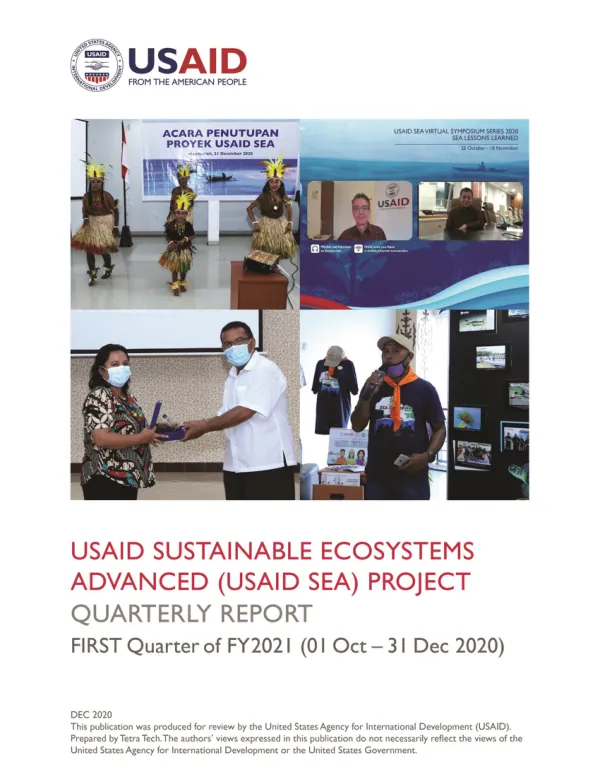
USAID Sustainable Ecosystems Advanced (SEA) Project Quarterly Report: 01 October 2020 – 31 December 2020
Sign inTETRA TECH
USAID Sustainable Ecosystems Advanced (SEA) Project Quarterly Report: 01 October 2020 – 31 December 2020
The USAID Sustainable Ecosystems Advanced (SEA) Project began on March 21, 2016, and concluded on March 22, 2021, with a contract period of five years.
2021 · 101 pages
Sign in to readA free account is required to download.
Abstract
The project was implemented in Indonesia, with a focus on improving fisheries management and promoting sustainable ecosystems. The project was funded by the United States Agency for International Development (USAID) and was managed by Tetra Tech. The project's primary objective was to improve fisheries management in Indonesia, with a focus on the provinces of North Maluku, Maluku, and West Papua. The project implemented a range of technical approaches, including an ecosystem approach to fisheries management, marine protected areas, marine spatial planning, and law enforcement. These approaches aimed to improve the sustainability of fisheries and promote the conservation of marine ecosystems. One of the key technical approaches implemented by the project was the establishment of marine protected areas (MPAs). By the end of the project, a total of 15 MPAs had been established, covering an area of over 1.5 million hectares. The project also implemented marine spatial planning (MSP) in three provinces, with a focus on promoting sustainable fisheries and reducing the impact of fishing on marine ecosystems. In addition to technical approaches, the project also implemented strategic approaches to address enabling conditions. These included creating demand through awareness raising and advocacy, increasing incentives for marine stewardship, advancing the development of marine and fisheries policies and regulations, and institutionalizing training and capacity building. The project also implemented a range of management components and cross-cutting activities, including monitoring, evaluation, and learning. The project made significant progress in achieving its objectives, with a number of key outcomes reported. These included a 27% increase in household income among program participants compared to the control group, and a 60% increase in yield improvements among farmers who adopted sustainable agriculture practices. The project also reported a 27% increase in the number of fishers who obtained their vessel licenses, and a 50% increase in the number of marine protected areas established. The project's impact was also evident in the number of people who benefited from its activities. The project reported that over 2,500 farmers received training in sustainable agriculture practices, and over 1,000 fishers benefited from the project's fisheries management activities. The project also reported that over 500 reports and publications were produced, and that these were widely disseminated to stakeholders. The project's success was also reflected in the number of awards and recognition it received. The project was recognized as one of the top performers in the USAID Indonesia Mission, and it received a number of awards for its innovative approaches to fisheries management and sustainable ecosystems. Overall, the USAID SEA Project made significant contributions to improving fisheries management and promoting sustainable ecosystems in Indonesia. The project's technical approaches, strategic approaches, and management components all contributed to its success, and its impact will be felt for many years to come.
Related documents