USAID DEC
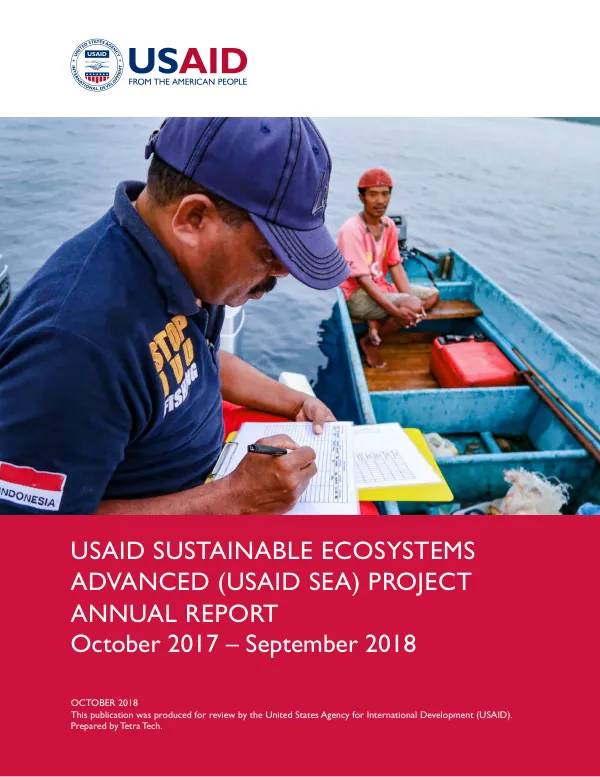
USAID Sustainable Ecosystems Advanced (USAID SEA) Project Annual Report: October 2017 – September 2018
Sign inTETRA TECH
USAID Sustainable Ecosystems Advanced (USAID SEA) Project Annual Report: October 2017 – September 2018
The USAID Sustainable Ecosystems Advanced (USAID SEA) Project is a five-year initiative aimed at improving fisheries management in Indonesia.
2018 · 138 pages
Sign in to readA free account is required to download.
Abstract
The project began on March 21, 2016, and is set to conclude on March 22, 2021. The project is implemented by Tetra Tech and is funded by the United States Agency for International Development (USAID) Indonesia. The project focuses on four technical approaches to improve fisheries management: an ecosystem approach to fisheries management, marine protected areas, marine spatial planning, and law enforcement. These approaches are designed to address the root causes of fisheries degradation and promote sustainable fishing practices. One of the key strategies employed by the project is the creation of demand through awareness raising and advocacy. This involves working with local communities, government agencies, and other stakeholders to raise awareness about the importance of sustainable fisheries management and to promote the adoption of best practices. The project also places a strong emphasis on institutionalizing training and capacity building. This involves providing training and technical assistance to government agencies, fishing communities, and other stakeholders to build their capacity to manage fisheries sustainably. The project's management components and cross-cutting activities are designed to support the implementation of the technical approaches and strategic approaches. These components include monitoring, evaluation, and learning, as well as key challenges, lessons learned, and opportunities moving forward. The project has made significant progress in achieving its objectives, with notable achievements including the establishment of marine protected areas, the implementation of marine spatial planning, and the development of law enforcement capacity. The project has also made significant progress in addressing enabling conditions, including the creation of demand through awareness raising and advocacy, the increase of incentives for marine stewardship, and the advancement of marine and fisheries policies and regulations. The project's monitoring, evaluation, and learning (MEL) plan is designed to track progress towards the project's objectives and to identify areas for improvement. The plan includes a range of indicators and metrics to measure progress, including the number of marine protected areas established, the number of fishing communities trained in sustainable fishing practices, and the level of awareness and adoption of best practices among fishing communities. The project's staff and management structure are designed to support the implementation of the project's objectives. The project has a team of experienced staff, including a chief of party, deputy chief of party, and project manager, as well as a range of technical specialists and support staff. The project's geographic focus is on the provinces of North Maluku, Maluku, and West Papua, where the project is working to improve fisheries management and promote sustainable fishing practices. The project is also working to leverage investment and promote long-term investment and wealth creation opportunities in the fisheries sector. Overall, the USAID SEA Project is making significant progress in improving fisheries management in Indonesia and promoting sustainable fishing practices. The project's technical approaches, strategic approaches, and management components are designed to support the achievement of the project's objectives and to promote long-term sustainability in the fisheries sector.