USAID DEC
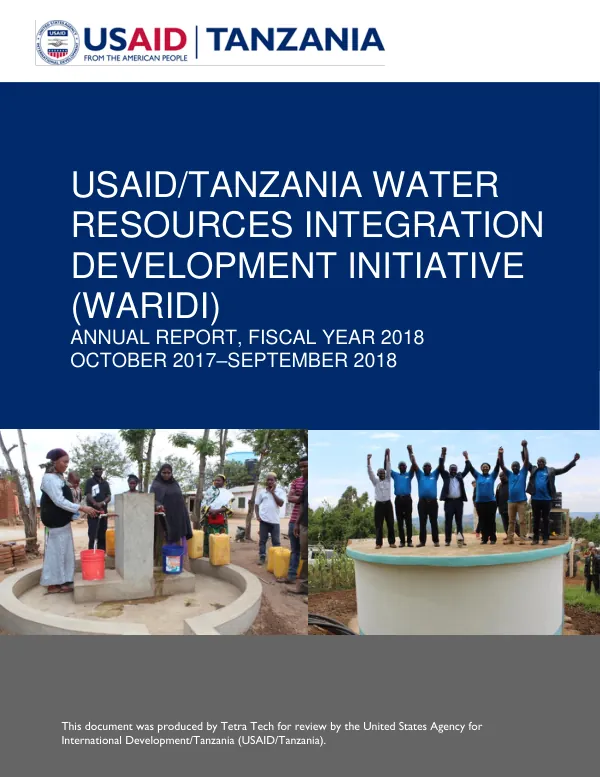
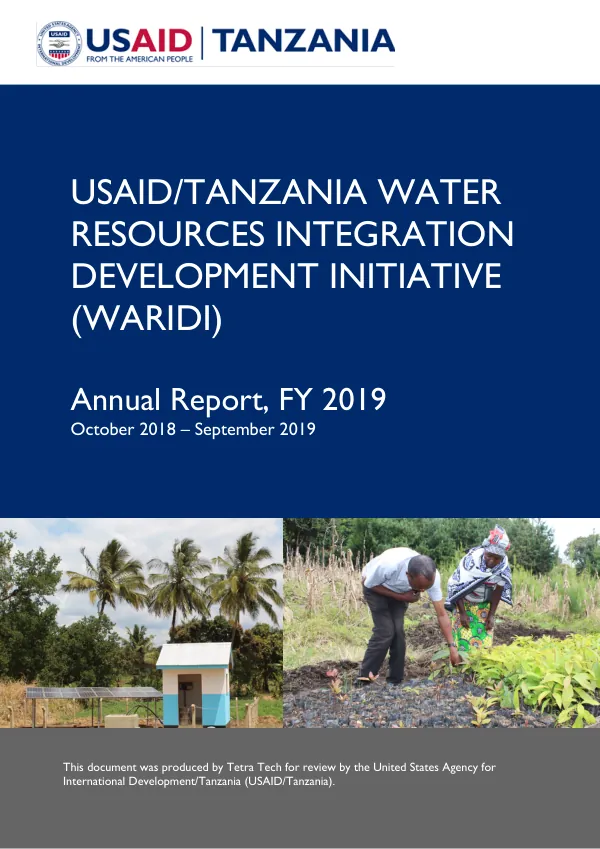
USAID/Tanzania Water Resources Integration Development Initiative (WARIDI) Annual Report, FY 2019
Sign inTETRA TECH
USAID/Tanzania Water Resources Integration Development Initiative (WARIDI) Annual Report, FY 2019
Tanzania's health, economy, and food security depend on sustainably managed water resources.
2019 · 151 pages
Sign in to readA free account is required to download.
Abstract
However, water scarcity challenges are growing along with the impacts of climate change, while reliable access to safe drinking water and sanitation services is still beyond the reach of far too many people. To address these interconnected, water-related challenges, USAID's Tanzania Water Resources Integration Development Initiative (WARIDI) promotes integrated water resources management and delivery of services across multiple sectors. The specific goal of WARIDI is to improve water resources management, increase service access, and enhance climate change adaptation in Tanzania. In selected Local Government Authorities (LGAs) of the Rufiji and Wami-Ruvu river basins, WARIDI works to achieve its objectives through three main components. Component 1 focuses on Water, Sanitation, and Hygiene (WASH) Services, aiming to increase utilization of sustainable multiple-use water and sanitation services. Component 2 targets Governance, seeking to strengthen governance for sustainable and resilient management of water resources and services under a changing climate. Component 3 focuses on Private Sector, aiming to increase livelihoods through private sector investment opportunities for sustainable water services, agriculture, and natural resource management. Implementation of WARIDI's activities began in October 2018 and continued through September 2019. During this period, significant progress was made in achieving the initiative's objectives. In the WASH Services component, more than 2,000 households gained access to sustainable multiple-use water and sanitation services. In the Governance component, management capacity of Basin Water Boards, catchment, sub-catchment committees, and water users associations was strengthened. Additionally, data and information management for decision-making was improved, and integrated water and land management planning approaches were facilitated. In the Private Sector component, strategic partnerships were established, and a WASH microenterprise capacity-building program was implemented. Alternative livelihood opportunities were also increased, enabling communities to diversify their income sources. Cross-cutting and integration activities, including gender integration and youth inclusion, LGA engagement, and communications, were also undertaken to ensure the initiative's objectives were met. Scientific research and innovation played a crucial role in WARIDI's activities, with a focus on climate change studies and analysis to support the implementation of WARIDI interventions. Management and administrative issues, environmental management and compliance, grants management, monitoring, evaluation, and learning, and special events for the next quarter were also addressed throughout the year. Financial support for WARIDI was provided by the American People through the United States Agency for International Development (USAID). The initiative's progress was monitored and evaluated through regular reporting and assessments, ensuring that its objectives were met and its impact was maximized.