USAID DEC
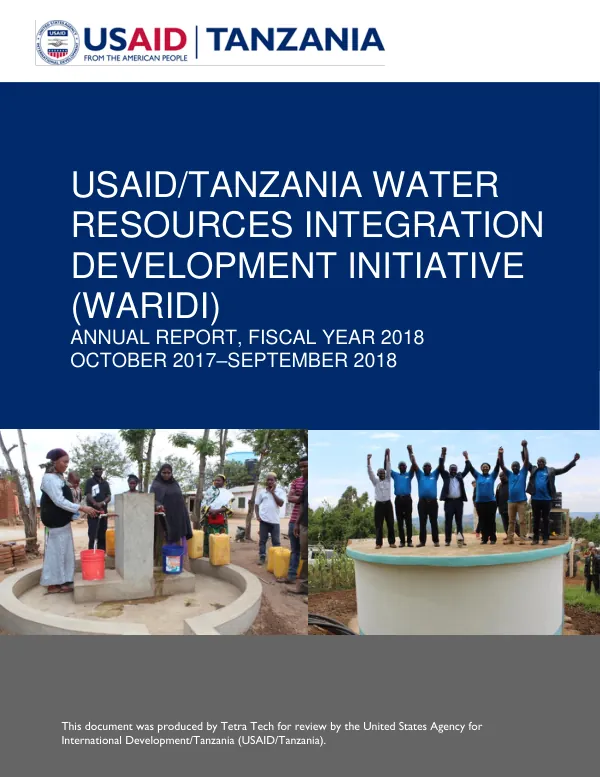
USAID/Tanzania Water Resources Integration Development Initiative (WARIDI): Third Year (FY 18) Annual Work Plan Amendment 1: Provision of Improved Water Supply Services for Remote Villages in Mvomero and Kilosa LGAs
Sign inTETRA TECH
USAID/Tanzania Water Resources Integration Development Initiative (WARIDI): Third Year (FY 18) Annual Work Plan Amendment 1: Provision of Improved Water Supply Services for Remote Villages in Mvomero and Kilosa LGAs
The USAID/Tanzania Water Resources Integration Development Initiative (WARIDI) is a program aimed at improving access to water in remote villages in Tanzania.
2018 · 28 pages
Sign in to readA free account is required to download.
Abstract
The program is implemented by Tetra Tech, a consulting firm, and is funded by the United States Agency for International Development (USAID). The program's third year annual work plan amendment focuses on providing improved water supply services to remote villages in Mvomero and Kilosa districts. In the original plan, WARIDI aimed to construct 70 shallow wells in five villages, including Nyameni, Ilakala, Maharaka, Homboza, and Chohero. However, USAID advised WARIDI to consider the potential impacts of climate change, which could make shallow groundwater less abundant in the future. As a result, the program shifted its focus from shallow wells to deep boreholes, which would be equipped with storage tanks and small distribution pipelines to serve nearby sub-villages. Feasibility studies were conducted in Nyameni, Ilakala, and Maharaka villages to assess the number of boreholes required given the settlement pattern, population density, and geography of the villages. The results of the feasibility studies suggest that 12 boreholes will be sufficient to serve the populations of these three villages. However, some remote houses will still be outside the range of the distribution system and will need to walk more than 800 meters to access the improved water source. As a next step, WARIDI will engage a consultant to complete hydrogeological surveys to site the boreholes and engage a drilling company to drill the boreholes. Once the yield of each borehole is established, a vendor will be contracted to design a water supply system and install a solar-powered pump and storage tank. The two villages that will no longer benefit from WARIDI (Homboza and Chohero) will be informed of the shift in technical direction through a formal letter, and the District Water Engineer of Mvomero will also be officially notified. The recommended boreholes and potential beneficiaries are as follows: * Nyameni (Kilosa): 6 boreholes, benefiting 3,047 people * Ilakala (Kilosa): 3 boreholes, benefiting 1,642 people * Maharaka (Mvomero): 3 boreholes, benefiting 3,144 people * Total: 12 boreholes, benefiting 7,833 people The villages have good relationships with their Local Government Authority (LGA) and the District Water Engineer (DWE). The Mvomero and Kilosa DWE are aware of WARIDI plans in those villages and have representatives to accompany WARIDI teams when visiting the villages. In the process of assessing potential water supply interventions in Year 2 of the project, the five remote villages participated in Open Defecation Free (ODF) training and baseline data collection as part of WARIDI's "Lead with Sanitation" strategy. The villages also contributed financial resources for water services, with Nyameni contributing TZS 881,500, Ilakala contributing TZS 430,000, and Maharaka contributing TZS 2,700,000. The program's focus on providing improved water supply services to remote villages in Mvomero and Kilosa districts is expected to improve the health and well-being of the communities, particularly in areas where access to clean water is limited.