FINTRAC
USAID-TAPP monthly bulletin #64
The Tanzania Agriculture Productivity Program (USAID-TAPP) is a five-year initiative implemented by Fintrac Inc.
2015 · 2 pages
Sign in to readA free account is required to download.
Abstract
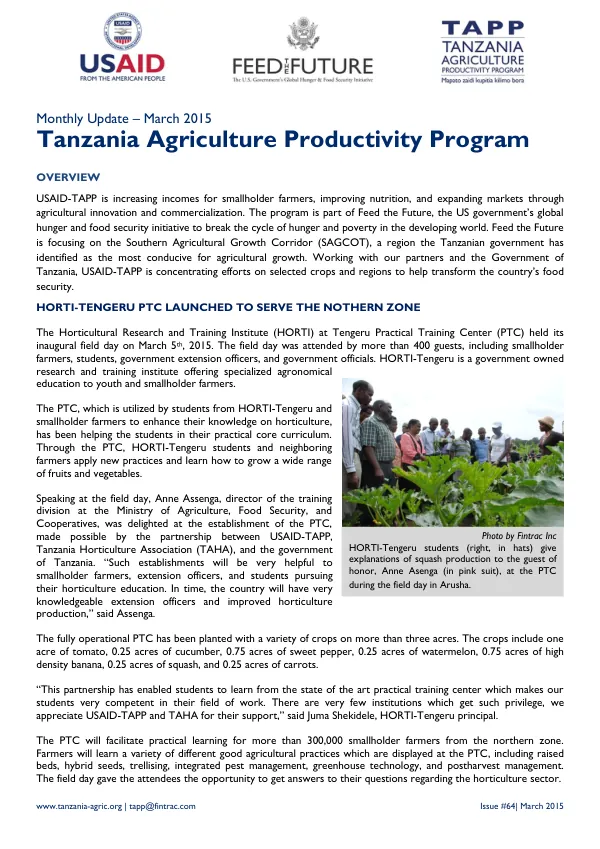
to enhance smallholder farmer incomes through increased productivity, crop diversification, and improved market access. The program is part of the Feed the Future initiative, a global hunger and food security program launched by the US government to break the cycle of hunger and poverty in the developing world. Feed the Future is focusing on the Southern Agricultural Growth Corridor (SAGCOT), a region identified by the Tanzanian government as the most conducive for agricultural growth. USAID-TAPP is working with partners and the Government of Tanzania to concentrate efforts on selected crops and regions to help transform the country's food security. The program has established three Practical Training Centers (PTCs) in Zanzibar, Morogoro, and Arusha to serve students, extension officers, and smallholder farmers. The PTCs provide practical learning opportunities for more than 300,000 smallholder farmers from the northern zone, focusing on good agricultural practices such as raised beds, hybrid seeds, trellising, integrated pest management, greenhouse technology, and postharvest management. The Horticultural Research and Training Institute (HORTI) at Tengeru Practical Training Center (PTC) held its inaugural field day on March 5th, 2015, attended by over 400 guests, including smallholder farmers, students, government extension officers, and government officials. The PTC has been planted with a variety of crops, including tomatoes, cucumbers, sweet peppers, watermelons, high-density bananas, squash, and carrots, covering more than three acres. The PTC will facilitate practical learning for smallholder farmers, enabling them to adopt new practices and improve their horticulture production. USAID-TAPP has also launched orange-fleshed sweet potato (OFSP) tuber and vine kiosks in Arusha to link smallholder farmers with consumers. The launch was part of the ongoing OFSP awareness campaigns, which have introduced OFSP kiosks in local markets in Arusha. The field day conducted at the HORTI-Tengeru PTC resulted in the sale of 10,000 vines to farmers and other organizations. The kiosks have provided a ready market for OFSP farmers, with over 6 tons delivered to vendors since the launch. The demand for OFSP tubers and vines has been significant, driven by the nutritious content and low cost of production.