FINTRAC
USAID-TAPP monthly bulletin #32
The Tanzania Agriculture Productivity Program (USAID-TAPP) is a five-year initiative implemented by Fintrac Inc.
2012 · 2 pages
Sign in to readA free account is required to download.
Abstract
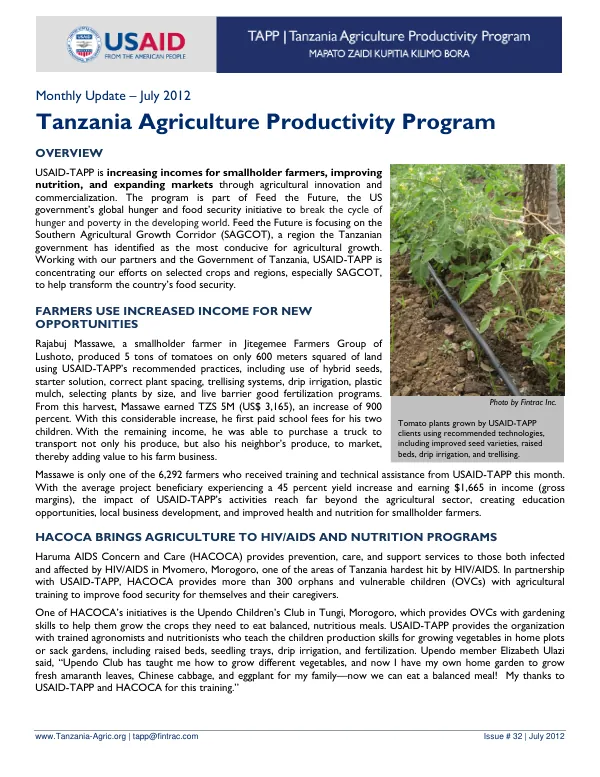
in conjunction with the Tanzania Horticultural Association (TAHA). The program aims to increase smallholder farmer incomes through enhanced productivity, crop diversification, and improved market access. USAID-TAPP is part of the Feed the Future initiative, a global hunger and food security program launched by the US government to break the cycle of hunger and poverty in the developing world. The program is focusing on the Southern Agricultural Growth Corridor (SAGCOT), a region identified by the Tanzanian government as the most conducive for agricultural growth. USAID-TAPP is working with partners and the Government of Tanzania to concentrate efforts on selected crops and regions, particularly SAGCOT, to help transform the country's food security. The program is providing training and technical assistance to smallholder farmers, with over 6,292 farmers receiving training and assistance in the month of July 2012. Rajabuj Massawe, a smallholder farmer in Jitegemee Farmers Group of Lushoto, is one of the beneficiaries of USAID-TAPP's training and technical assistance. Massawe produced 5 tons of tomatoes on 600 meters squared of land using recommended practices, including hybrid seeds, starter solution, correct plant spacing, trellising systems, drip irrigation, plastic mulch, selecting plants by size, and live barrier good fertilization programs. As a result, Massawe earned TZS 5M (US$ 3,165), an increase of 900 percent. With this income, Massawe was able to pay school fees for his two children and purchase a truck to transport his produce to market. In addition to training and technical assistance, USAID-TAPP is also working with partners to provide smallholder farmers with access to local markets. The program hosted a field day for 15 major wholesale traders from the largest markets at Kariakoo, Temeke, and Ilala, where traders saw firsthand the improvement in product quality resulting from the use of recommended technologies. As a result, the traders agreed to partner with USAID-TAPP, nominating smallholder farmer groups with whom to work directly. The project will provide recommended technology inputs, including seed trays, trellising materials, and drip irrigation, to these farmer groups, and the traders will invest an equal amount in the same groups after the first harvest. The program is also working with Haruma AIDS Concern and Care (HACOCA) to provide agricultural training to over 300 orphans and vulnerable children (OVCs) in Mvomero, Morogoro. HACOCA is providing nutrition classes, life skills training, and psychological services to the children, and as a result, they are improving their nutritional status and growing enough produce to sell the surplus and raise the household income. The organization is expanding its successful model to new districts in the Morogoro region. USAID-TAPP is also partnering with Africado Ltd. to build the avocado industry in Tanzania. Africado has provided 1,000 smallholder farmers with 30,000 grafted Hass avocado trees, equivalent to 141 new hectares of avocado and enough to produce 3,000 tons of avocados for export through Africado's outgrower scheme. The program is providing Africado with four agronomists to establish demonstration plots and train farmers to produce Hass avocados to international export standards. As a result of this intervention, farmer incomes are expected to increase by 100 percent, and the avocado industry as a whole benefits from increased seedling production, improved grower standards, and more consistent export supply.
Related documents