FINTRAC
USAID-TAPP Monthly Bulletin #31: June 2012
The Tanzania Agriculture Productivity Program (TAPP) is a five-year initiative implemented by Fintrac Inc.
2012 · 2 pages
Sign in to readA free account is required to download.
Abstract
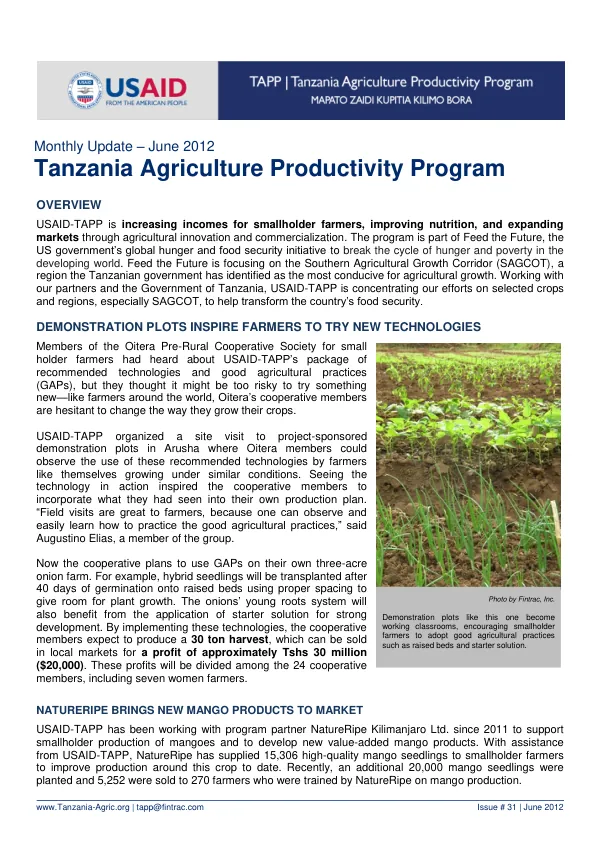
in conjunction with the Tanzania Horticultural Association (TAHA). The program aims to increase smallholder farmer incomes through enhanced productivity, crop diversification, and improved market access. TAPP is part of the Feed the Future initiative, a global hunger and food security program launched by the US government to break the cycle of hunger and poverty in the developing world. The program focuses on the Southern Agricultural Growth Corridor (SAGCOT), a region identified by the Tanzanian government as conducive for agricultural growth. TAPP is working with partners and the Government of Tanzania to concentrate efforts on selected crops and regions, particularly SAGCOT, to help transform the country's food security. The program is designed to increase the supply of raw materials for local and international markets, with a focus on value-added products. Demonstration plots have been established in various regions to showcase good agricultural practices (GAPs) and recommended technologies to smallholder farmers. These plots serve as working classrooms, encouraging farmers to adopt new techniques and improve crop yields. For instance, the Oitera Pre-Rural Cooperative Society for smallholder farmers observed the use of GAPs on demonstration plots in Arusha and subsequently incorporated these practices into their own production plan. The cooperative expects to produce a 30-ton harvest of onions, which can be sold in local markets for a profit of approximately Tshs 30 million ($20,000). USAID-TAPP has also been working with program partner NatureRipe Kilimanjaro Ltd. to support smallholder production of mangoes and develop new value-added mango products. With assistance from USAID-TAPP, NatureRipe has supplied over 35,000 high-quality mango seedlings to smallholder farmers, resulting in improved production around this crop. The company has also developed six new value-added mango products, including mango jam, mixed fruit jam, and mango juice, which are sold in local supermarkets. In addition to mango production, USAID-TAPP is partnering with Buturi Investments Ltd. (BIL) to introduce GAPs and recommend technologies to 2,400 sweet potato growers in the coastal towns of Mkuranga, Gezaulole, Kimbiji, Mwandege, Mkuza, and Mvuti. This partnership aims to expand market opportunities and secure the livelihoods of sweet potato farming communities in this region. USAID-TAPP is also starting a new initiative to develop the pineapple industry in Tanzania by working with project partner TAHA to improve pineapple productivity through the introduction of new planting material and GAPs. The local market for pineapples is growing, with prices tripling over the past three years alone. By introducing GAPs, pineapple yields could increase significantly, with correct plant spacing alone potentially increasing yields six-fold.
Related documents