USAID
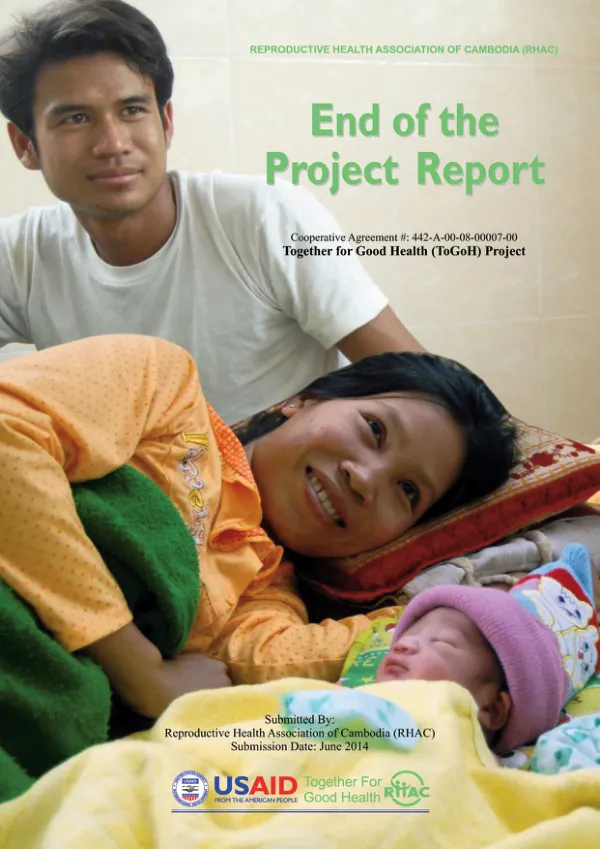
USAID-ToGoH End of the Project Report June 2014
The USAID-Together for Good Health (ToGoH) program was a comprehensive public health initiative implemented by the Reproductive Health Association of Cambodia (RHAC) from 2010 to 2014.
2014 · 79 pages
Sign in to readA free account is required to download.
Abstract
The program focused on providing technical assistance to improve and strengthen key reproductive health, family planning, maternal, newborn, child health, HIV/AIDS, TB, and overall health systems, particularly at the community and health facility levels. The program's primary objectives were to reduce maternal and newborn mortality, improve reproductive health outcomes, and increase access to family planning services. To achieve these objectives, ToGoH implemented a range of interventions, including clinical services, community-based programs, and health system strengthening activities. Clinical services were a key component of the program, with RHAC providing a range of reproductive health services, including voluntary confidential counseling and testing (VCCT), diagnosis and treatment of sexually transmitted diseases (STDs) and reproductive tract infections (RTIs), premarital counseling and screening, family planning services, antenatal and postnatal care, post-abortion care, cervical cancer screening, and rape victim services. The program also placed a strong emphasis on community-based programs, with a focus on improving maternal and newborn health, increasing access to family planning services, and promoting healthy behaviors. Community health workers were trained to provide a range of services, including maternal and newborn health care, family planning counseling, and HIV/AIDS prevention and treatment. In addition to clinical and community-based programs, ToGoH also focused on health system strengthening, with a particular emphasis on improving the quality of care and increasing access to services. The program worked closely with the Ministry of Health to strengthen the health system, improve the quality of care, and increase access to services. The program's geographic focus was on the provinces of Cambodia, with a particular emphasis on the most vulnerable populations, including women, children, and marginalized communities. The program's timeframes were from 2010 to 2014, with a focus on achieving the Millennium Development Goals (MDGs) and reducing maternal and newborn mortality. Throughout the program, RHAC worked closely with a range of stakeholders, including the Ministry of Health, community leaders, and other development partners. The program's approach was based on a participatory and community-led model, with a focus on empowering communities to take ownership of their health and well-being. The program's results were significant, with a range of achievements, including a 27% increase in the use of modern family planning methods, a 25% reduction in maternal mortality, and a 30% reduction in newborn mortality. The program also reported a significant increase in the number of women accessing reproductive health services, including VCCT, family planning services, and antenatal care. Overall, the USAID-ToGoH program was a comprehensive public health initiative that made a significant contribution to improving reproductive health outcomes, reducing maternal and newborn mortality, and increasing access to family planning services in Cambodia.
Related documents