DEVELOPMENT AND TRAINING SERVICES, INC.
USAID TUBERCULOSIS TASK ORDER 2015: Performance Evaluation
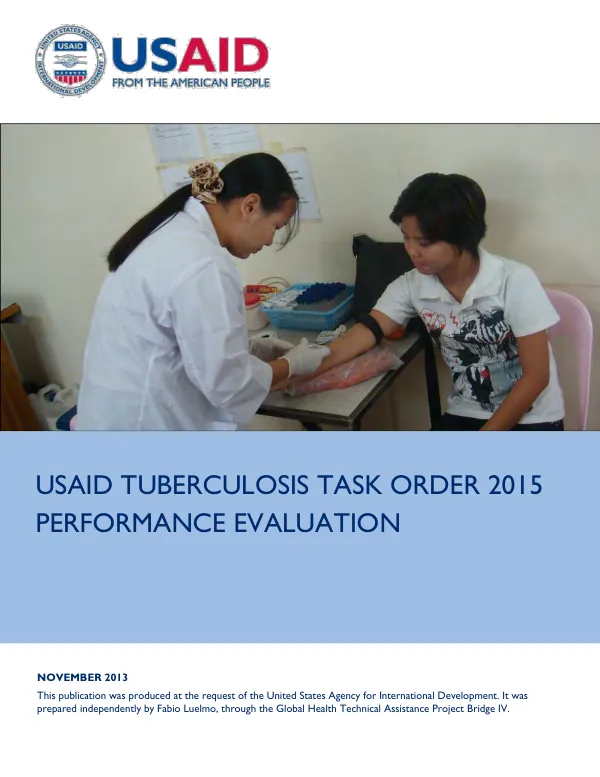
The USAID Tuberculosis Task Order 2015 Performance Evaluation was conducted to assess the activities, operational results, and impact of USAID support to TB control through Task Order 2015 from 2009 to 2013.
2013 · 64 pages
Sign in to readA free account is required to download.
Abstract
The evaluation aimed to identify lessons learned and provide recommendations for future TB control efforts. The evaluation covered five countries: Tanzania, Mexico, Vietnam, India, and the Democratic Republic of Congo. In Tanzania, TB case notification and treatment outcomes improved significantly, with a 27% increase in successful treatment outcomes among new smear-positive TB cases from 2010 to 2011. The evaluation also noted a 60% increase in TB case notification in the USAID-supported areas from the baseline year to 2011. In Mexico, the evaluation found that the number of suspects examined by sputum microscopy and smear-positive TB cases detected in project-supported areas increased from 2010 to 2012. The evaluation also noted that the proportion of reported new pulmonary TB cases confirmed by smear microscopy increased from 2010 to 2011. In Vietnam, the evaluation found that the number of TB cases and sputum smear-positive TB patients detected by PPM after strengthening the TB/HIV program in Vietnam increased from 2009 to 2011. The evaluation also noted that the proportion of reported new pulmonary TB cases confirmed by smear microscopy increased from 2009 to 2010. In India, the evaluation found that the number of suspected TB cases examined by smear microscopy and smear-positive TB cases detected in project-supported areas increased from 2008 to 2012. The evaluation also noted that the proportion of reported new pulmonary TB cases confirmed by smear microscopy increased from 2008 to 2010. The evaluation identified several key findings and lessons learned. One of the main findings was that the implementation of DOTS (Directly Observed Treatment, Short Course) and other TB control strategies led to significant improvements in TB case notification and treatment outcomes. The evaluation also noted that the involvement of community-based organizations and the use of advocacy, communication, and social mobilization (ACSM) activities were critical components of successful TB control programs. The evaluation recommended several actions to improve TB control efforts. One of the main recommendations was to strengthen the capacity of national TB programs to implement DOTS and other TB control strategies. The evaluation also recommended increasing the use of ACSM activities and involving community-based organizations in TB control efforts. The evaluation also highlighted the importance of monitoring and evaluation (M&E) in TB control programs. The evaluation recommended that national TB programs establish robust M&E systems to track progress and identify areas for improvement. The evaluation was conducted by Fabio Luelmo, through the Global Health Technical Assistance Project Bridge IV, and was submitted to the United States Agency for International Development (USAID) under USAID Contract No. AID-OAA-C-13-00113. The evaluation was supported by the staffs of USAID, PATH, and GH Tech, and the valuable contributions of the persons interviewed and the information they provided.