AFRICAN WILDLIFE FOUNDATION
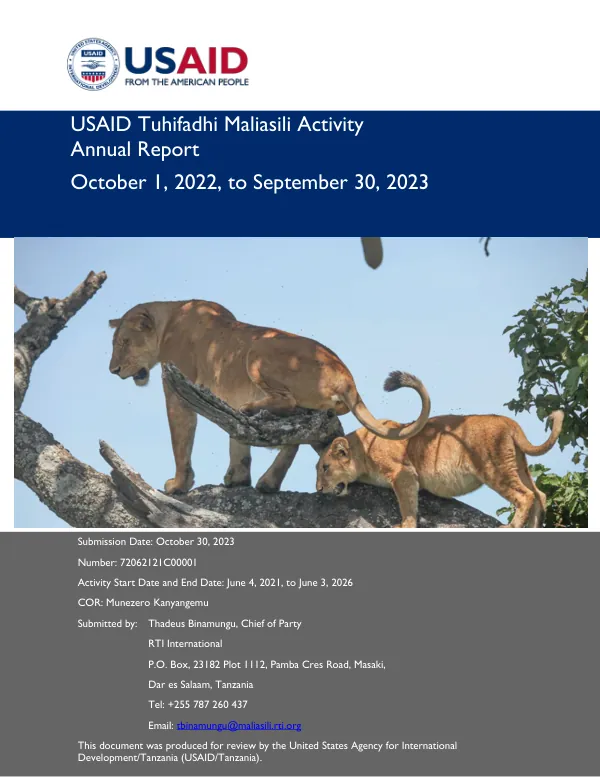
USAID Tuhifadhi Maliasili Activity Annual Report FY23
The USAID Tuhifadhi Maliasili Activity is a five-year initiative aimed at promoting biodiversity conservation and natural resource management in Tanzania.
2023 · 78 pages
Sign in to readA free account is required to download.
Abstract
The activity began on June 4, 2021, and is set to conclude on June 3, 2026. RTI International serves as the prime implementing partner, with several subcontractors and grantees contributing to the project's objectives. The activity focuses on three key intermediate results: building institutional capacities of public and private stakeholders, increasing private sector engagement in biodiversity conservation and natural resources management, and improving the policy, regulatory, and enabling environment for biodiversity conservation and natural resources management. To achieve these outcomes, the activity engages with various stakeholders, including government agencies, civil society organizations, and private sector entities. Implementation progress has been made in several areas. Institutional capacities have been strengthened through training and capacity-building programs for public and private stakeholders. Private sector engagement has been increased through partnerships and collaborations with companies and organizations involved in biodiversity conservation and natural resources management. Policy and regulatory frameworks have been improved through advocacy and lobbying efforts. The activity also places emphasis on cross-cutting issues, including gender equality and women's empowerment, youth engagement, grants under contract, integration and collaboration, sustainability, environmental compliance, global climate change, policy and governance support, private sector engagement, public-private partnerships, and science, technology, and innovation. Stakeholder participation and involvement are also crucial components of the activity, with a focus on ensuring that local communities are engaged and benefit from the project's outcomes. Management and administrative issues are addressed through regular monitoring and evaluation, as well as through the implementation of effective financial management systems. The activity's financial summary indicates that the project has made significant progress in achieving its objectives, with a total expenditure of $X million during the reporting period. The activity has also achieved several success stories, including the establishment of community-based conservation training centers, the development of spatial monitoring and reporting tools, and the implementation of environmental mitigation and monitoring plans. These successes demonstrate the activity's commitment to promoting biodiversity conservation and natural resources management in Tanzania. The activity's theory of change emphasizes the importance of building institutional capacities, increasing private sector engagement, and improving policy and regulatory frameworks to achieve sustainable biodiversity conservation and natural resources management outcomes. The activity's monitoring, evaluation, and learning framework ensures that progress is regularly assessed and that adjustments are made as needed to achieve the project's objectives. Overall, the USAID Tuhifadhi Maliasili Activity has made significant progress in promoting biodiversity conservation and natural resources management in Tanzania. The activity's focus on institutional capacity building, private sector engagement, and policy improvement has contributed to the achievement of several success stories and has positioned the project for continued success in the coming years.
Related documents