USAID DEC
USAID Vietnam Clean Energy Program: Energy Simulation Measures for Head Office of the State Securities Commission of Vietnam
Sign inABT ASSOCIATES
USAID Vietnam Clean Energy Program: Energy Simulation Measures for Head Office of the State Securities Commission of Vietnam
The USAID Vietnam Clean Energy Program has been working with the Ministry of Construction to promote energy efficiency in the construction sector.
2017 · 20 pages
Sign in to readA free account is required to download.
Abstract
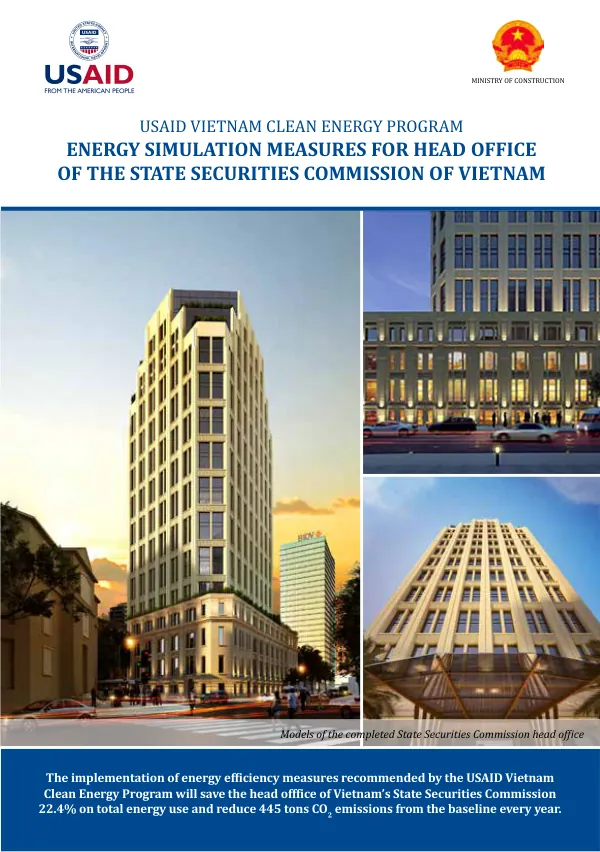
The program supports the Ministry and local Departments of Construction in major cities to enhance capacity to acquire, analyze, and use energy sector data in decision-making. This aims to increase energy efficiency in the building sector. The program has been implementing energy simulation measures for several buildings in Hanoi, including the State Securities Commission head office and the 33 Truc Bach Building Complex. The implementation of energy efficiency measures recommended by the program will save the State Securities Commission head office 22.4% on total energy use and reduce 445 tons CO2 emissions from the baseline every year. Similarly, the 33 Truc Bach Building Complex is expected to save 45.5% on total energy use and reduce 213 tons CO2 emissions from the baseline every year. The program's recommended design for the State Securities Commission head office includes the use of an air-conditioner system VRV 4 and a heat recovery system for each floor. The use of Light-Emitting Diode (LED) systems with a power density of 6W per square meter is also recommended. These measures will help to save 22.4% on energy operation use of the building, compared to the minimum requirements by the Vietnam Green Building Council (VGBC) and the Ministry of Construction's QCVN 09:2013 Code. For the 33 Truc Bach Building Complex, the program recommended the use of an energy-efficient air-conditioner system VRV 4, energy-efficient lighting (LED), and Solar Heat Gain Coefficient (SHGC) glass with a coefficient of light transmission 0.37. The use of these energy-saving measures will help to reduce the annual energy consumption by 297 MWh, equivalent to 213 tons CO2 emissions per year. The program has been working with the building owner and the developer (TT-Associates) of the 33 Truc Bach Building Complex since December 2015 to implement energy simulation measures to the architectural design and construction. The building owner has agreed to register for the green building Lotus certification issued by the Vietnam Green Building Council (VGBC). The program's recommended energy simulation for the 33 Truc Bach Building Complex shows that the use of the VRV 4 air conditioning system and LED lights will save up to 45.5% on energy operation use, which allowed the building owner to register the building for a green building Silver level Lotus certification. The program's simulation specialists found that the energy-saving measures will help to reduce the annual energy consumption by 297 MWh, equivalent to 213 tons CO2 emissions per year. The program supported the building owner with technical guidance to register for a Lotus certification for the 33 Truc Bach Complex. The program aims to strengthen the foundation for low emissions energy systems in Vietnam's construction sector by enhancing capacity to acquire, analyze, and use energy sector data in decision-making. The City of Hanoi has been implementing energy efficiency promotion policies, including the city's Program on Energy Savings and Efficiency for the period 2016-2020 (Decision No.5815/QD issued by the People's Committee on October 30, 2015). The program works with local Departments of Construction, Departments of Industry and Trade, and Departments of Science and Technology in major cities to promote energy efficiency in the construction sector. The program has been working with the building owner and the developer (TT-Associates) of the 33 Truc Bach Building Complex since December 2015 to implement energy simulation measures to the architectural design and construction. The program's recommended energy simulation for the 33 Truc Bach Building Complex shows that the whole building simulation allows interactions of all building systems. The program aims to strengthen the foundation for low emissions energy systems in Vietnam's construction sector by enhancing capacity to acquire, analyze, and use energy sector data in decision-making. The program's recommended energy-saving measures will help to reduce the annual energy consumption by 297 MWh, equivalent to 213 tons CO2 emissions per year.
Related documents