USAID
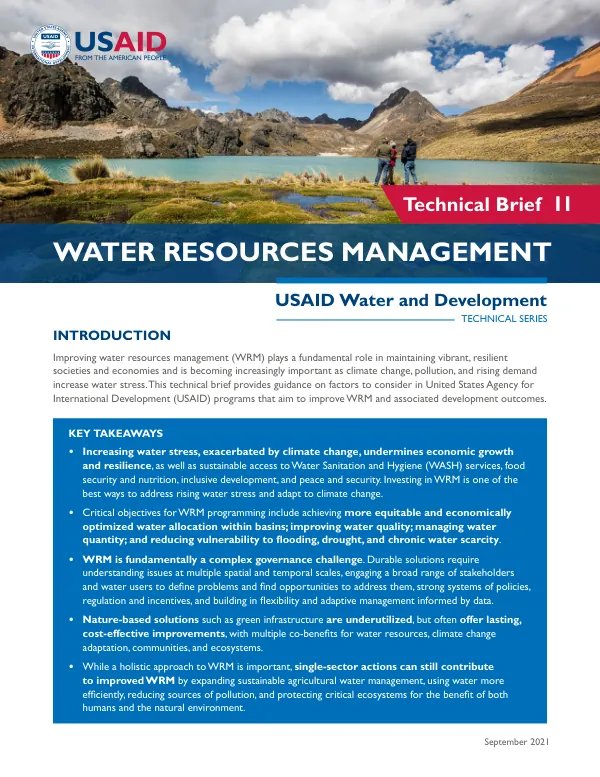
USAID Water and Development Technical Brief 11: Water Resources Management
Improving water resources management (WRM) plays a fundamental role in maintaining vibrant, resilient societies and economies.
2021 · 14 pages
Sign in to readA free account is required to download.
Abstract
As climate change, pollution, and rising demand increase water stress, it is essential to address this issue to ensure sustainable access to water, food security, and nutrition, inclusive development, and peace and security. Investing in WRM is one of the best ways to address rising water stress and adapt to climate change. Critical objectives for WRM programming include achieving more equitable and economically optimized water allocation within basins, improving water quality, managing water quantity, and reducing vulnerability to flooding, drought, and chronic water scarcity. WRM is fundamentally a complex governance challenge, requiring understanding of issues at multiple spatial and temporal scales, engaging a broad range of stakeholders and water users, and building in flexibility and adaptive management informed by data. Nature-based solutions such as green infrastructure are underutilized but often offer lasting, cost-effective improvements with multiple co-benefits for water resources, climate change adaptation, communities, and ecosystems. While a holistic approach to WRM is important, single-sector actions can still contribute to improved WRM by expanding sustainable agricultural water management, using water more efficiently, reducing sources of pollution, and protecting critical ecosystems for the benefit of both humans and the natural environment. Freshwater is a limited and essential resource for human societies and ecosystems. A growing population and increasing demand for food, energy, and water for industry and domestic use have resulted in a six-fold increase in freshwater use since 1900, putting stress on global water resources. Changes in land use and unchecked ground and surface water pollution are degrading ecosystems and the services they provide, further reducing the amount of water available for many uses. Water is at the center of the climate crisis, and climate change will both exacerbate these existing challenges and create new ones. Poor governance exacerbates water stress and amplifies the negative impacts of extreme events like flooding and drought. Lack of investment in water allocation and infrastructure, insufficient institutional and human capacity, or lack of political will to satisfy the range of demands for available water can lead to economic water scarcity, where there is an inefficient and inequitable distribution of water resources, even if there is physical abundance of water. Improving water resource governance through WRM is therefore critical for building the resilience of systems and people reliant on water supplies who will see dramatic climate-related shifts over the next few decades. A particular challenge in WRM is that water does not recognize political or administrative borders. Water links land, sea, and sky; mountain, inland, coastal, and political geographies; as well as natural and built environments. Because water flows between jurisdictions and simultaneously underpins social, economic, and environmental outcomes, the process of reconciling the many and often competing demands for freshwater is a critical, if complex, challenge. Decisions about water management, which are made without an appreciation for this interconnectedness, will inherently have unintended consequences, including increased conflict and insecurity. Water Resources Management (WRM) is the process of planning, developing, and managing water resources, in terms of water quantity and quality, within and across water uses for the benefit of humans and ecosystems. WRM includes the institutions, infrastructure, incentives, and information systems that support and guide water management and uses. Integrated Water Resources Management (IWRM) is a process that promotes the coordinated development and management of water, land, and related resources. Watersheds are areas of land that drain or "shed" water into a specific waterbody, and every body of water has a watershed. Watersheds or basins represent the unit of management for water resources. Ecosystem services are the short- and long-term benefits people obtain from ecosystems, including the provisioning of goods and services, production of basic goods, regulation of services, cultural services that provide spiritual, aesthetic, and recreational benefits, and supporting services necessary for the production of all other ecosystem services. Nature-based solutions (NbS) are actions to protect, sustainably manage, and restore natural or modified ecosystems that address societal challenges effectively and adaptively, simultaneously providing human well-being and biodiversity benefits. Green infrastructure is any engineered structure that uses vegetation, soils, and natural processes to manage water and create healthier built environments for people and the natural resources that sustain them.