USAID DEC
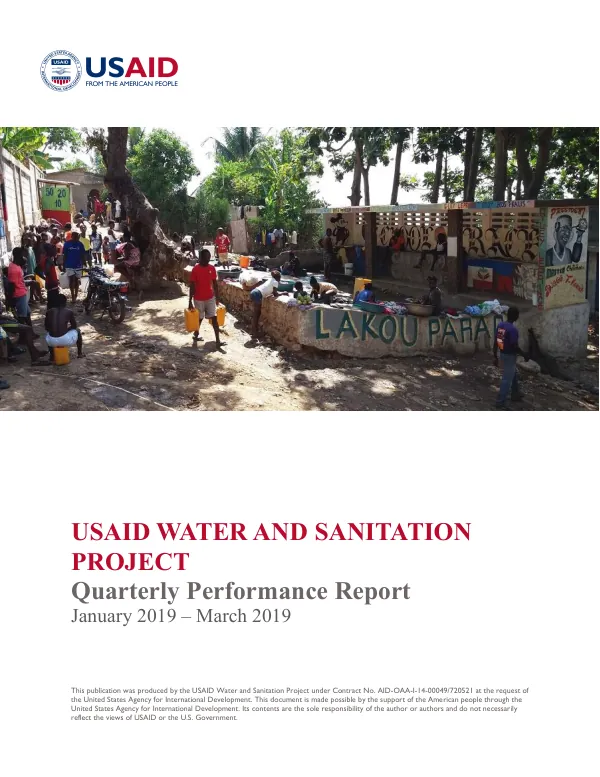
USAID Water and Sanitation Project Quarterly Report January 2019 – March 2019
The USAID Water and Sanitation Project in Haiti aims to increase access to water and sanitation services in the country.
2019 · 34 pages
Sign in to readA free account is required to download.
Abstract
Launched on December 4, 2017, the project targets urban areas where water and sanitation services needs are the greatest. The project focuses on increasing access to water and sanitation services in three communes identified by the Government of Haiti as priority cholera "hotspot – Type A" communes (Cap-Haitien, Croix-des-Bouquets and Mirebalais) and in two communes recovering from Hurricane Matthew (Les Cayes and Jeremie). The project is organized in three mutually reinforcing components to support its objectives: Component 1 - Increased access to sustainable water supply services, Component 2 - Increased access to sustainable sanitation services, and Component 3 - Strengthened enabling environment for sustainable delivery, operation, and maintenance of water, sanitation, and hygiene (WASH) services. Additionally, the project has an enterprise acceleration fund (EAF) to stimulate the WSS market and promote the strengthening of local actors integral to sustainable water and sanitation services. In this quarter, the project primarily focused on advancing work on the Quick Impact Projects (QIPS) in Cap Haitien and Les Cayes, and finalizing activities that could act as metrics against which the project measures success. The project also focused on working with stakeholders to develop creative approaches to sanitation by using small business enterprise. The Project performed the infrastructure planning and identified the key investments to achieve project goals and had advanced the two QIPs to begin construction in Q3. An additional QIP was identified to be executed in FY19. Component 1 of the project focuses on building the technical, managerial and financial capability of water providers (Offices Régionaux de l'Eau Potable et de l'Assainissement [OREPAs], CTEs, and private operators) along with making strategic infrastructure investments aimed at increasing access to sustainable water services. Over this quarter, the project finalized work developing comprehensive assessments of the characteristics of the water supply and sanitation infrastructure of each of its target communities. This information, in conjunction with meetings with DINEPA, OREPAs, the CTE, donors, and other stakeholders, was used to develop a capacity building plan for improving the efficiency and sustainability of the CTE system. The project also made significant progress in Component 2, which focuses on increasing access to sustainable sanitation services. The project finalized the Sanitation Strategy with respect to the sanitation market assessments conducted in the five communes and with DINEPA. The sanitation market assessments revealed a few similar points in terms of governance, and demand and supply characteristics across the five communes. The Household Baseline Survey has been ongoing since mid-March and will present its results next quarter. The project's accomplishments and deliverables submitted to USAID during this quarter include the FY19 Work Plan Gantt chart, Q1 FY19 report, QIP design reports for Cap-Haitien and Les Cayes, Cap-Haitien's final plans and specifications, and Les Cayes 90% design, Les Cayes EMMP report, Cap-Haitien and Les Cayes assessment reports and commune-level WSS roadmaps, the project gender strategy, completion of the sanitation strategy, and completion of the sanitation market assessment. The project faced significant challenges during this quarter, including a period of civil unrest that led to an evacuation of non-essential personnel at the US mission, as well as two project staff temporarily during the end of February. The office was closed for a total of 4 days, and while senior technical staff continued to work during this time, activities for the baseline, sanitation and CTE assessments were delayed by a week and a half. Additionally, petrol shortages during this time caused additional delays in ensuring staff could get to relevant communes around the country. Since mid-March, the situation has remained relatively stable, and the project has continued working to complete these tasks.