GOVERNMENT OF SENEGAL
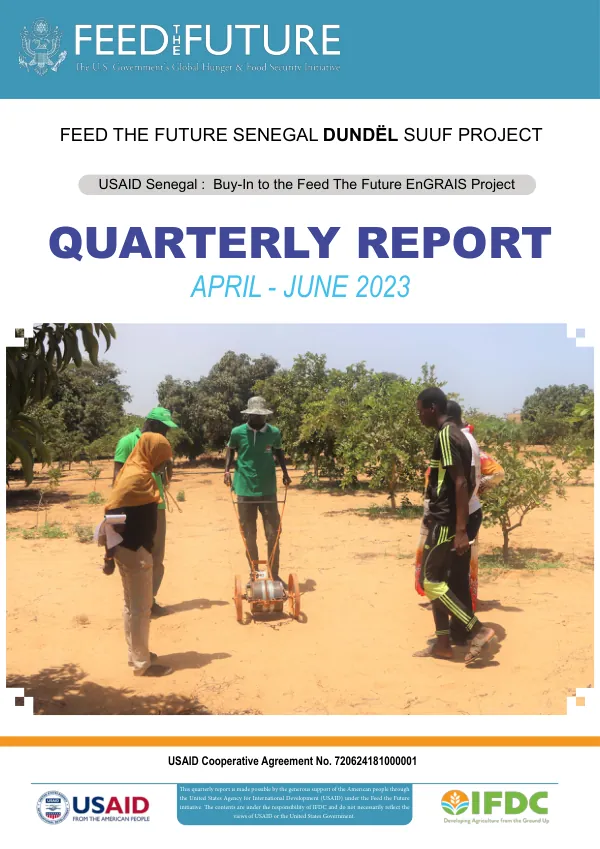
Quarterly Report: Feed the Future Senegal Dundël Suuf Project
The Feed the Future Senegal Dundël Suuf project is a USAID-funded initiative implemented by the International Fertilizer Development Center (IFDC) in collaboration with the Government of Senegal.
2021 · 31 pages
Sign in to readA free account is required to download.
Abstract
The project aims to improve soil fertility through the development and promotion of environmentally sound fertilization products and technologies. The project's objective is to contribute to the Senegalese government's goal of sustainably increasing production to achieve self-sufficiency in key crops, including rice, maize, millet, sorghum, onion, and potato, and exporting surplus horticultural products. The project focuses on three intervention zones: the Senegal River Valley, the Niayes region, and the Peanut Basin. In these areas, the project will analyze and map soil nutrient deficiencies, develop new fertilizer formulas, promote the adoption and use of suitable fertilizer products and technologies, and contribute to the improvement of the policy and regulatory framework in the fertilizer sector. The project's results framework outlines three intermediate results (IR) and three cross-cutting activities. IR 1 aims to develop and make available improved and appropriate fertilizer formulas to farmers. IR 2 focuses on disseminating and scaling up proven environmentally sound fertilizer products and technologies. IR 3 seeks to improve the policy and regulatory framework of the fertilizer sector. The cross-cutting activities include promoting the adoption and use of suitable fertilizer products and technologies, promoting a supply and distribution system led by the private sector, and contributing to the improvement of the policy and regulatory framework in the fertilizer sector. The project's geographic focus is on the Senegal River Valley, the Niayes region, and the Peanut Basin, where priority crops such as irrigated rice and vegetables, fruits and vegetables, peanut, cowpea, sorghum, millet, maize, and fruits and vegetables are grown. The project's timeframes are not explicitly stated, but the quarterly report covers the period from October to December 2021. The project's implementation involves several activities, including analyzing and mapping soil nutrient deficiencies, developing new fertilizer formulas, promoting the adoption and use of suitable fertilizer products and technologies, and contributing to the improvement of the policy and regulatory framework in the fertilizer sector. The project also involves private sector participation, with the goal of improving the efficiency of supply systems to increase the availability and use of quality fertilizers in Senegal. The project's achievements are reported in the quarterly report, which highlights progress made in achieving the project's intermediate results and cross-cutting activities. The report also discusses challenges faced by the project and plans for addressing these challenges in the future. Overall, the Feed the Future Senegal Dundël Suuf project aims to improve soil fertility and increase crop production in Senegal through the development and promotion of environmentally sound fertilization products and technologies. The project's implementation involves several activities, including analyzing and mapping soil nutrient deficiencies, developing new fertilizer formulas, promoting the adoption and use of suitable fertilizer products and technologies, and contributing to the improvement of the policy and regulatory framework in the fertilizer sector.
Related documents