USAID DEC
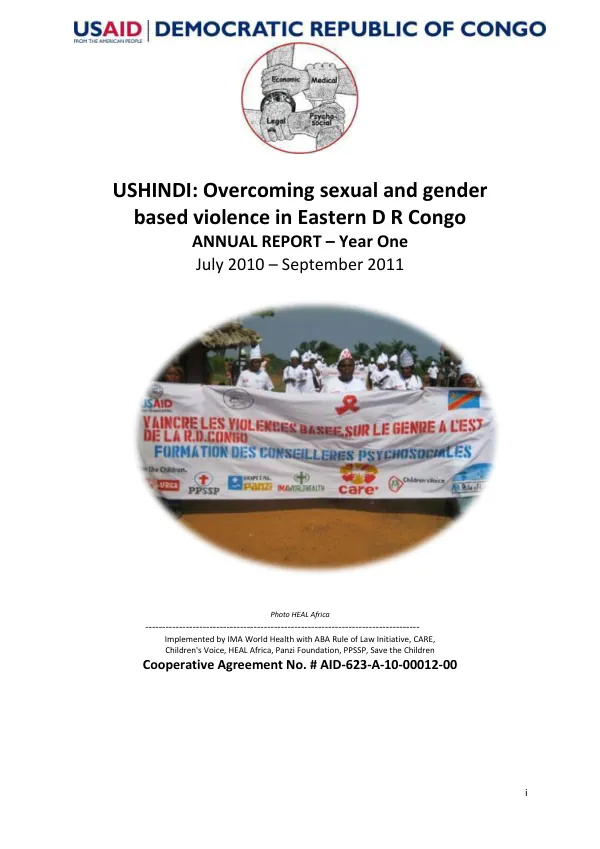
Ushindi: Overcoming Sexual and Gender Based Violence in Eastern D R Congo Annual Report – Year One
Sign inCARE
Ushindi: Overcoming Sexual and Gender Based Violence in Eastern D R Congo Annual Report – Year One
The Ushindi project, implemented by IMA World Health, aims to combat Sexual and Gender Based Violence (SGBV) in Eastern Congo.
2011 · 47 pages
Sign in to readA free account is required to download.
Abstract
The project focuses on increasing access to timely and quality services for individuals affected by SGBV, improving the quality of services and interventions for individuals and communities affected by SGBV, and reducing the vulnerability of individuals to future acts of abuse and violence. The project operates in four provinces and ten health zones, targeting a population of 1.3 million people. The project's first year of activities has seen significant progress in achieving its four Intermediate Results. IR1, Increased access to quality and timely care and treatment services, has been addressed through various initiatives. Assessment of local stakeholders established the psychosocial, medical, and socio-economic needs of female and child victims and children born of rape. Psychosocial support, medical support, legal support, and economic support were provided to meet the needs of SGBV survivors. Wamama Simameni Houses were established and rendered functional to provide emergency services, including protection, legal, psychosocial, and economic support, in each health zone. IR2, Increased organizational & community capacity to respond to SGBV/facilitate recovery of survivors, has also seen significant progress. Community leaders, health service providers, counselors, women's and children's groups, and local authorities have been trained to respond effectively to SGBV. Medical facilities have been equipped to provide services for SGBV, including appropriate medicines, supplies, referrals, and counter-referrals. IR3, Improved ability of communities and individuals to lead & participate in community-based social integration and economic recovery activities, has been addressed through various initiatives. Local discussions and programs have created awareness of the consequences of SGBV, and opportunities have been created for survivors to engage in livelihood and advocacy activities. Community responsibility has been established for social protection and recovery activities. IR4, Strengthened community's ability to prevent SGBV, has also seen significant progress. Community-level awareness campaigns have helped to reduce community tolerance of SGBV and community rejection of SGBV survivors. Local forums have discussed the collective and individual impact of SGBV and promoted a sense of responsibility to protect individuals. Women- and child-led community groups have engaged community leaders to promote women and children's rights. The project has also made progress in project management, monitoring, and evaluation. The project has implemented a monitoring and evaluation system to track progress and identify areas for improvement. Environmental monitoring has been conducted to assess the project's impact on the environment. Problems encountered, solutions, and lessons learned have been documented to inform future project activities. The project has achieved significant progress in its first year of activities, and the Ushindi project is well-positioned to continue its efforts to combat SGBV in Eastern Congo. The project's success is a testament to the dedication and hard work of the project team, implementing partners, and technical partners.