GEORGE WASHINGTON UNIVERSITY CIBER
Annual Report – Program Year 3: Counter Gender-Based Violence Project
The Counter Gender-Based Violence Project is a comprehensive project implemented in the Democratic Republic of Congo to help communities respond to and prevent gender-based violence and Trafficking in Persons (TIP).
2020 · 94 pages
Sign in to readA free account is required to download.
Abstract
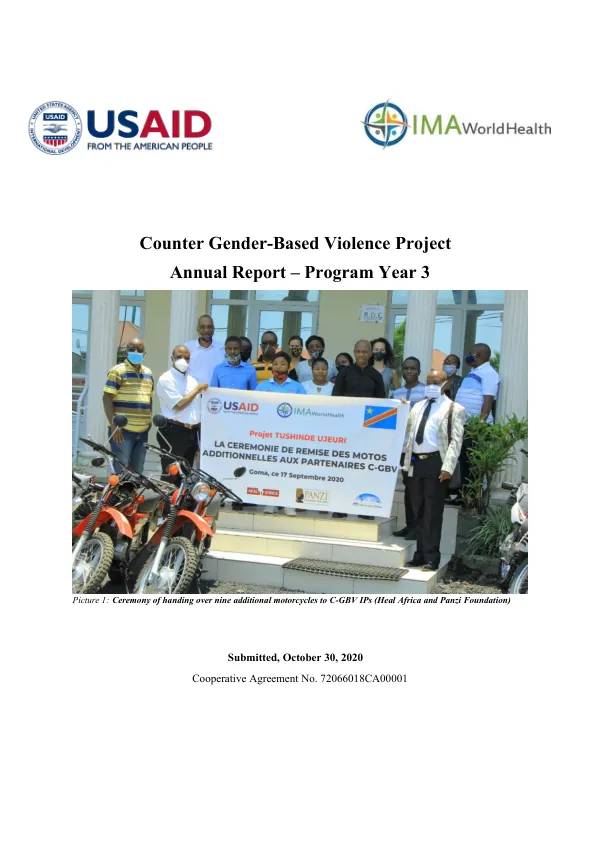
The project is funded by the United States Agency for International Development (USAID) and implemented by IMA World Health. The project's overarching goals are to strengthen community-based prevention of and response to gender-based violence, reduce GBV incidence, and improve the quality of and access to holistic care for survivors, particularly among vulnerable groups. The project is implemented in five Health Zones (HZs) in the North and South Kivu Provinces of the DRC. In North Kivu, the project is implemented by Heal Africa in two HZs, Walikale and Karisimbi. In South Kivu, Panzi Foundation is implementing in three HZs (Nyangezi, Bunyakiri, and Katana). Additional consortium technical partners include Search for Common Ground (SFCG), the American Bar Association Rule of Law Initiative (ABA-ROLI), and the University of Washington (UW)/Johns Hopkins University (JHU). During the year covered by this report, North Kivu province experienced recurring crisis situations fueled by armed conflict, human traffickers, banditry in the large cities, and activism by both national and foreign militias. In South Kivu, the security situation has remained relatively calm despite the presence of armed groups and widespread banditry. The Walikale HZ experienced significant insecurity due to land problems between local communities, while the Karisimbi HZ was characterized by increasing insecurity due to banditry and a lack of effective law enforcement. The project has been implemented regularly despite the security challenges. The project's activities have included campaigns against violence in general and against women, as well as the organization of mobile courts to sentence and jail perpetrators. The project has also implemented activities to strengthen community-based prevention of and response to gender-based violence, including training for community health workers and the establishment of village savings and loan associations. The project has achieved several key results, including the demonstration of greater acceptance of positive gender roles in target communities, the improvement of availability of community-level GBV-related services, and the reduction of perceptions of stigma surrounding reintegrated survivors. The project has also improved the quality of and access to holistic care for survivors, particularly among vulnerable groups. The project's achievements are presented in the following intermediate results: * IR 1: Target communities demonstrate greater acceptance of positive gender roles. * IR 2: Availability of community-level GBV-related services improved. * IR 3: Perceptions of stigma surrounding reintegrated survivors reduced. The project's activities have been carried out in collaboration with local partners, including Heal Africa, Panzi Foundation, and Search for Common Ground. The project has also received support from USAID and other international partners. The project's achievements are a testament to the effectiveness of community-based approaches to preventing and responding to gender-based violence. The project's success has been made possible through the hard work and dedication of project staff, local partners, and international supporters.