IMA WORLD HEALTH INTERNATIONAL
Counter Gender-Based Violence Program ANNUAL REPORT (FY18)
The USAID Counter Gender-Based Violence (C-GBV) Program, also known as Tushinde Ujeuri, is a comprehensive program aimed at helping communities in the Democratic Republic of Congo (DRC) respond to and prevent gender-based violence (GBV).
2018 · 56 pages
Sign in to readA free account is required to download.
Abstract
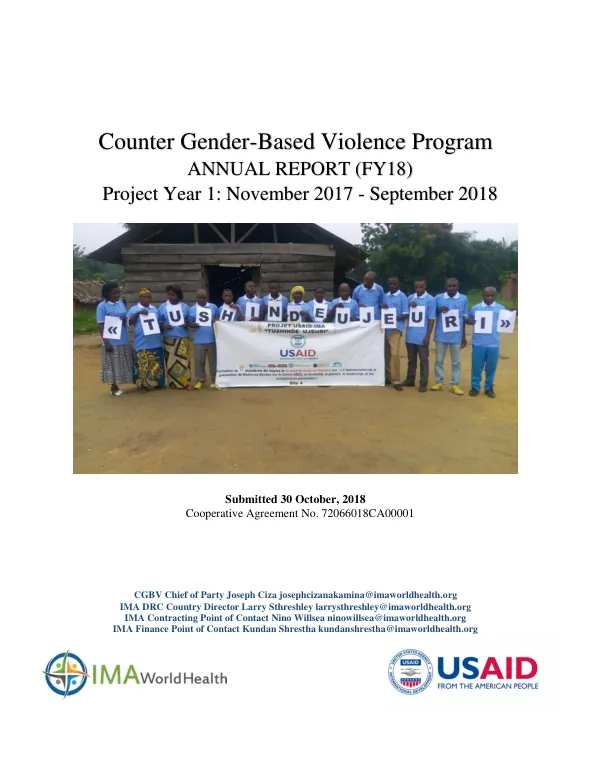
The program is implemented in five health zones in the North and South Kivu Provinces of the DRC, with Heal Africa and Panzi Foundation serving as implementing partners. The program's overarching goals are to strengthen community-based prevention of and response to GBV, reduce GBV incidence, and improve the quality of and access to holistic care for survivors, particularly among vulnerable groups. The program works in an integrated manner across three intermediate results (IRs): IR 1, which focuses on increasing community acceptance of positive gender roles; IR 2, which aims to improve the availability of community-level GBV-related services; and IR 3, which seeks to reduce perceptions of stigma surrounding reintegrated survivors. During the first year of the program (October 2017-September 2018), the focus was on startup activities, including the submission of project documents, recruitment of staff, assessment and contracting of partners, and orientation and planning meetings with partners in Goma and the USAID staff in Kinshasa. Key deliverables included the Tushinde Ujeuri Implementation Plan, MEL Plan, and Environmental Mitigation and Monitoring Plan, which were submitted on time and accepted and approved by the Assistant Officer Representative (AOR). In the second, third, and fourth quarters of the year, the focus shifted to refresher training and rapid start-up in the three former health zones of Ushindi, establishment of office and safe houses in the two new zones, and recruitment of staff. While performance in Q2 was below projected targets, progress was made in key output indicators, including the training of persons, completion of procurement, and mobilization of teams. The program's performance monitoring plan (PMP) reporting table presents progress to targets to date, with results in key output indicators provided in the table below. The table shows the overall step-wise progression of project indicators from quarter to quarter, with cumulative achievements and progress to annual targets. The program's geographic coverage includes five health zones in the North and South Kivu Provinces of the DRC, with target populations by health zone as follows: * North Kivu Province: Karisimbi, Walikale, and Katana health zones * South Kivu Province: Bunyakiri and Nyangezi health zones The program's target populations include women, men, and children in the target geographic areas, with a focus on vulnerable groups such as survivors of GBV. The program's intermediate results (IRs) are as follows: * IR 1: Target communities demonstrate greater acceptance of positive gender roles * IR 2: Availability of community-level GBV-related services improved * IR 3: Perceptions of stigma surrounding reintegrated survivors reduced The program's performance indicators include: * Prevalence rate of GBV among women, men, and children in target geographic areas * GBV community organizational capacity strengthened * Number of GBV community organizational capacity strengthened The program's overall goal is to strengthen community-based prevention and response to sexual and gender-based violence in Eastern Congo.
Related documents