USAID DEC
Using Data to Advance Gender Equality in Male-Dominated Industries
The Engendering Industries Program, a USAID initiative, aims to enhance gender equality and improve business performance in male-dominated industries.
2023 · 6 pages
Sign in to readA free account is required to download.
Abstract
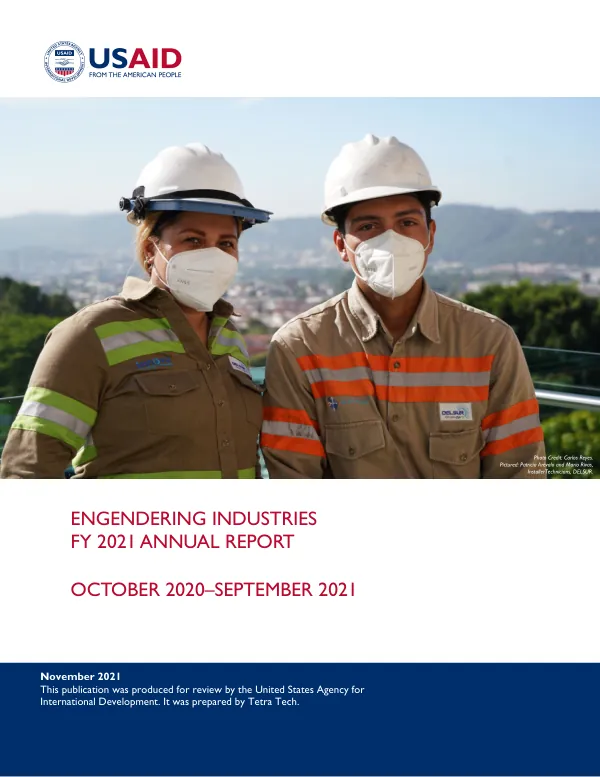
The program uses evidence-based programming and decision-making to support partners in using data to advance equality at each phase of the employee lifecycle. One of the key strategies employed by the program is the use of surveys to generate data on the female talent pool and identify entry points to introduce gender equality initiatives. In the energy sector, men hold 78 percent of jobs and occupy most technical roles globally. Many companies overlook the importance of attracting new female talent, which can improve business performance. Understanding the size of the existing female talent pool in a particular labor market is a critical first step in creating effective outreach and recruitment strategies to increase the number of women in technical roles. The Engendering Industries Program collaborated with its partners in El Salvador and Senegal to collect, analyze, and use labor market data to advance gender equality in talent outreach and recruitment efforts in the energy sector. In El Salvador, the Electric Company, Distribuidora De Electricidad Delsur S.A De C.V (DELSUR), joined the program in 2019 with less than 20 percent of its employees being women and no women employed in technical roles. Engendering Industries provided DELSUR with a grant to conduct a labor market study and assess employment prospects for women pursuing technical careers in El Salvador. The study revealed that the proportion of women in the energy sector increased from 12 percent in 2012 to 18.7 percent in 2021, but women held only 3.9 percent of technical positions. The study also showed that women in technical roles had more advanced educational qualifications than their male counterparts. However, women represented only 21.1 percent of the total number of students pursuing an education that could lead to a career in the energy sector, and both male and female students consistently agreed that technical jobs were "masculine." DELSUR used the data to develop new outreach and recruitment strategies with confidence. The company held an internal session to share the survey results with human resources employees and then added language encouraging women to apply to all job postings alongside gender equitable photographs. They also joined the Ministry of Education, Science, and Technology to launch a program to break down gender stereotypes for women STEM that has so far reached more than 3,500 girls in 24 public schools. In Senegal, the Société Nationale d’Électricité du Sénégal (SENELEC) joined the Engendering Industries Program in 2020 with only 22 percent of its employees being women and women holding only four percent of technical roles. SENELEC conducted qualitative data collection and paired it with an analysis of existing quantitative data from labor market surveys. The focus groups revealed underlying misperceptions and biases about women's representation and role in technical careers, including the perception that women were underrepresented in STEM programs, lacked interest in technical careers, and were less capable of succeeding in such fields. The Engendering Industries Program's use of data and surveys has provided valuable insights into the challenges faced by women in male-dominated industries and has helped companies develop effective outreach and recruitment strategies to increase the number of women in technical roles. The program's approach has also helped to break down gender stereotypes and biases, creating a more inclusive and equitable work environment.