INTERNATIONAL COMMITTEE FOR THE RED CROSS
Using DHIS2 for Health Facility Stock Management in Humanitarian Settings
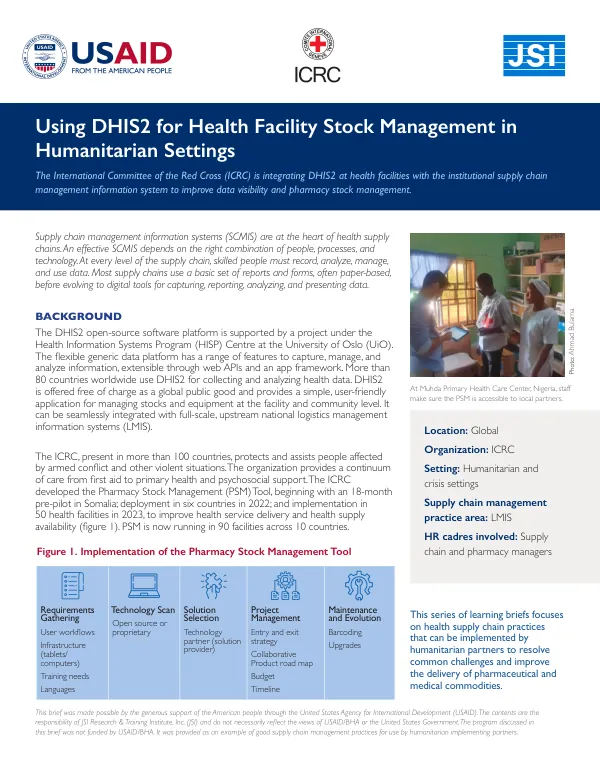
The ICRC's Pharmacy Stock Management (PSM) Tool is an integrated and standardized medical stock management system that has moved processes from paper to digital management, with improved stock visibility, planning, and optimization.
2024 · 3 pages
Sign in to readA free account is required to download.
Abstract
The PSM Tool integrates three platforms into one holistic solution connected by the operational data store (ODS): DHIS2 to enter stock-on-hand and stock distributed, IRIS/JDE Oracle to place supply orders with automatic calculation of quantities, and Tableau to conduct data analytics. The ICRC selected the DHIS2 solution because of its open-source platform, with offline capability, mobile application, and compatibility with other systems in the ICRC health information ecosystem. The solution includes DHIS2-RTS, a real-time stock management system that allows ICRC to capture supply quantities distributed from the pharmacy, stock losses, and stock corrections by using a mobile device and scanning barcodes. The stock management process has four steps: record data on the tablet, share and/or change data on DHIS2 web/desktop, place an order on IRIS (ordering platform), and monitor data on Tableau. The stock data automatically appear in the ordering system, which uses an embedded formula to calculate quantities when medical storekeepers or managers place their orders. The ICRC's experience with the PSM Tool has shown that integrating pharmacy stock data through DHIS2 resolves a range of information challenges, including paper-based management, slow and error-prone processes, limited analysis, and missing last-mile data. The PSM Tool has improved stock visibility, planning, and optimization, and has enabled data-driven decision-making by collecting and analyzing relevant and actionable data for health supply chain management. Effective supply chains depend on end-to-end visibility of the right data of the right quality at the right time, in the hands of the right people in the right place, to make the right decision and take the right action. The supply chain manager needs to know the essential data needed to manage a supply chain, the use of LMIS data, the tools and processes that enable end-to-end visibility of data, and considerations for applying technology to improve LMIS. The Building Capacity to Improve Pharmaceutical and Medical Commodity Management in Humanitarian and Disaster Settings Program improves the capacity of people who manage health supply chains in humanitarian settings. It helps staff from international organizations and local NGOs to manage pharmaceutical and medical commodities by equipping them with training, guidance, resources, and follow-up support. The program is funded by USAID's Bureau for Humanitarian Assistance. Key lessons learned from the ICRC's experience with the PSM Tool include identifying a workflow and designing a system that is easy to navigate and understand, integrating mobile capabilities into the system, enabling data-driven decision-making, simplifying data entry and calculations for storekeepers, and assessing the organization's technical and deployment capacity. These lessons are essential for adapting to complex settings and improving the delivery of pharmaceutical and medical commodities in humanitarian and disaster settings.
Related documents
Documents in this collection
 2020
2020USAID DEC
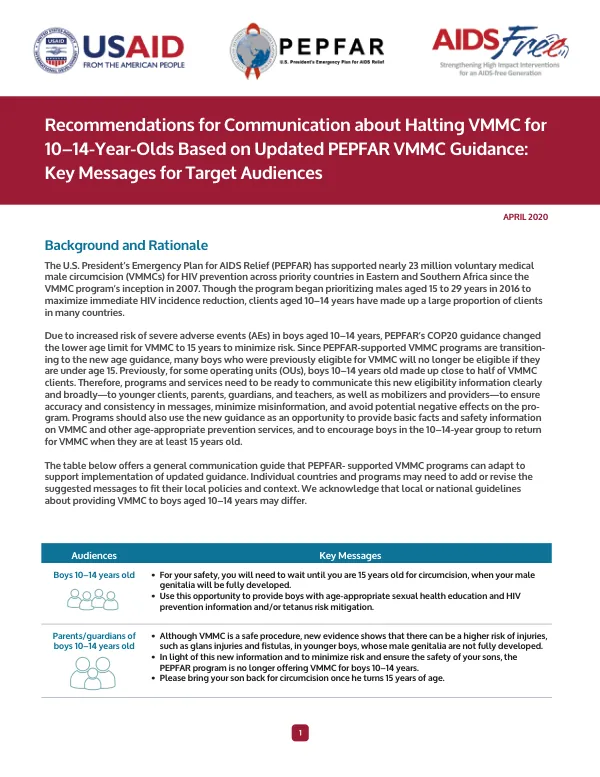
Recommendations for Communication about Halting VMMC for 10–14-Year-Olds Based on Updated PEPFAR VMMC Guidance: VMMC Key Messages for Target Audiences
Open record 2020
2020USAID DEC