U.S. DEPARTMENT OF STATE/OES
Uzbekistan U.S. Foreign Assistance Performance Publication FY 2009
The United States Government provided assistance to Uzbekistan in FY 2009 to support regional peace and stability, respect for human rights and democratic ideals, a healthy and educated populace, and a prosperous economy.
2009 · 5 pages
Sign in to readA free account is required to download.
Abstract
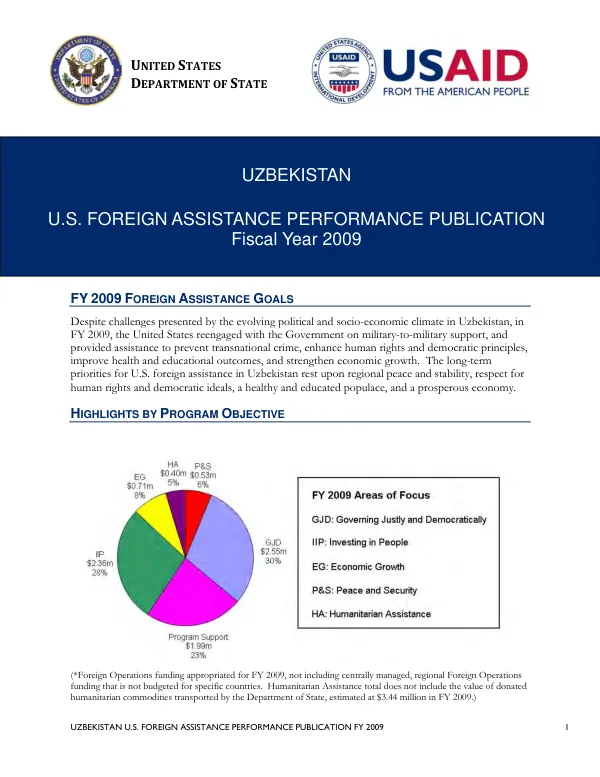
The long-term priorities for U.S. foreign assistance in Uzbekistan include regional peace and stability, respect for human rights and democratic ideals, a healthy and educated populace, and a prosperous economy. In FY 2009, USG assistance focused on several key areas, including peace and security. The USG provided commodity identification training to prevent the proliferation of sensitive commodities through computer-based instruction and examination of dual-use products to Customs, Interior Ministry, and Border Guard personnel. The USG also supported various border security-related training attended by Uzbek officials, including the Department of Energy International Nonproliferation Export Control Program Technical Expert Working Group, the Defense Threat Reduction Agency course "Countering the proliferation of WMD through enhanced border security," and International Border Interdiction Training presented by the Department of Homeland Security. The USG helped the Government of Uzbekistan's Customs Service establish a canine-training center for drug interdiction and funded participation by Uzbeks Customs officers at a conference in Kazakhstan on the use of canines by customs officials. This was the first event of its kind in Central Asia, and it helped to establish working-level contacts among customs officials in the region. The USG also funded three competitive United States-Uzbek research projects, which engaged former weapons scientists in civilian research. In addition, the USG facilitated greater cooperation between non-governmental organizations (NGOs) and local officials as called for by the new anti-trafficking law and the National Trafficking in Persons Action Plan. Assistance also facilitated NGO cooperation with Regional Women's Committees, Makhalla Committees, and law enforcement bodies in forming interagency working groups to combat trafficking. The USG trained 12 heads of counter-trafficking units in the regions, who are now able to conduct their own trainings for their staff members, thus ensuring project sustainability independent of foreign assistance. The USG also provided training to 1,300 law enforcement officers, and strengthened their capacity in the field of investigating and prosecuting trafficking cases and providing assistance to trafficking victims. They were also trained how to use referral mechanisms when dealing with trafficking victims and how to carry out prevention work among the population. The USG provided a seminar on forensic medicine to which the Government of Uzbekistan invited 72 professionals from across the country, including investigators, judges, and forensic personnel. In the area of governing justly and democratically, the USG trained 180 public defenders, prosecutors, and judges on the implementation of habeas corpus legislation. The USG supported the Association of Advocates Tashkent City Branch Clinic's efforts to train 31 law students, and 252 clinicians and practicing attorneys on how to represent clients effectively. Conducted regional professional development workshops for 800 attorneys, supported one professional exchange, and launched a trial-monitoring program. The USG also supported civic groups to monitor and respond to new and existing legislation affecting NGOs, while building their responsiveness to public needs. Strengthened locally based issue groups (e.g., housing associations) and worked to expand citizen participation in low-level governance structures and activities. Grants to organizations focused on bolstering the rights of people with disabilities and educated disabled persons about their rights, improving integration of disabled persons into workspaces and educational institutions. In the area of investing in people, the USG suggested changes to tuberculosis (TB) reporting forms that were adopted by the Ministry of Health and integrated into the national data collection plan. Trained TB volunteers on modern approaches and methods of information collection. Advised the Government on improvements to its National TB Program incorporating international standards. The USG supported a joint effort by the Global Fund to Fight AIDS, TB, and Malaria and the World Bank to finance HIV surveillance and train community leaders and general practitioners on HIV prevention. The USG also supported general practitioner (GP) faculty development and ongoing upgrades to the GP curriculum. Changes to the major chronic cardiovascular and respiratory conditions short-term curriculum for GPs were accepted and incorporated into classes organized by the Institute for Advanced Medical Education across the country. Trained 50 health professionals and 20 medical school faculty on evidence-based medicine (EBM), and updated EBM website with content and news of local, regional, and worldwide relevance. The USG facilitated a number of major health reforms and activities, including the nationwide rollout of rural primary health care (PHC) per-capita financing, improved teaching methodology for undergrad and post-graduate medical education, and expanded the patronage nurse training program. Quality improvement projects in Ferghana Oblast grew from the three initial pilot sites to cover two-thirds of PHC facilities in the entire oblast, and three clinics in Tashkent oblast.
Related documents