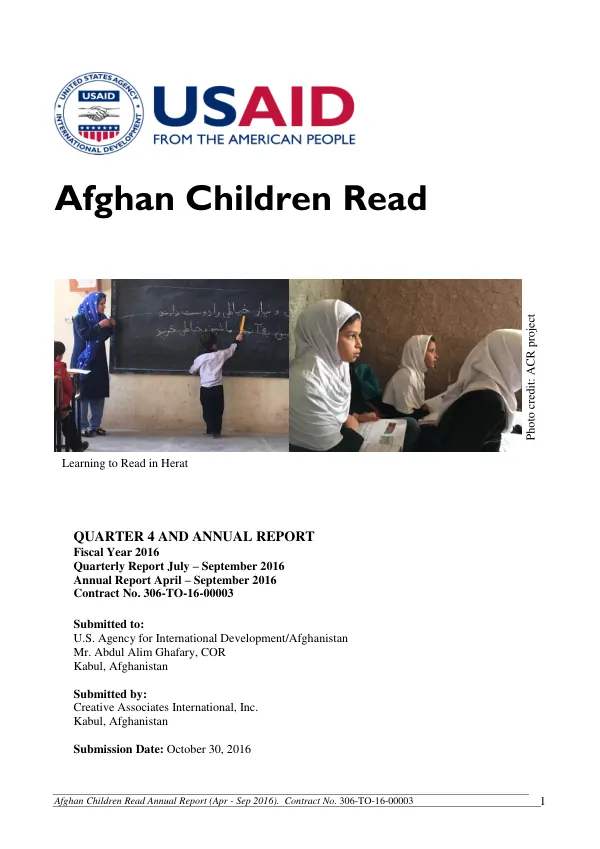
CREATIVE ASSOCIATES INTERNATIONAL INC.
Afghan Children Read Annual Report (Apr - Sep 2016)
The Afghan Children Read project is a USAID-funded primary education initiative designed to improve equitable access to education in Afghanistan.
2016 · 58 pages
Sign in to readA free account is required to download.
Abstract
The project aims to build the capacity of the Ministry of Education (MoE) to provide an evidence-based early grade reading (EGR) program in both formal and Community-Based Education (CBE) schools for students in grades 1 to 3. The project's envisioned outcome is to provide an EGR program in Dari and Pashto languages. The project has made considerable progress in collaboration with the MoE, with the MoE taking on a leadership role and agreeing to the Rapid Production Model for the development of EGR materials for grades 1 to 3. The Early Grade Reading Steering Group (SG) and Technical Work Groups have been formed to build the MoE's capacity to sustain and scale the project. A core development team of writers, illustrators, graphic designers, and editors has been established, with support from internationally recognized experts, to develop a scope and sequence for grades 1 to 3 in both Dari and Pashto. The project has also established the necessary protocols for security measures, including the setup of the Afghan Children Read office and residence for international employees. This will provide a safe venue for meetings and workshops. The project will continue to provide feedback loops for beneficiaries and stakeholders and translate lessons learned into effective approaches for implementation in the ensuing years of project implementation. The project has made significant progress in establishing the pillars for smooth project implementation, with the majority of Creative staff and consortium partner staff recruited. The necessary protocols have been met in establishing all security measures for the Afghan Children Read office and residence for the Project's international employees. As a result, the Project will continue to provide a safe venue for meetings and workshops. The project's results framework overview outlines the key performance indicators (KPIs) and targets for the project. The project has achieved several successes, including the formation of the Early Grade Reading Steering Group and Technical Work Groups, the development of a scope and sequence for grades 1 to 3 in both Dari and Pashto, and the establishment of the necessary protocols for security measures. However, the project has also faced several major challenges, including the lack of availability of EGR Survey Project results and the high-risk security environment. The project has taken several associated actions to address these challenges, including the formation of the Early Grade Reading Steering Group and Technical Work Groups, the development of a scope and sequence for grades 1 to 3 in both Dari and Pashto, and the establishment of the necessary protocols for security measures. The project has also established a monitoring and evaluation system to track progress and identify areas for improvement. The project has made significant progress in establishing the necessary infrastructure for project implementation, including the setup of the Afghan Children Read office and residence for international employees. The project has also established a system for monitoring and evaluation, including the development of a results framework and the establishment of key performance indicators (KPIs) and targets. The project's project management framework outlines the key activities and deliverables for the project, including the development of a scope and sequence for grades 1 to 3 in both Dari and Pashto, the establishment of the necessary protocols for security measures, and the setup of the Afghan Children Read office and residence for international employees. The project has also established a system for monitoring and evaluation, including the development of a results framework and the establishment of key performance indicators (KPIs) and targets. The project's monitoring and evaluation system includes the development of a results framework and the establishment of key performance indicators (KPIs) and targets. The project has also established a system for tracking progress and identifying areas for improvement. The project's communications strategy outlines the key messages and channels for communicating with stakeholders, including beneficiaries, partners, and the media. The project's budget report outlines the key financial information for the project, including the quarterly budget report and the cost data report. The project has also established a system for tracking expenses and identifying areas for cost savings. The project's key meetings and field trips conducted during year 1 include the Early Grade Reading Steering Group meetings, the Technical Work Groups meetings, and the setup of the Afghan Children Read office and residence for international employees. The project's annexes include several documents that provide additional information on the project's activities, including the Afghan Children Read activities chart analysis, the ACR - summary of targets vs actuals, the success story, and the Early Grade Reading Steering Group 1st meeting minutes. The project's annexes also include several documents that provide additional information on the project's methodology, including the suggested methodology and the evaluation framework.